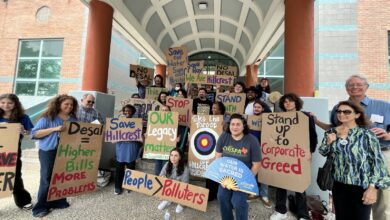
Eight defendants in the 2025 Prairieland ICE detention center case in Texas have been sentenced to a combined 450 years in federal prison for an anti-ICE protest. This marks the first federal terrorism prosecution and sentencing associated with the Trump administration’s crackdown on “antifa” and “anti-Americanism”.
One defendant – who was not even at the protest – received a 30-year sentence for transporting a box of political zines. Another was sentenced to 50 years in federal prison for sitting in a car nearby the protest. Others were prosecuted on conspiratorial charges for owning a printing press and being part of a radical book club.
The message this ruling sends is unmistakable: the state will deploy the full machinery of repression in order to crush dissent and maximize its control over anything less than far-right political views. In fact, the sentencing judge even admitted that he intended to “send a message to anyone who shares a similar ideology.” What exactly that “ideology” is, beyond protesting against ICE terror, remains unclear.
The Partnership for Civil Justice Fund, a Washington D.C.-based constitutional rights legal organization stated, “The Trump administration’s ideologically-driven NSPM-7 is an open political attack based on points of view that the administration wants to criminalize into silence. It is a direct attack on First Amendment rights using the weight of law enforcement and prosecutorial power in an effort to chill, prosecute, censor and repress political opposition to its policies and actions that are vastly opposed by the people of the U.S. The goal here is to sow fear and chill engagement in First Amendment expression.”
This is not entirely an anomaly, however. It is a role Texas has long played within U.S. politics that requires our full attention to understand the implications for our movements today.
A longstanding Texas tradition
Texas was founded in a counter-revolution to the erupting abolitionist movement –– its secessionist roots, forged in a defense of slavery, have positioned Texas to emerge as a vanguard of far-right experimentation.
When Mexico moved to abolish slavery in the 1820s, white settlers in Texas territory violently rebelled. The 1836 “Texas Revolution” – which resulted in the succession of Texas from Mexican control – was not a revolution for “independence” waged by valiant fighters, but one fundamentally defensive of the institution of chattel slavery.
For nearly a decade, Texas existed as an independent republic that sought to challenge the United States for dominance in the African slave trade. However, its ambitions outpaced its capabilities. Facing pressure from abolitionist Mexico and revolutionary Haiti, the Republic of Texas was reluctantly annexed into the United States in 1845.
The new U.S. state of Texas saw a dramatic increase in the enslaved population and accelerated assaults on the territories of the indigenous Comanche, Kiowa, and Plains Apache peoples. By 1861, Texas again led the unsuccessful charge to secede from the United States, driven by its deep commitment to slavery. Even after slavery was heroically toppled in 1865, it required thousands of Union troops to compel the slavers in Galveston, TX to actually free the enslaved.
The conclusion of the Civil War and the freeing of enslaved people ignited a historic hostility between the ruling enslavers of Texas and the federal government. As historian Gerald Horne describes, abolition created “one of the largest uncompensated expropriations in world history.” In Texas, this fury fueled what he called a “terrorist insurgency” that “propels politics even today.”
In response, Texas served as a kingpin in imposing Jim Crow and the Black Codes during the Reconstruction era. By the 1920s, Dallas hosted the largest Ku Klux Klan chapter in the entire country. The discovery of oil in Texas in this context, dating back to 1866, created the basis for unprecedented wealth-accrual for a line of reactionary families capable of funding politicians like anti-communist Senator Joseph McCarthy and anchoring the far-right delegation in Washington D.C.
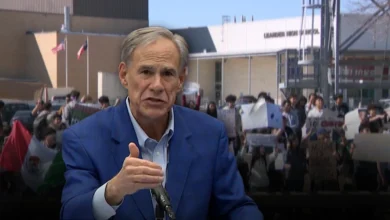
Today, we see Texas Governor Greg Abbott – the longest-serving incumbent governor in the US, who has served for three consecutive terms and is seeking a fourth – fueling the far-right agenda even further. If Texas was founded as a bulwark of slavery and reaction, Abbott is the modern-day steward – deploying the full machinery of the state to quell dissent, criminalize and disenfranchise Black and immigrant communities, and entrench minority rule.
Prairieland: A dangerous precedent
The Prairieland sentences are not merely harsh punishment –– they are a fundamental assault on First Amendment rights, and a sadistic criminalization of any and all who seek to exercise them. The sentences, equaling hundreds of years behind bars, regardless of whether an individual actually engaged in violence, are unprecedented. They reveal the true purpose of the prosecution at its core: the weaponization of counter-terrorism law to suppress political opposition.
The implications of these case proceedings are not simply limited to Texas. They set far-reaching and dangerous implications that could fundamentally reshape the landscape of political protest and free speech in the United States. “Antifa”, as the defendants were described, is not a formal organization, but an ideological label. With the development of NSPM-7, the term has essentially been weaponized by the Trump administration as a placeholder for “leftist” in order to craft an anonymous boogeyman. Similar “antifa” charges have been filed against anti-ICE activists in Minnesota. Prairieland was a test case for how far the state can go in criminalizing dissent.
Repression breeds resistance – and resistance breeds repression
The Prairieland case is designed to instill fear in any and all who seek to protest and organize for a new world. However, the state’s harshness is itself a measure of the threat it perceives from our collective action.
Texas, though often discounted as a politically-backwards and irredeemably-red state, has an immense role to play in forging a new future for the United States. Texas remains the second most populous state and a bastion of reactionary politics since its foundation. But it also has the largest Black population in the country – the historic vanguard of U.S. social progress – and a rapidly growing immigrant population that has been alienated by the state’s policies. The potential for organized resistance to the grip that far-right politics has on Texas grows every day as a direct response to these very policies.
The history of Texas – and the entire United States – demonstrates that the most brutal repression has always been met with resistance. From enslaved Africans who defeated slavery and waged a war against white supremacist terror during Reconstruction, to the activists who are on the frontlines against ICE terror today, we know that our fight is not lost in response to the Prairieland sentencing.
As the Trump administration wages wide-scale attacks on our history, our movements, and our civil liberties overall, the necessity of our collective organized and determined resistance grows deeper and stronger. The counter-revolution of 1836 is not over – but neither is the struggle against it.