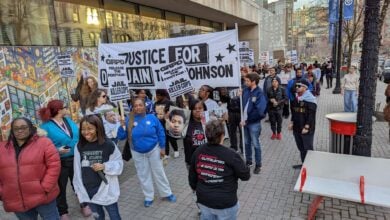
Protestors celebrate after charges against the six officers involved in Freddie Gray’s killing are announced. Credit: Flickr/talkmedeianewsphotoarchives (CC BY-NC-SA 2.0)
This April marks the 10-year anniversary of the killing of Freddie Gray and the subsequent uprising against police brutality in Baltimore. Those who lived in Baltimore at the time will never forget the anger, grief, and revolutionary energy that permeated the city for those few weeks. The whole truth about what happened to Gray, what occurred in the uprising, and what city government and local media did to cover it all up would only be revealed in the weeks, months, and years to come.
Gray’s life reflected that of many Black residents of Baltimore. He was often harassed and brutalized by police, grew up in housing that gave him lead paint poisoning, and lived in an area abandoned by city government and marked by widespread poverty. Gray’s friends, family, and neighbors remembered him as the person you go to when you need a laugh, a gentleman, someone who went out of his way to make people happy. He had some run-ins with the law, but as one of his neighbors put it to the Baltimore Sun at the time, “The police have made up their minds about who we are.”
Black Baltimore rose up for Freddie Gray
On April 12, 2015, Gray allegedly made eye contact with a police officer while looking for breakfast with two friends. He started running, and three cops on bicycles chased him. The cops caught him, pushed him down by his face, and twisted his legs behind him. Witnesses also saw officers tase Gray, though the Baltimore City Police Department denied it. One neighbor, Kevin Moore, recorded Gray crying out in pain as police pushed him into the back of a police van. The van stopped around the corner, and officers took Gray out to “complete the arrest process.” Witnesses say officers tased Gray again, shackled his ankles, then threw him into the van head first. BPD denied tasing or throwing Gray. They claimed the van made four more stops before officers brought Gray, unconscious, with a fractured neck and pinched spinal cord, to the hospital where he died a week later.
In the following weeks, spontaneous protests led by his family and neighbors evolved into a mass movement that garnered growing media attention. When protests disrupted the tourist area downtown, Governor Larry Hogan sent State Troopers to Baltimore, and denied any leave for police until protests quieted down. Many protesters were detained in that first week, before any rocks were thrown. Tensions hit a boiling point when protests moved towards the baseball stadium downtown. After racist bar patrons and sports fans harassed Black protesters and police and security did nothing to de-escalate, some protesters smashed the windows of police cars and threw rocks. Later, police attacked both protesters and members of the press. From there, all eyes were on Baltimore, and the story dominated the news cycle.
BPD took advantage of social media and the press to manipulate the public narrative, releasing unfounded allegations that Baltimore gangs were allying to target and kill police and circulating rumors of teenagers calling for a “purge,” a day of lawlessness inspired by the movie series. Police used these later-discredited claims to justify escalation and blanket criminalization of Black youth. The ensuing police violence sparked the uprising.
The next day, the National Guard was called in and a curfew was put into effect. Enforcement of the curfew was flagrantly racist — while brutalizing and arresting Black protesters throughout the city, police allowed white protesters in the Hampden neighborhood to stay out past curfew without arrests. The streets only began to cool down on May 1, when State’s Attorney Marilyn Mosby announced charges against the six officers associated with Gray’s killing. The curfew was lifted and the National Guard sent away in the following week.
Victories of the Baltimore Uprising
The uprising forced powerful institutions in Baltimore to make unprecedented concessions. Charging an officer was and remains rare, but charging six officers in the killing of one man was unheard of. Though a conservative darling, Governor Hogan signed a bill creating a task force to initiate equipping law enforcement with body cameras. While the desired advantages aren’t always borne out in practice — police departments control the storage of body cam data, and it’s up to officers to turn them on for interactions with the public— it’s clear this was a direct response to demands for transparency and accountability.
The uprising also pushed the Department of Justice to investigate the BPD, which led the two parties to negotiate a consent decree. The investigation proved the outcry of Black Baltimore correct: BPD was engaging in a pattern of unconstitutional and racially discriminatory practices. In every single one of BPD’s nine police districts, the proportion of Black pedestrian stops exceeded the proportion of the Black population. Among other things, the consent decree mandated BPD limit the scope and circumstance of stops and frisks, treat youth and mentally ill adults in a manner appropriate to their development, respect First Amendment rights, thoroughly investigate complaints of officer misconduct, and establish a Community Oversight Task Force to recommend reforms to existing civilian oversight procedures.
Victories eroded and betrayed
None of the six officers charged in Gray’s killing were convicted. The state’s case was insulting, devoting time to debating whether officers knew BPD policy on seatbelting detainees rather than revealing discrepancies between witness testimonies and the BPD narrative. Reporting collected in the “Undisclosed” podcast, later expanded upon in Justine Barron’s book “They Killed Freddie Gray,” revealed that BPD and the State’s Attorney’s Office had crucial evidence which they never intended to make public. This evidence included witness testimony that officers used force against Gray on multiple occasions, with accounts from the second stop which stated officers threw him into the van head first. A collision like that is precisely the kind of impact that caused Gray’s fatal injury, yet city officials maintained publicly that his lethal injury must have happened during transport.
Despite mishandling the investigation into Gray’s killing, BPD was tasked with implementing, reviewing, and reporting on the reforms required by the consent decree. It remains challenging to find the data on stops and searches that BPD was mandated to record and release. The Community Oversight Task Force complained as recently as December 2024 that BPD only provides misconduct case files to review when cases are near expiration. The city has ignored the task force’s repeated calls to create an independent Office of Police Accountability.
Regardless of any reforms, the BPD continues to use excessive force against Black residents with impunity. Many recent incidents began, like with Freddie Gray, when the victim fled BPD officers, putting a fatal penalty on fear of a police force that is proven to be racist and murderous. The logic of police reform assumes that officers simply need more training, more supervision, a better knowledge of policy and the law. Yet people at the highest levels of city government and BPD, like Mayor Brandon Scott and Police Commissioner Richard Worley, wouldn’t even condemn an officer who held a gun to the temple of a fully restrained man. Clearly such violence is a leadership-approved function of BPD, not a mistake.
Only months after the uprising, Councilman Nick Mosby pitched the idea for Baltimore’s own “Cop City” training facility. Justification for the facility rests on the consent decree, arguing that it will allow BPD to better train officers on BPD policy and constitutional practices. However, its design documents make clear that the true goal is to further militarize policing in Baltimore. The preferred construction site for the facility is at the Southern end of Coppin State’s campus, in the middle of a predominantly Black neighborhood, in the same police district where Freddie Gray was killed and the first protests demanding justice were held. The projected cost of its construction is over $330 million.
What does justice look like for Black Baltimore?
At the time of the uprising, President Obama remarked, “When individuals get crowbars and start prying open doors to loot, they’re not protesting, they’re not making a statement.” This remark disrespected the defiance underlying these acts. Most of the items people took from businesses were necessities like baby formula, toilet paper, or cleaning supplies. Claiming these items without purchase was a statement — that Black Baltimore has a right to all of these necessities. Necessities that killer cops like the ones who killed Gray are responsible for guarding as private property.
Freddie Gray is gone, but we can still fight for the future he deserved — a future where Black Baltimore is guaranteed the self-determination it has so long been denied. One where no one grows up harassed by armed officers trained to criminalize them, and everyone is guaranteed all the basic necessities of life, lifelong education, universal healthcare, and housing without hazards like lead paint. In this future, when we say “the next Freddie Gray,” we will mean the next man who makes his friends laugh, is loved by his community, and will be missed when he’s gone — not one who is taken from his loved ones too soon.