The Supreme Court’s recent decision in Louisiana v. Callais has gutted one of the main powers of the Voting Rights Act – its capacity to protect equal representation of minorities in the drawing of voting districts. This decision pulls back over one hundred years of progress towards equality in elections, pushed forward by generations of mass political involvement and mobilization. “It means you can have entire communities that can go without having representation,” said Cliff Albright, a co-founder of Black Voters Matter. “It is literally throwing us back to the Jim Crow era unapologetically, and that’s not an exaggeration.”
This 6-3 decision came down along political lines, in a move that has opened the door for conservatives in the Trump camp to push to redraw voting districts in advance of the midterms. Several states (primarily in the South) have already pushed to do this, including some that are or that are near holding primary elections.
This case comes from Louisiana, a state that holds six seats in the House of Representatives. Though one-third of the state is Black, the state’s district maps have typically been drawn to create five majority-white districts and one majority-Black district. After several years of legal battles charging violating the Voting Rights Act (VRA) with this map, the State Legislature approved a new map that created a second majority-Black district.
Represented by an attorney associated with the Federalist Society, reactionary Louisianians then filed suit claiming that the new map constituted discriminatory and unconstitutional gerrymandering. In this decision penned by Justice Anthony Alito, the Court essentially agreed and took the extra step of greatly dismantling the power of the Voting Rights Act as a tool to hold states accountable for discriminatory maps. In her dissent, Justice Elena Kagan wrote that this decision marks the “latest chapter in the majority’s now-completed demotion of the law.”
Decision makes it impossible to claim racial discrimination
In this decision, the Court changed the requirement of proof to bring a claim of racially discriminatory voting maps, making it nearly impossible to do so. Instead of only having to show the discriminatory impact of a particular map, a challenger must show discriminatory intent in making the map to exclude or weaken the voting power of particular racial groups. A challenger would have to show this to the exclusion of any other plausible purpose, such as purely partisan powergrabbing, which is extremely difficult.
The Court justified its decision in part by making the claim that the South has been accomplishing “great strides” in ending entrenched racial discrimination since the VRA passed in 1965. The opinion also stated that while the Court has long-held that it will not review issues of partisan gerrymandering, the VRA has been exploited to “repackage” partisan gerrymandering claims as racial gerrymandering claims.
In stating such, the Court has effectively dismantled Section 2 of the VRA, one of the primary tools to hold states accountable for discriminatory districting practices. Particularly in the South, this decision allows the elimination of districts that elect Black Democrats merely by stating a partisan motive.
States are quickly dismantling Black voter districts
Though this decision landed less than a month ago, states have been quick to enact its holdings. For Louisiana in particular, the decision puts Cleo Fields, a Democratic Representative of District 6, on the list of endangered seats. And the effect is immediate – the state was slated to hold primary elections on May 16, with absentee ballots having already been sent out to voters. Around 42,000 people had already cast their vote when Louisiana Republicans canceled the election to draw a new map to eliminate one or both of its Black-majority districts.
It’s not just Louisiana. Alabama, Florida, and Tennessee have already enacted new maps that have eliminated Black-majority districts, while Mississippi and South Carolina are taking steps to do the same. Alabama Republicans have already forced through a vote on two redistricting bills, even during tornado sirens and flooding in the Legislature.
It’s not clear how these immediate measures will play out, but dramatic overhauls of state maps are expected by the 2028 presidential election, especially across the South.
It took a mass, multinational struggle to win the Voting Rights Act
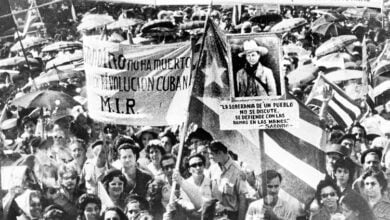
The Voting Rights Act was created and pushed through the legislature by mass organizing and mobilizations to end Jim Crow, and it was hard fought for. Organizers across the south, under the umbrella of organizations such as the Student Nonviolent Coordinating Committee and the Southern Christian Leadership Conference held countless community forums, peaceful protests, voting drives and even national mobilizations.
Activists in this movement were Black and white, and came from every part of the country. They faced immense repression from the Nixon Administration, state governors, politicians and prosecutors, and local police departments. This is no more evident than in Bloody Sunday, where hundreds of peaceful protestors were brutalized by police with batons and tear gas during the March 1965 march from Selma to Montgomery to call for the removal of barriers to the right to vote. The VRA was signed into law by Lyndon B. Johnson only five months after this.
At the time the law was passed, only one-third of eligible Black voters were registered in the states where voting was the most difficult. The VRA has changed the voting landscape, contributing to the elections of thousands of Black and Latino representatives at all levels of government. Sherrilyn Ifill, the former president of the NAACP Legal Defense Fund and current law professor at Howard, said that in 1970, there were about 1,500 Black elected officials across the country. Today, there are more than 10,000. The VRA has been used to strike down barriers to voting such as poll taxes and literacy tests, and to disempower the violent mobs intimidating people from going to the polls.
The latest in a series of attacks on the Voting Rights Act
This decision comes as the latest in a long concerted effort to dismantle the VRA since its enactment. Chief Justice John Roberts himself has been vocal in this fight for decades. He fought against the 1982 amendment and reauthorization of the VRA during his time as an attorney in the Reagan Administration. The 1982 amendment to Section 2 of the Act is exactly what he joined the majority opinion to end in Callais. During Roberts’ confirmation hearings in 2005, he agreed that the constitutionality of the VRA was a settled question. But ever since he took the bench, he has worked to erode it.
Another major cut to the VRA took place from the 2013 ruling in Shelby County v Holder, which eliminated the provision of the VRA that required 15 states with a history of voter discrimination to get federal approval before making changes to their election processes. Since that decision, 31 mostly Republican states have passed a wave of over 115 bills restricting election access.
A mass movement in the streets won voter rights. Now another movement is needed to protect the rights that our predecessors fought for. Already Alabamians are protesting their state Senate to object to the redistricting legislation. We can take heed from their chants, reflecting those of the civil rights era, “We know you want us to leave, but we shall not be moved. Just like a tree, planted by the waters, we shall not be moved. This is the people’s house. We built this house. This is our house.”
We will not forget this legacy as we continue to stand up to preserve the right to equal voting access and representation for all!
Picture: 1963 national civil rights march in Washington DC for jobs and justice. Credit: Wikimedia Commons.