Climate change is leading to more frequent and intense weather events. As a result, many insurance companies are raising their rates or even exiting certain markets altogether because they cannot make a profit. Insurance is a huge industry claiming to care for people in their most difficult times, which in reality exists to make a profit by gambling on the chance that most consumers will not actually need their services.
Meanwhile as climate change-linked storms cause costly damages and companies increase rates, the Trump administration is doubling down on climate denialism. This dynamic can be seen in Illinois.
Beginning Aug. 15, about one third of Illinois homeowners will see an increase in their insurance premiums. State Farm stated last month their premiums would be going up. How much will the working class be expected to pay? The increase will cost the average policyholder around $350 annually. According to State Farm, the increase in premiums is due to more intense and damaging storms in the Midwest, as well as the rising costs in home replacements.
In 2024, for every $1.00 in homeowner’s premiums collected from Illinois policyholders, State Farm paid out $1.26 in total costs.
This isn’t the first time that State Farm has used extreme weather as an excuse to hike up prices for homeowners. Last year, the company said that Illinois had $638 million in hail damage claims, second in the nation only to Texas, which had $1.1 billion in damages. In their filing, the company stated: “Over the last several years, our catastrophe provision has proven to be inadequate when compared to our actual catastrophe loss experience. While there is volatility associated with extreme weather events, our Illinois catastrophe losses have exceeded the year’s catastrophe provision in 13 of the last 15 years, signaling the provision used in rating has been insufficient in recent history.”
Illinois is one of the least restrictive states in the country when it comes to insurance. Unlike many other states, insurers in the state of Illinois are able to hike their prices without regulatory approval before or after the fact. Insurers in Illinois are only required to inform the regulators when they do so.
State Farm, headquartered in Bloomington, Illinois, has been criticized by Illinois governor J.B. Pritzke: “These increases are predicated on catastrophe loss numbers that are entirely inconsistent with the Illinois Department of Insurance’s own analysis — indicating that State Farm is shifting out-of-state costs onto the homeowners in our state . . . Hard-working Illinoisans should not be paying more to protect beach houses in Florida.” Pritzker is now advocating for more regulations in the state to help prevent more hikes here in the state of Illinois.
However, Illinoisans aren’t the only ones experiencing premium hikes. In fact, homeowners all over the country can expect to see increases happening soon. Extreme weather events don’t discriminate and we have seen this in real time as places like California, Florida, Texas and many more states have been hugely impacted in the last couple of years. Homeowners have experienced hikes in their insurance premiums and will most likely continue to see them unless immediate action is taken. The Consumer Federation of America published a report in April showing U.S. homeowners’ premiums increased by an average of 24% over the last three years. CFA found homeowners, nationally, saw premiums rise twice as fast between 2021 and 2024, which amounts to a $21 billion total price hike.
The truth is that extreme weather events are rising and becoming the new normal. These extreme climate events aren’t just happening in the state of Illinois. The entire country has been hit repeatedly. According to NOAA’s National Centers for Environmental Information, in 2024 there were 27 individual weather and climate disasters that resulted in at least $1 billion in damages. These disasters caused at least 568 direct or indirect fatalities. In the last 45 years, it has been estimated that the cost in damages due to these extreme weather events has been approximately $182.7 billion.

In 2024, the United States experienced 27 separate weather or climate disasters that each resulted in at least $1 billion in damages. Credit: NOAA map by NCEI
Climate change heightens the risks of wildfires, tornadoes, hail and other natural disasters. As a result, companies no longer make a profit from the policies that they sell so they are now passing down the bill to consumers. This problem is being exacerbated by the passing of Trump’s “Big Beautiful Bill.”
The bill was passed on July 4, with major cuts seen in important policies that would have supported wind and solar power and clean energy services that could help diminish such catastrophic disasters. Rather than investing in the well-being of the working class and the future of our planet, this new bill will boost the use of fossil fuels and dismantle much of the progress that has been made in order to fight climate change. The bill essentially gives the oil industry everything that it wants including opening up federal lands to drilling and making it cheaper to operate there. Trump has also made it harder for climate change to be taken seriously by appointing three climate skeptics — John Christy, Roy Spencer and Steven E. Koonin to advisory roles in the Department of Energy.
Who are these climate contrarians?
John Christy and Roy Spencer are both research scientists at the University of Alabama at Huntsville and Steven E. Koonin is a researcher at Stanford University’s Hoover Institution. Koonin previously served at the Department of Energy under the Obama administration and was also a scientist for BP, an oil and gas company. Koonin, along with others, pushed for a public “red team” debate on climate science finds during the first Trump administration, but was ultimately overruled by political advisors in the White House at the time. The “red team” debate would have essentially been a platform where conservative groups could push back on mainstream climate science and challenge the prevailing scientific consensus about humans’ impact on climate change.
Christy and Spencer have long maintained that satellite data does not show the same trends and extent of global warming as surface weather data. They have used this to discredit mainstream scientific data. Many in the scientific community have rebutted the message that these “experts” have put out. Andrew Dessler, a climate scientist at Texas A&M University stated, “Hiring Koonin, Spencer, and Cristy is not just irregular, it’s a recognition that none of the normal channels would give them the answer they want. This seems to be a thread running through this administration. They don’t seek legitimate expert opinion; instead, they find people to give them the answer they want.”
The Trump administration’s billionaire agenda is invested in climate denialism because the capitalist class cannot see beyond this quarter’s profits. Making the changes required to address the climate crisis would cut into their profits right now. Instead they are focused on rolling back climate and other environmental protections to assure the unfettered flow of wealth into their coffers.
What needs to be done?
Climate change is accelerating and the end of the window to avoid catastrophic consequences is rapidly approaching. Scientific research shows it’s not too late to implement large-scale measures to stop and even reverse climate change if society acts now. The obstacle to implementing these measures is the chokehold on political and economic power held by the capitalist class, which is willfully focused on short term profits over the long term survival of life on this planet.
Even the issue of insurance premiums would be addressed if we had a government that put people’s needs first. Much could be done to prevent storm damage, for instance, by requiring residences to be built to climate resilient standards while retrofitting existing homes. Repairing damage after storms would be a guaranteed right along with the right to a home. Parasitic insurance companies need to go extinct, not the human species! The question before us is how to organize and win political and economic power for the working class to create a government that can implement these necessary changes.
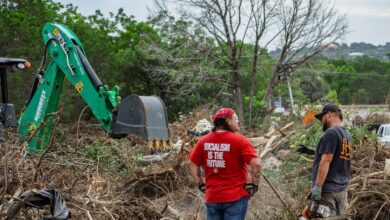
Feature photo: Storm damage to a home in Naperville, Illinois, in 2021. Credit: National Weather Service Chicago/Romeoville, Illinois