Climate scientists have warned that a “Super El Niño” climate cycle is developing in the South Pacific – the strongest in more than a century. In capitalist-owned media outlets like the Washington Post and New York Times, the catastrophic consequences of Super El Niños like this one and others in the late 19th century, are being reported like they’re natural phenomena. Little reference is made to the historical and colonial man-made effects that have greatly contributed to the climate crises working people experience today.
The ruling class is trying to prepare us for a seemingly unavoidable mass death and suffering across the Global South. While they attempt to wash their hands of any responsibility, we have to understand that climate catastrophe is not the root cause of such disasters. Capitalism itself is.
Crash course in climate science
El Niño is just one of three phases of a larger, global weather cycle called The El Niño-Southern Oscillation (ENSO) that begins in the South Pacific near the Equator. As warm water collects near the surface of the ocean off the western coast of South America, it drives the creation of storms in the area and affects the way air currents circulate around the globe. The opposite part of the ENSO cycle, La Niña, happens when cooler water accumulates in this area, which has a dampening effect on storms but affects global air currents in its own ways. The third phase of ENSO is simply the neutral-in-between phase. This cycle happens irregularly, typically between 2-7 years, but scientists have not yet found a way to accurately predict when the next phase will occur.
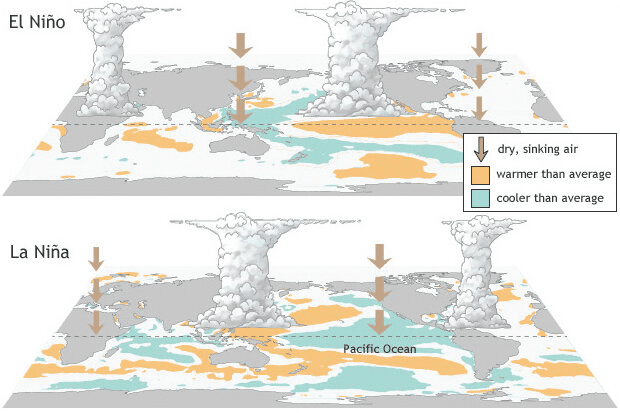
El Niño and La Niña might be associated with hot and cold over the South Pacific, but the impact they can have on global weather patterns can be diverse. El Niño can produce severe droughts in some regions and heavy, sporadic rainfall in others. In all cases, they are disruptive to economic and ecological systems, including human agriculture. However, as might be expected, the increase in global average temperature caused by anthropogenic (human-induced) global warming has been making the ENSO cycles more extreme and more common, with the expected destructive effects on weather elsewhere.
“Late Victorian Holocausts”
In a May 12 article, the Washington Post asked: “A super El Niño wiped out millions of people in 1877. Are we better prepared now?” While the authors of this and similar articles in the New York Times and other outlets all make a brief nod toward the “deliberate actions of colonialists,” their focus is almost solely on the scientific questions of weather prediction and measurement. In fact, the comparison to 1877 is apt, but it’s because then as now, the true crisis is capitalism.
In his 2000 book Late Victorian Holocausts: El Niño Famines and the Making of the Third World, historian Mike Davis explains that the catastrophic famines of the late 19th and early 20th centuries that have been blamed on fickle weather patterns were actually caused by the destructive and heartless behavior of European imperialists who colonized those lands.
Davis looked specifically at the famines in 1876-78, 1896-97, and 1899-1901 spanning from Brazil to East Africa, South Asia, and China. He found droughts and floods, but he also found millions of small farmers and peasants, whose lives had existed outside a global, money-driven economy, suddenly forced into it. Food that had been kept in village granaries for hard times had to be sold on the market for cash to buy the necessities of life that they had formerly traded for or produced themselves; and when the hard times came, they often had no money to buy the food needed to fend off starvation.
No help came from their colonial overlords, either. Following a pattern they had already used to kill 1 million people in British-ruled Ireland during an Gorta Mór, the Great Famine from 1845-1852, the British both cultivated and exported cash crops like cotton from starving areas of their empire while refusing to send food aid to the populations there.
“Millions died, not outside the ‘modern world system,’ but in the very process of being forcibly incorporated into its economic and political structures,” Davis writes. “They died in the golden age of Liberal Capitalism; indeed, many were murdered, as we shall see, by the theological application of the sacred principles of [Adam] Smith, [Jeremy] Bentham and [John Stuart] Mill.”
Indeed, Lord Lytton, the British colonial governor of India at the time, justified his hands-off response to the 1877 famine by citing a horrid quote from Adams Smith’s 1776 book The Wealth of Nations, which claimed that “famine has never arisen from any other cause but the violence of government attempting, by improper means, to remedy the inconvenience of dearth.”
That quote, in turn, was in reference to another famine in British-ruled Bengal in 1770 that killed 10 million people, or roughly one-third of the population. However, the Post, which is owned by Jeff Bezos, one of the richest men on the planet, actually denies that this relationship exists today.
“The devastating losses associated with the super El Niño of 1877 to 1878 aren’t likely to repeat today because the social, political and economic factors that exacerbated the effects don’t currently exist,” the paper claims. Historical records reveal this is far from the truth.
Finance capital guts state protections
A similar logic to Smith’s can be found today in the economic policies promoted by the International Monetary Fund and the World Bank, the pillars of international finance capital and the systems of neo-colonialism used to keep the Global South under the thumbs of London, Washington, and Paris.
The famine in Malawi in 2002, which killed several thousand people, was directly connected to the World Bank’s steady dismantling of the Agricultural Development and Marketing Corporation (ADMARC). The parastatal entity was set up to support the 85% of Malawians who were farmers. In order to obtain World Bank loans, Malawi was forced to adopt pro-free market policies and partially privatize ADMARC, cut its state-supported fertilizer imports, and sell off its grain reserves, which the World Bank had denounced as unfair to the free market.
A similar situation, vis-a-vis the IMF, unfolded in Niger between 2005-2006. IMF “structural adjustment programs” exacerbated the famine crisis, affecting one-third of the country’s 12 million people.
In 2023, Nigeria, the largest oil producer in Africa, was compelled to make major cuts to its state petroleum subsidies to repay the massive IMF loan they took out under the economic pressures of the COVID-19 lockdowns. This has sharply increased the costs of living for working-class Nigerians, but earned praise from the IMF, which said that all forms of government subsidy “should be phased out completely.”
It was for precisely this reason that Burkinabè revolutionary leader Thomas Sankara once defined food aid by saying: “Those who come with wheat, millet, corn or milk, they are not helping us. Those who really want to help us can give us ploughs, tractors, fertilizers, insecticides, watering cans, drills and dams.” He recognized that political sovereignty and food sovereignty were intertwined, which is why the institutions of the empire work so hard to dismantle and deny it to the rest of the planet.
The crisis is capitalism
What the Washington Post’s article fails to address are the aggressive, market-driven policies behind the super El Niño crisis. Multi-billion-dollar international corporations are prioritized at the expense of small farmers and workers.
Droughts and powerful storms are a natural part of Earth’s diverse weather, but mass suffering and death are not inevitable consequences of them. Especially as climate change drives more extreme weather patterns, it becomes more apparent than ever that the same capitalist system that has pushed us into climate catastrophe is incapable of preventing the human suffering these weather changes will otherwise bring.
Only a socialist system, that puts people’s needs ahead of the interests of private profit, can provide a humane answer to the humanitarian crises already unfolding. What is needed is not “structural adjustment” that crushes the sovereignty of nations, but solidarity that supports their independent development needs. A global solution to the climate crisis will require a global economic plan built on an international system where respect and solidarity between nations is the foundational principle — not policies aimed at protecting the interests of a tiny group of ultra-wealthy billionaires.