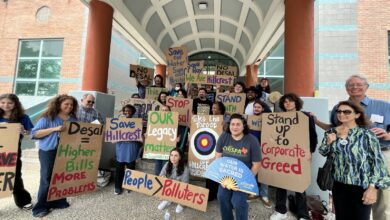
Update: August. 13, 2025: On July 22, the Illinois Education Labor Relations Board officially recognized GEO as the representative for Research Assistants at UIUC. The unionization election, held 12 days prior, saw more than 95% of voting RAs choose GEO representation. While this immediately guarantees RAs key workplace protections such as Weingarten rights, which allow employees to have union representation at investigatory interviews, other protections must still be won in their first contract. GEO will soon negotiate the inclusion of RAs into their existing collective bargaining agreement, drawing thousands more workers into the labor struggle. As university campuses become a key site of the struggle against the billionaire agenda, the entire working class benefits when our strength increases. With morale high and momentum growing, union organizers are excited for the future of the labor and student movements at UIUC.
On May 15, research assistants at the University of Illinois Urbana-Champaign made history by submitting a unionization interest petition. If they vote yes for union representation at the upcoming July 10 election, the Graduate Employees Organization will become one of the largest single-campus higher-education unions in the country and the second largest educator’s union in the state of Illinois.
The unionization drive, organized over the past year, emerged as a defiant, militant movement against Trump’s billionaire agenda that seeks to push back the significant gains made by graduate worker unions over the last five to 10 years. Despite federal funding freezes and draconian visa revocations for international students, the graduate workers at the University of Illinois are sending a clear message to this administration that they intend to fight.
3,700 research assistants keep the university running
Research assistants, also known as RAs, make up the workforce for the University of Illinois Urbana-Champaign’s research machine. More than 3,700 RAs conduct laboratory experiments, analyze data and publish papers in important fields like artificial intelligence and medicine, contributing to the endowments and prestige that place the university among some of the most influential higher education institutions in the country. RAs also engage in the less visible but equally important labor of mentoring new researchers, overseeing laboratory safety plans and recruiting new graduate students. Without their labor, the university would simply not run.
Freddy Hancock, a lead organizer with the campaign and a member of the Party for Socialism and Liberation, said, “RAs are such an important part of this campus because they’re the ones actually doing the work of researching. We know this, the union knows this, but it doesn’t feel like the university does.”
Despite being the largest employment category for graduate workers at UIUC, RAs have been working without union representation. Their colleagues employed as teaching assistants and graduate assistants have been represented by the Graduate Employees Organization since 2002, but the University intentionally excluded RAs from the collective bargaining agreement on the grounds that RAs were not legal workers. In 2019, however, Illinois House Bill 253 passed, recognizing all graduate assistant categories as workers and permitting them to legally unionize.
Last year, pre-professional graduate assistants took the first step in fighting back against the historical exclusion of graduate assistants. Through a unionization campaign that ran from Fall 2023 to Spring 2024, more than 50% of PGAs signed membership cards that confirmed their interest in union representation. The campaign to unionize RAs continued from the momentum built from successfully bringing PGAs into the union. However, given the sheer number of RAs, lead organizers realized that for the campaign to succeed it was going to need to be flexible and inclusive.
Fighting Trump attacks on universities through union organizing
When the Trump administration began a full frontal assault on higher education institutions, many RAs were personally affected. In response, the campaign quickly mobilized a town hall for graduate workers on how to respond to the funding issues. The overwhelming response was that they needed a union. Alex Green, an RA in the Astronomy Department, highlighted the effect of bringing the concerns of rank-and-file workers into an existing initiative: “I think that’s always how the union should be. It’s not a thing that exists outside of the workers. It’s something that emerges from the workers.”
Organizers also moved to incorporate health care into the unionization drive. In the summer of 2024, the University changed the graduate employees’ healthcare plan, which nearly doubled many of the out-of-pocket costs. This came as a shock to many graduate workers, including RAs, who could not afford the difference. For workers with families or making the minimum stipend, this reinforced the need for a strong union, one which included all assistants fighting side-by-side.
Marley Santora, a lead organizer for the campaign, remarked on the mood of RAs: “I came into a scenario where we had surveyed a lot of the RAs on campus about the issues that they were facing. And the picture became really clear once we got the results of that survey that so many RAs on campus are overworked. I would say the vast majority of them are working over their hours. A lot of them are facing really horrible conditions, whether it be in the form of abuse from supervisors or just unsafe working conditions.”
An international student from India and a lead organizer of the campaign, who wishes to remain unnamed, sad: “When we heard from so many RAs that they wanted better working conditions and shared their issues, it felt like something all RAs want, not just some organizers. The goal was much bigger than what a small group of people wanted, it was felt all across campus.”
Protection of immigrants becomes key union fight
Many RAs identified the Trump administration’s repression of immigrants as another key struggle. The majority of research assistants are international students, typically with F-1 and J-1 visas. After Trump’s inauguration, he set his billionaire agenda into motion against the student population through a wave of deportation notices, most notably Mahmoud Khalil at Columbia University and Rümeysa Öztürk at Tufts University. Starting in March, graduate workers at UIUC started receiving emails notifying them that their visas had been revoked and they had one week to leave the country. There were reports that more than 50 students received such notices. Although UIUC’s administration claimed to be on top of the situation, RAs widely reported feeling frustrated with the university’s response.
“It’s just laughable to see that because as a university administrator, you would think it’s your role to make sure that your students can stay in the country, can feel safe on campus. But they honestly just kind of threw their hands up and said there’s nothing we can do,” Santora said. “So we saw it as a time to take action. And we saw it as a time to step in and do the work that the university really ought to have been doing, but clearly was not.”
One of the lead organizers, himself an international student who wished to remain unnamed, said this spurred other international students to organize with the campaign. “A lot of my international student friends don’t realize that they have a right to demand these things. I’m not saying the campaign will solve everything, but my hope is that this will take us one step closer to believing this is our right.”
After rebounding from the struggle against the repression of international students, signatures started coming in again in huge numbers. In mid-April, the campaign reached its minimum goal of 30% and by the beginning of May, the final goal of 1,350 signatures was surpassed. After a year of intense organizing, the GEO sent the Illinois Education Labor Relations Board the signed petition indicating their intent to hold a certification election.
With the election approaching, the mood around campus is high. Santora emphasized the positive effects such a victory can have for a union: “I think that’s a really, really good part of the culture in this union right now is that we celebrate each other, we celebrate the work that we do, and even in the face of some really challenging goals and timelines, that we can just stay in the moment and realize that we’re doing the work that needs to be done and that we can celebrate one another for doing it.”
‘We celebrate each other and the work we do’
If more than 50% of RAs vote yes in the upcoming July 10 election, then the union will meet the University at the table to negotiate their inclusion into the collective bargaining agreement. This election will begin a year of organizing to incorporate RAs into the union while preparing for full contract bargaining.
But the larger fights are far from over. As the Trump administration faces challenges abroad and domestically, many graduate workers expressed concern about an escalating political situation. Still, union organizers at UIUC see this as part of their mission in fighting for a more just society, built on working-class power. “In this trying time, I anticipate that we’ll continue to see union power on the rise, because this administration, this economy, this political climate is putting the squeeze on people. And I think in those moments, that’s when the power of the union shines the brightest. It’s an institution that’s here for you, regardless of what else is going on,” said Santora.
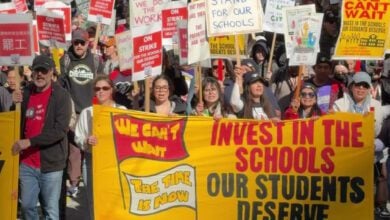
Feature photo: Research assistants at the University of Illinois Urbana-Champaign rally in favor of unionization. Liberation photo.