There’s a revival happening in the U.S. labor movement, and women educators are leading the way. The profession has been devalued because of the feminization of the education workforce: 80% of teachers in the U.S. are women. Compared to other professions that demand the same level of education, educators are underpaid, often by more than 20%. Under U.S. capitalism, teachers are portrayed as pursuing their career out of altruism or “love of children.”
An educators’ strike upends that narrative. No longer is the schoolteacher long-suffering: now she is demanding dignity and fair pay for the labor she performs. The idea that women won’t accept less than they deserve out of love of their students is profoundly threatening to the capitalist system. Worse still, this rejection of martyrdom is made visible to students and community members, sending the message to all workers that they are more valuable than they’ve been told. A strike that shuts down schools forces those in power to reckon with a unified working class.
Since the reactionary shifts of the Reagan Era, much of the militant strike readiness has faded from labor unions in the U.S.. But that’s no longer the case in educators’ unions around the country. Within the past three months, five different educator locals in California alone have walked off the job. In the last 15 years, educators from Chicago to West Virginia to Los Angeles have breathed life back into the labor movement, proving that workers still win big when we stand together.
West Virginia, home of the coal miner and steelworker unions, used to stand at the forefront of the battle for workers’ rights. Yet recent decades saw West Virginians, along with much of Appalachia, struggle with the brutal conditions of extractive capitalist forces. The teachers’ strike of 2018 broke through that hopelessness spectacularly. West Virginia school workers walked off the job – illegally, given their state’s “right-to-work” status – not just in one town or one school district, but across the entire state. Their demands mirrored those of educators today: healthcare, livable wages and fully staffed schools. They forced billionaire governor Jim Justice to approve 5% raises not just for teachers, but for all state workers: an almost unbelievable concession from a capitalist who had said there was absolutely not enough money to meet the teachers’ needs.
Renewed teacher militancy in most populated state
An electric wave of educator strikes across the nation followed. Oklahoma and Arizona teachers all struck that same year. In 2019, Denver teachers went on strike as did the Chicago Teachers Union, already a formidable force in their own right, winning big. United Teachers of Los Angeles, the second largest educator’s union in the country, also struck in 2019. That win, spurred by tens of thousands of community members in the streets of LA, sparked a renewed militancy in California educators.
In California under the rule of Democrats at this time, labor rarely dared to venture into such an antagonistic position; after all, weren’t we lucky to live in a state that recognized our right to collective bargaining? Shouldn’t we be grateful that our own mega-wealthy politicians at least paid lip service to workers’ rights? The Los Angeles strike brought those contradictions into sharp resolution: the conditions of workers, even in the belly of the Democratic Party stronghold, were in many ways no better than those in right-wing, right-to-work states. Teachers in LA faced not only insultingly low pay and over-packed classrooms, but an aggressive wave of charter school privatization. Their determination to demand better for themselves and their students transformed what California educators believed was possible. If LA could do it, why not everyone?
The notion of a statewide educator campaign simmered for years across California before officially debuting in 2025 under the banner “We Can’t Wait.” Originally comprising 12 California Teacher’s Association locals and eventually growing to 32 distinct locals, the We Can’t Wait campaign has captured the imagination of workers across the state. The campaign calls out the chronic underfunding of public education in California, and rather than shying away from the tactic of striking, it accurately names the strike as the strongest tool available to workers, and one that should be used when the bosses create untenable conditions. In San Francisco, United Educators of San Francisco leaders knew that preparing for a successful strike would take years of organizational transformation, building not only the skills of members and the structures at work sites, but also the fortitude and political orientation of membership to believe they could be successful.
Women-led unions lead working class fight-back
Women and LGBTQ people have a unique position in the labor force due to the manifestation of patriarchy under capitalism. For most of the capitalist era women have been predominant in caretaking jobs that are positioned closely to reproductive labor, such as nursing, care for the elderly, childcare and hospitality. This reality has contributed to the huge gender imbalance in education.
What we’re seeing right now through this wave of reinvigoration in the educator labor movement is that this gender imbalance can actually be a strength. The power of our position as educators in our communities is impossible to ignore. The resilience of women workers who are accustomed to battling not just economic oppression from the boss, but social and sexual oppression from society, prepares us for the fight ahead. The wisdom of women who understand the ways that economic oppression is inherently linked to all other forms of oppression positions us to lead with vision, not just reactionary anger.
Just as educators in West Virginia revitalized the labor movement in their state and beyond in 2018, educator unions across the country are finding their power and revitalizing the labor movement on a broad national scale. Every contract victory, every strike, and every collective action taken by workers represents broad class leadership that moves class struggle forward everywhere.
Led largely by women in a feminized workforce, the wave of educator union contract campaigns and strikes that make up the We Can’t Wait campaign is winning material gains for educators, students, and communities in California.
The Chicago Teachers Union, currently led by Stacey Davis Gates, is a powerhouse on the local and national labor scene. Their strike in 2012, a harbinger of the wave of strikes to come, took on wages and privatization and laid the groundwork for their 2015 demand for a $15-an-hour floor for all school workers, including those outside their own membership. In 2019, the union struck again, winning a nurse and social worker in every school, services for homeless students, class sizes limits, a charter school moratorium, advances in bilingual education, and protections for undocumented students.
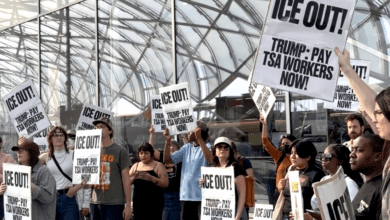
Now, in 2026, the CTU plays a crucial role in the Chicago working class’s fight against ICE, with women leaders taking part in rapid response networks and demanding an immediate cessation of ICE operations. In March, CTU’s House of Delegates approved a resolution seeking full support from the mayor and the board of education to declare May 1 as a “Day of Civic Action,” calling for a national day of “No Work, No School, and No Shopping” in an effort to “defend our Democracy, demand ICE out of our cities, and tax the rich to support our schools and vital services.”
Similarly, the Minneapolis Federation of Educators struck in 2022 and won common goods demands like doubling the number of nurses and counselors in elementary schools as well as requiring a social worker in every building. In 2026, When DHS descended on Minneapolis and ICE agents terrorized working class communities, the MFE played a key role in fighting back, and MFE President Marcia Howard was one of the first labor leaders to call for a mass mobilization and day of action on January 23 in Minneapolis, stating:
“Power concedes nothing without a demand, We are not asking, we’re demanding . . . These are our streets. We’re taking them back one at a time . . . Minneapolis Federation of Educators are joining in with other unionists, other labor organizations, and neighborhood organizations in demanding that ICE leave all public institutions.”
Once other unions, community groups, and political organizations joined the call, Minneapolis held the first citywide General Strike in the United States in nearly 80 years, with over 100,000 people taking to the streets in downtown Minneapolis. The temperature hit -20F that day with windchills nearing -40F, but a poll conducted by Blue Rose Research found that 23% of Minnesotans still took part in the day of action in some form.
Other women-led unions in labor militancy revival
And this fight back is not just limited to educators. Other historically feminized workforces, including nurses, domestic workers, flight attendants and more, are showing broad class leadership as well. Nearly 15,000 New York State Nurses Association members recently struck for 41 days, securing new 3-year contracts featuring improved, enforceable safe staffing ratios, better pay, and enhanced workplace safety, including protections for immigrant patients and nurses. These contact wins represent victories for workers, but also for patients and the working class more broadly.
Sara Nelson, International President of Association of Flight Attendants-CWA has emerged as a working class leader by declaring that a response to the Trump regime should include “building a new economy, building a new set of principles… that’s based from the ground up” because “for too long it’s been about the elite… the Rockefellers and the Mellons and now the Musks and the Bezos believing that they’re the job creators… If every worker in America were to simply hold up and stop working, the capitalists would yield to any and all demands.”
By organizing their workplaces and demanding better for themselves and their students, these women-led struggles are demonstrating broad class leadership that is sure to inspire workers nationally.
Featured image: United Educators of San Francisco members on strike. Liberation photo.