The writer is a candidate for District 27 Community Education Council in Queens, New York City.
Walk into any New York City District 27 Queens classroom and you’ll see the crisis: Children struggling to read basic sentences, middle schoolers counting on fingers, high schoolers unprepared for college or careers. The latest state data shows fewer than 40% of our students are proficient in math, with reading scores even worse. This isn’t just a Queens problem, it’s the result of two decades of failed mayoral control that has silenced and excluded parents and teachers across New York City.
Right now, elections for Community Education Councils (CECs), the last remnants of local school governance, are underway through May 13. These volunteer bodies approve school zoning maps, debate issues affecting local schools and ensure transparency from New York City Public Schools(NYCPS). Yet in the last election, just 2% of eligible parents voted. This abysmal turnout isn’t an accident, it’s the inevitable result of a system designed to exclude community input.
This year’s CEC election is already revealing the disdain NYCPS has for parental input. Their voting portal crashed on opening day, again. Translation services for immigrant parents remain inadequate, despite public outcry on this exact same issue during the last election cycle. Outreach to Black and brown communities is an afterthought while the mayor’s office spends millions defending mayoral control in Albany, the state capital. But we cannot afford to sit out another election while our children fall further behind.
The effect that an empowered CEC can have was infamously illustrated in 2021, when Brooklyn’s CEC District 15 elected a slate of wealthy parents who promptly blocked efforts to integrate the highly segregated district. However, these same councils could become tools for justice. The zoning votes that enforce segregation could instead mandate integration. The public hearings dominated by special interests could e used to amplify the voice of working-class families. Before mayoral control gutted local power in 2002, elected school boards hired principals and managed budgets. Today’s CECs retain just shadows of that authority—but even these limited powers matter.
Internationally, the contrast between socialist and capitalist school systems is stark. Finland’s teacher-designed curricula and Cuba’s parent-teacher councils outperform our system at a fraction of the cost. Vietnam, working with the GDP equivalent to the state of Mississippi, achieves a 98% literacy rate. These nations succeed because they trust educators and families, not political appointees, to make decisions.
In District 27, where schools suffer the city’s worst absenteeism and below average reading and math test scores, I’m running to win back community control of our schools. This campaign will:
• Reject zoning changes that reinforce inequality
• Transform hearings into public accountability sessions
• Build neighborhood councils where parents and teachers rewrite failed curricula.
Here’s what NYC parents of public’s school students can do: Contact your school’s parent coordinator to activate your NYC Schools Account. Vote for candidates who want to empower parents and teachers, by May 13 at: schools.nyc.gov. Finally, and most importantly, organize with other parents and third party political organizations like the Party for Socialism and Liberation to forge a force accountable to the working class of NYC and not the billionaires in power right now.
They took our schools in 2002. This election we can begin to fight back!
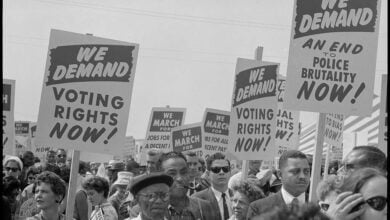
Photo: Protesters oppose segregation in public schools. Credit: Wikimedia commons.