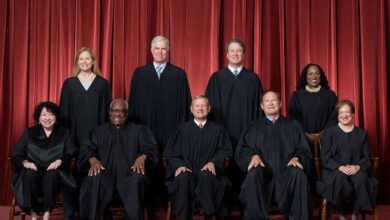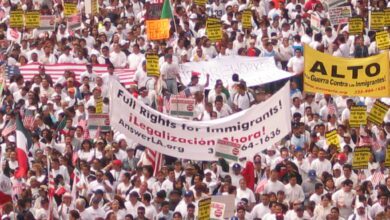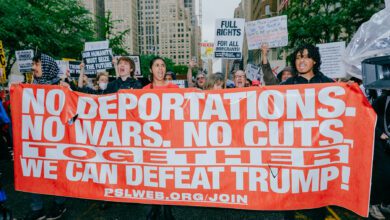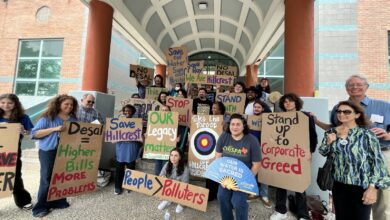
Trump continues to escalate the war on immigrant rights, with National Guard troops supporting ICE in Los Angeles, Washington, D.C. and soon in Memphis, Tennessee, while the Supreme Court has approved racial profiling in ICE arrests, explicitly targeting Black and Brown community members. Trump has also threatened residents of Chicago with National Guard troops and eliminated Temporary Protected Status and humanitarian parole for 1.5 million migrants. In the midst of this anti-immigrant crackdown, we see overtly anti-Black, xenophobic rhetoric targeting Haitians across the United States.
How can we forget that during the ABC presidential debate, Trump blatantly said: “In Springfield, they are eating the dogs. The people that came in, they are eating the cats. They’re eating – they are eating the pets of the people that live there.” This declaration provided the ammunition for the harassment of Haitian community members both physically, politically and socially. Haitians are experiencing what they always have: displacement, isolation, violence and erasure. But Haitians are doing what they always do in the face of repression: resist!
For several months, Trump has worked to revoke TPS for nearly 348,000 Haitians, which has the potential to trigger mass layoffs and destroy tens of thousands of families in dozens of cities. That hasn’t stopped major corporations such as Walmart, Sam’s Club, and Amazon from inflicting damage to Haitians in states like Ohio ahead of impending threats to special protections.
Court rulings have put the brakes on this process. A ruling by U.S. District Judge Edward Chen of San Francisco blocked the Trump administration’s measure to end TPS, allowing 600,000 Venezuelans and 500,000 Haitians (including Humanitarian Parole residents) to maintain their protected status until February 2026.
A July ruling from U.S. District Court Judge Brian Cogan upholds for now Biden’s 2024 extension of TPS for those Haitians living in the United States. Cogan held that Noem’s termination was unlawful “because the government ignored provisions in the TPS statute that seek to provide early notice to recipients, including barring termination until a previous extension expires.” Cogan pointed out that Haitian TPS recipients have “enrolled in schools, taken jobs and began medical treatment in reliance on the U.S. government’s previous representations about the duration of the protections.”
But the attack isn’t stopping, as Congress this summer provided ICE with $75 billion to hire more officers, to expand detention space and increase the rates of arrests and deportations to immigrant communities. There is a clear game of ping pong that is being played with the lives of almost half a million Haitian workers and families in the United States.
As sweeping attacks continue to cause fear, confusion for many Haitian communities, there has also been a mounting fightback movement in defense of immigrant rights all over the country — from Springfield, Ohio to New York City — as there should be!
Haitians and community members organize a fight back
Both coordinated and uncoordinated actions have taken place within Haitian communities across various regions of the country, with the mission to keep community members safe. The scale of resource sharing is also at an unprecedented level, with community members actively finding and translating ICE Know Your Rights materials to canvass throughout Haitian neighborhoods. But practices like these are not uncommon for the Haitian community — it goes back to the Haitian Revolution.
Voices of resistance from the Haitian community
The Haitian Revolution has been a roadmap for nation-building, redefining human history not only in the West and Global North but the entire world, despite attempts by the imperialist powers to dilute, fear-monger and erase its impact. The Haitian Revolution, which started Aug. 21, 1791 was ushered in a week earlier by a convergence, a spiritual ceremony called Bwa Kayiman. Bwa Kayiman was also a political convening of hundreds of enslaved people to take the next step towards liberation. Bwa Kayiman continues to represent collective resistance in the face of all oppression and it is at this event that we heard how community members feel and are handling these recent xenophobic attacks on the Haitian community.

On Aug. 17, organizers with the Party for Socialism attended the Bwa Kayiman Ceremony in Brooklyn, New York to talk to Haitian community members about how they’re fighting back:
When I think about the current struggle for Haitians here in this country and at home, their status and punishment have a lot to do with the Haitian Revolution. Haitians have struggled a lot with political repression for liberating themselves…so thinking about TPS in its current situation…has a lot to do with the Western imperialist forces who have destroyed the conditions for them to live at home. – Danou, community organizer, Brooklyn NYC
The TPS struggle in the U.S. is connected to the Haitian struggle in the Caribbean primarily through the stories of resistance…particularly from an imperial, colonial core…this Ceremony demonstrates how Haitians in the US have created a home and are still resisting and fighting back here for Haiti’s liberation. – Barbara, Rasanbleman Pou Ayiti, NYC
This event and ceremony connects [to the TPS struggle] to send a clear message: we are not afraid! I guarantee you, if ICE came here, it would be a serious issue…the community should not fear…we are here to say that we are not afraid. Our work is ongoing to change the mindset here and in Haiti…we have to unite and be in solidarity. We are here, we are not going anywhere! – Dr. Yaa and Babba Yaw, NYC
It is clear that many in the Haitian community not only have a clear analysis of what they are facing but also what is needed for their own futures. It is clear that the Haitian community is ready to organize for their fellow community members. As organizers, it is critical for us to cut through the fearmongering and show how the working class – regardless of status – are standing in solidarity to stop the mass deportations and attacks from ICE, DHS, and Trump’s administration. The attacks on Haitians today, connect to the ongoing struggle for Haiti’s liberation in the Caribbean. The Haitian liberation struggle is part of the fabric that weaves the immigrant rights struggle inside the United States.
Jean-Bertrand Aristide once said “If one suffers we all suffer. Togetherness is strength.” Aristide emphasized the interconnectedness of the human experience and the importance of solidarity in the face of suffering. Simply put, none of us are free until we are all free.
No human being is illegal! Ayibobo!
Feature image: Liberation photo of 2022 No Occupation in Haiti protest in Brooklyn, NY.