Since the final months of 2025, at least 30 U.S. cities have canceled their contracts with Flock, and many more have paused Flock services in response to public concern. Activists around the country are pushing for full cancellation of the contracts and to prevent Flock’s replacement with a different brand of surveillance technology.
In February, Lynnwood, Wa. City Council canceled its contract with mass surveillance company Flock Safety, which operates in thousands of cities across the U.S. This makes the Seattle area suburb one of the most recent cities to join Charlottesville, Va,. Denver, Cambridge, Ma. and other cities around the U.S., in canceling Flock contracts. Less than a week later, the mayor of neighboring Everett announced that Everett would temporarily pause Flock cameras while studying the issues surrounding their use.
However, in Denver after a yearlong campaign forced the cancellation of the city’s Flock contract, Mayor Mike Johnston alleged he’d “heard” the people and proposed a new contract with Axon, a different surveillance company. Despite a strong outpouring of opposition to the City Council, the Axon contract was adopted March 31.
For communities concerned with mass surveillance in general as well as the intersection of mass surveillance technologies, mass deportation and racist policing, it’s important to understand these technologies.
What is Flock?
Flock is a privately owned company which operates a nationwide network of Automatic License Plate Recognition cameras. This means that data on where people are going in their cars are being saved and stored in a giant, national database that can be searched and shared, raising broad concerns about privacy and mass surveillance.
People around the U.S. are especially troubled about Flock data being searched by federal immigration enforcement and deportation officers in order to locate their immigrant neighbors in order to detain and deport them. Specifically, Flock data generated in Washington has been searched by ICE in violation of state law (University of Washington Center for Human Rights). In addition, Texas law enforcement have searched Flock data in Washington in an attempt to track the movements of a Texas woman who had been accused of having an abortion by her abusive partner. (Electronic Freedom Foundation)
One way concerned community members have taken action is by filing public information requests for Flock data. Jose Rodriguez, a tattoo artist in Washington, began filing requests because he felt that Flock violated people’s privacy while going about daily activities. “I felt like that’s violating my privacy, everyone’s privacy,” he told Seattle’s KING 5 News. “It’s not like they are a traffic light camera that takes pictures of all the people that are breaking the law by speeding or whatever.”
While some cities complied with the freedom of information requests, two cities sued Rodriguez. The case went before a judge in Skagit County Superior Court who ruled in favor of Rodriguez Nov. 6, 2025. This means that anyone can request access to the data. Instead of making communities safer, as Flock claims, it actually endangers people, by enabling stalkers and ICE agents in locating potential victims. (EFF)
The ruling in the Rodriguez case has already resulted in numerous cities in Washington pausing Flock rather than handing over surveillance data to anyone who asks.
Adding fuel to the anti-Flock fire was a report from the University of Washington Center for Human Rights that documented numerous instances of ICE, Customs and Border Patrol, and other federal agencies involved in the mass deportation drive, searching Washington state Flock data. This is in direct violation of Keep Washington Working, a law passed in 2019 restricting local law enforcement and state agencies from cooperating with federal immigration enforcement. Under the law, state resources cannot be used to investigate or detain individuals solely based on immigration status.
From lawsuits and research to community organizing
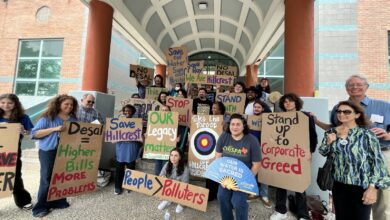
An effective strategy against Flock that has emerged is the political pressure campaign. In Lynnwood, activists with DeFlockLynnwood engaged in research, reached out to City Council members and regularly spoke during public comment portions of council meetings. They circulated petitions and encouraged letters and calls to council members as well. This led to a unanimous vote to cancel the contract.
Shortly after the victory in Lynnwood, Mayor Cassie Franklin in neighboring Everett, Wa. announced that the city was pausing its Flock program, ostensibly in response to the Rodriguez case ruling.
At the March 7 Everett State of the City event, activists flyered and spoke to attendees about the campaign to fully cancel the Flock contract. Among people at the event, the demand to cancel Flock was well-received. “There was no pushback, in fact people were thanking us,“ volunteer Emily Salcedo told Liberation News about her experience leafleting with “Cancel the Contract” flyers at the State of the City.
The movement against Flock in particular is growing across the country. At Emory University in Atlanta, a coalition of student and faculty organizations are leading a campaign to get Flock’s license plate readers off campus as well as demanding Emory immediately “terminate its relationship with Flock Safety, remove all ALPR cameras from campus property, and initiate a transparent community-led review of campus surveillance practices.”
The petition continues to state: “The university must choose whether it will defend academic freedom and civil liberties, or whether it will entrench itself in a surveillance regime that operates in quiet lockstep with the Trump administration, under which expanded immigration enforcement and data-driven tracking have become central tools of governance.”
Don’t be fooled: Same surveillance, different label
In Denver, a successful pressure campaign led to the decision to not renew the city’s Flock contract. The mayor then came forward with a proposal to replace Flock with Axon, a different ALPR company.
“We feel like we heard from Denverites and we got feedback. And we have spent the last nine months listening to the community, working with City Council, working with privacy experts … and law enforcement on what people wanted from a system that would meet everyone’s concerns,” Denver’s mayor Mike Johnston said to the Denver Post. In the same interview, he asserted, “Axon has the single highest level of security protections,” adding, “It’s essentially the same standard used for storing people’s personal medical information.” Really?
Axon’s copious on-line presence tells the story. They are selling their AI-powered “real-time crime centers” to police departments big and small. The RTCCs work in part because Axon makes many different policing and surveillance tools that can all work together, bringing different streams of data into one window.
Rick Smith is the CEO of Axon and describes the company as “the world’s largest sensor network.” They are the biggest maker of body-worn cameras in the U.S. and also make ALPR cameras, dash cameras, movement sensors, drones and other surveillance robots. Now they also own FUSUS AI software which assists in police decision-making based on data from the various Axon-owned information streams.
Axon is the biggest maker of tasers globally and is a major vendor for ICE, with contracts for body cameras and Taser equipment. Former Border Patrol Chief Ronald D. Vitiello was hired by Axon to lead DHS Program and Strategy. Axon also provides tasers to the Israeli army and police where they are used to torture Palestinian prisoners.
Just like Flock, Axon threatens constitutional rights and is deeply intertwined with what could be called the “policing industrial complex” at the local, federal and international level. These companies claim that their technologies make our communities safer, although there is no hard data to back this up. Of course, it is no secret that a truly effective way to improve community safety would be to lift people out of poverty, with livable wage jobs, stable housing and comprehensive healthcare for all. The money spent on technology used to criminalize communities and invade privacy should be spent on housing, healthcare and schools.
Feature image: Liberation collage; photo credits Scott M Liebenson, CC BY-SA 3.0 (ALPR camera); Elvert Barnes (Stop watching us) CC BY-SA 2.0