On May 6, President Donald Trump announced that the U.S. military would cease “Operation Rough Rider,” the intense bombing campaign intended to punish Yemen for its Palestine solidarity actions in the Red Sea. Trump claimed Ansar Allah (called “Houthis” in the U.S. press) had told the U.S. that “they don’t want to fight anymore, they just don’t want to fight,” adding, “We will honor that. We will stop the bombings.” It has been reported that talks between the U.S. and Ansar Allah were facilitated by Oman.
Initial public response from Ansar Allah included a tweet from Salim Al-Moghales, a member of the Ansar Allah Politburo, who said on X that the announcement was surprising and from Mohammed Ali al-Houthi, a member of the Ansar Allah Supreme Political Council, who posted on X that they would evaluate the cessation of U.S. aggression.
The Media Office of Mohammed Nasser Al-Bukhaiti, a senior political official and spokesman for Ansar Allah, tweeted on May 7:
Our military operations in support of Gaza will not cease until the aggression against Gaza stops and the blockade on its residents is lifted, allowing the entry of food, medicine, and fuel. As for our attacks on the US, they fall within the context of the right to self-defense. If it halts its attacks on us, we will halt our attacks on it. This position also applies to Britain. We are committed to our operations in support of Gaza, regardless of the sacrifices it costs us. If the US persists with its operations in support of the Zionist entity, even if they are immoral, the only way to stop the war and avoid escalation is for the US to pressure Netanyahu to respect the terms of the ceasefire agreement. At that point, we will halt all our military operations in the Red Sea and deep within the Zionist entity.
Events leading up to Trump’s announcement
On May 4, Ansar Allah issued a statement announcing a “comprehensive” arial blockade on Israel by targeting its airports. The announcement followed the launch of two missiles over Israel on May 2. In conjunction with the statement, Ansar Allah asserted the Humanitarian Operations Coordination Center, a body set up last year to liaise between Yemeni forces and commercial shipping operators, issued a warning about targeting Israeli airports, saying Ben Gurion Airport would be the top target. They called “upon all international airlines to take this announcement into serious consideration … and to cancel all their flights to the airports of the criminal Israeli enemy, in order to safeguard the safety of their aircraft and passengers.”
Israel retaliated against Yemen on May 5 by bombing Hudaidah Port and a cement factory in Hudaidah province, as well as bombing Sana’a International Airport on May 6.
Trump’s announcement came on May 6; the Associated Press reported that the announcement came as a surprise to Israel: “Israel, according to this official who spoke on condition of anonymity to discuss private diplomatic talks, was irked by the unexpected news — particularly because the Houthis have continued to launch attacks on Israel proper and other Israeli targets.Israel does not appear to be covered by the U.S.-Houthi agreement.”
Previously, over the course of the six weeks following the March 15 resumption of U.S. bombing, Ansar Allah downed seven U.S. Reaper drones at a cost of more than $200 million. In addition, on April 28 a Navy F/A-18 Super Hornet fighter jet fell off the U.S.S Harry S. Truman aircraft carrier in the Red Sea. The aircraft carrier had made a hard turn to evade missiles and drones fired by Ansar Allah, causing the fighter to fall off and sink at the cost of $60 million.
The US military escalation: March to May
The United States, with the world’s biggest military, on March 15 resumed bombing Yemen in a significant escalation from the prior bombing campaign under Biden. During the Biden administration, a total of 931 strikes were made against Yemen, over a period of about one year; in contrast, the U.S. military hit Yemen 1000 times in just a few months this year. The ferocity of the U.S. strikes was so great that a dispute has opened up within U.S. military circles, not because the bombing was immoral, but because the campaign was using up so many missiles that it was cutting into stockpiles the imperialists had already earmarked for a future war on China.
The UK joined the U.S. military for a joint operation in Yemen April 30. While figures vary, the civilian death toll grew rapidly.
What was behind this escalated imperialist attack on Yemen?
Since Oct. 31, 2023, Yemen has been interrupting trade in the Red Sea in solidarity with the Palestinian people’s demand for a ceasefire. Ansar Allah has made it clear that Yemen sees this action as their legal and moral obligation to intervene against genocide.
Despite being a small country, Yemen’s actions targeting Israeli-linked vessels in the Red Sea meaningfully impacted world trade, by forcing ships to travel all the way around Africa instead of passing through the Bab al-Mandab Strait at the south end of the Red Sea.
Under the Biden administration, the U.S. military began bombing Yemen and increasing its presence in the Red Sea, hitting a total of 931 targets before the ceasefire in January, at which time Ansar Allah paused its attacks. As part of its ongoing genocide, Israel blocked aid into Gaza. Ansar Allah warned that its operations in the Red Sea would resume if aid were not let in, a condition of the ceasefire.
The U.S. military campaign against Yemen under Trump, as well as Biden and Obama before him, has been rooted in imperialist designs on the region, and has appeared to be closely linked with a strategy of unconditional support for Israel and its genocide on the Palestinian people. The stated aim of the latest U.S. intervention in the Red Sea, as well as the deadly strikes on targets in Yemen, was to force Yemen to step down from its solidarity actions in the Red Sea.
However, the only thing that had previously succeeded in stopping Yemen’s campaign in the Red Sea was the ceasefire that was declared in January of this year. Ansar Allah threatened to resume the attacks when Israel blocked all aid into Gaza on March 2 in violation of the ceasefire terms, and they said the attacks would continue until Israel allows aid deliveries in Gaza. On March 11, Ansar Allah announced the resumption of attacks on Israeli-linked ships in the Red Sea.
US strikes on Yemen are collective punishment, war crimes
Collective punishment is a war crime under international law whether the “punishment” takes the form of financial or legal penalties, military action or terrorism. The following actions and others taken by the U.S. military meet the criteria for this crime:
A migrant center in Saada was hit by a U.S. bomb on April 28. According to Yemeni media and local civil defense sources, the airstrike on the detention facility resulted in the deaths of at least 68 African migrants and injured dozens more. The facility was reportedly housing around 100 migrants, primarily from Ethiopia, who were attempting to cross Yemen to find work in Saudi Arabia.
On April 21, an open-air market in Sana’a was bombed, killing 12.
On April 17 the U.S. military hit the Ras Isa oil terminal, located on Yemen’s Red Sea coast, north of Hodeida. This port is a crucial entry point for imported fuel and has a storage capacity of three million barrels of oil. Yemenii officials reported that the strike was the deadliest since the U.S. began bombing Houthi targets in January 2024, with more than 70 people killed and as many as 150 injured. The U.S. struck this port again on May 2.
Yemen stands tall
It is important to understand that Yemen has a long, proud history of resisting imperialism and colonialism. In 1967, Yemenis in the south of the country drove out British imperialism and established the Peoples Democratic Republic of Yemen (which eventually united with north Yemen to form the Republic of Yemen). In 1991, Yemen cast the only “no” vote in the UN Security Council opposing the U.S. war on Iraq. Before the recent struggle in the Red Sea in solidarity with Palestine, Yemen survived a brutal U.S.-Saudi bombing war. Despite having the most advanced weaponry, the U.S.-backed Saudi air force could not defeat Yemen. All progressive and revolutionary people should stand in solidarity with Yemen and Palestine.
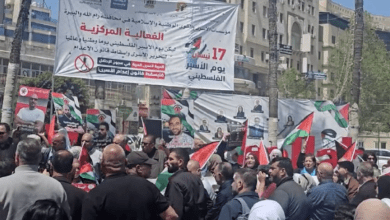
Feature image: Massive protest in Sana’a from December 2024. Similar protests take place every Friday. Credit: unknown. Wikimedia, CC 4.0.