This article was originally published in Lava, the journal of the Workers’ Party of Belgium.
It can be hard to believe that an individual like Donald Trump has actually ascended to the heights of political power in the United States. Considering his bizarre and completely unpredictable style of communication and decision-making, it can be tempting to draw the conclusion that Trump is an aberration – a fluke of history where an accidental figure is in the right place at the right time.
Chance and luck certainly were a factor in Trump’s ascent, and there certainly has not been a world leader in living memory that operated in the way that Trump does. But beyond personality, the forces propelling the rise of Trump and the far right have deep historical roots. A closer examination shows that the U.S. political and social system organically produces the far right ideology that animates the far-right sector of the US ruling class. It is this sector of the ruling class that saw Trump’s second administration as a vessel to alter the form of governance inside the United States by eradicating the expansive reforms that flowed from the Civil Rights Revolution (1955-1970).
That “revolution” did not, of course, shift core property relations. It was not a thoroughgoing social revolution. The capitalist class retained political and social power. But the impact on US political and social life was profound. In a very important way the achievements of the civil rights movement was the equivalent of a Second Reconstruction – a follow-to the First Reconstruction following the US Civil War that was eventually drowned in blood and resulted in a vicious form of apartheid and systemic white supremacy premised on state sponsored terror against Black America. The Second Reconstruction (1955-1970) was a the long-delayed completion of the bourgeois democratic revolution for Black Americans.
The mass struggle to end apartheid inside the United States detonated other mass movements in the 1960s and 1970s for the rights of women and millions of LGBTQ people, for environmental protections, job safety regulations, access for disabled people and political representation for Black, Latino and other oppressed communities. Politics and social life were profoundly changed inside the country. Most of the ruling class reconciled itself to the new reality. But a far-right sector of the ruling class worked for decades, mostly behind the scenes, to stack the courts and state legislatures with right-wing ideologues. Trump’s arrival as a “populist” leader and a second-term in the White House gave this semi-fascistic ruling class movement a popular vessel even though its actual policies are not popular.
Trump’s program and the MAGA movement is an effort to “go back’ to an era where the undiluted control over all of society was in the hands of those who upheld apartheid and mass disempowerment of the 40 million African-American population and the ever growing Latino population inside the country.
Trump, using the road map established by Project 2025 and the most right wing sectors of the US political establishment, seeks to radically change the form of governance by eviscerating democratic rights and ending any regulations that impede the unfettered control over society by capitalist corporations.
Thus, on the domestic front Trump represents an effort to create radical change. But in the realm of US foreign policy Trump’s hyper-aggressive actions are operating, at least in key areas, in conformity within existing US imperial positions.
Trump, in spite of his erratic and buffoonish qualities, also represents continuity rather than departure when it comes to the application of US military power and economic coercion as key tools in US foreign policy.
The war against Iran, the blockade of Cuba, the naval blockade of Venezuela and the kidnapping of Maduro, the support for Israel’s genocide in Gaza and war against Lebanon, selling $40 billion in weapons to Taiwan – all these actions are premised on bipartisan suppositions of both Democrats and Republicans and constitute strategic continuity rather than a departure from existing ruling class consensus positions.
In this article we review the extent to which Trump represents both something different, in some realms, but also as a continuation of ruling class politics that are deeply rooted.
White supremacy: the state ideology of the US
People outside the United States may not have a full understanding of how complete the system of racial segregation was in America. A racialized system of terrorism was erected after the defeat of the first Reconstruction (1865-1876). Police violence, mass incarceration for minor infractions and mob violence worked in tandem. Nearly 7,000 individuals were lynched by mobs in the decades following the civil war. Lynchers were rarely arrested and the few who were won acquittals by all-white juries. Lynchings were civic events where large crowds of white people would celebrate in picnic like environments as Black people were hung, beaten, shot and then burned. Black people who were trying to vote in elections were routinely murdered for trying. The percentage of Black people who voted in Mississippi in 1900 was under 2%. In 1964, the last presidential election before the passage of the 1965 Voting Rights, the number of Black voters in Mississippi was just 5%.
The US version of apartheid was not simply the legal separation of white and Black people in southern states. Segregation was extreme and enforced through methods of terror and violence associated with any effort to permit Black people to live outside of restricted areas throughout the country. In Rochester, New York where I grew up the Black community constituted 18% of the population of 300,000 in 1970. In the working class public high school I attended there was not one Black student out of a student body of 2,000. My father was one of the 55,000 workers who were employed by Eastman Kodak. The number of Black workers who were employed by Kodak was under 100. There was a rebellion of the unemployed in Rochester in the mid-1960s. The demand was raised that Kodak hire at least 600 Black people. The company refused, sparking a six-year long battle before there was an agreement to start hiring Black people.
People living outside of the United States will be unfamiliar with the term “sundown towns.” By 1970, there were about 10,000 sundown towns located in all parts of the country. These were all-white municipalities or suburbs that excluded Black people through the use discriminatory housing laws and the employment of state-sponsored police repression and extra-judicial violence carried out against Black people by the white residents of the sundown town. If Black people were found in the sundown town after sunset they would be arrested or the victims of violence.
This system of extreme racism and violence was societal in character not simply codified into the laws of some southern states. Extreme racism was the norm and not the exception. It bound white workers to their white capitalist bosses. It was the starkest example of class collaboration in the United States. The Civil Rights Movement (Revolution) shattered this status quo and led to a vast expansion of democratic rights and other struggles that infringed on the previously undiluted rights of capital.
Open racism is of course a central feature of the Trump phenomenon. Trump and top officials in his administration frame their mass deportation campaign as an effort to expel those who are “incompatible with western civilization”. He has systematically removed public acknowledgements of the history of slavery in institutions controlled by the federal government, like national parks and historical sites. Social media content on official administration accounts even shamelessly allude to Nazi propaganda slogans, like his labor department’s post about “One Homeland. One People. One Heritage.”
The prevalence of racist ideas in the United States, stemming from the system of slavery and the process of colonial expansion across the North American continent and beyond, is well known. But white supremacy in the United States should be understood not only in terms of social attitudes, but as an explicit state ideology that forms the basis for the political regime that ruled the country until it was overthrown in the Civil Rights revolution of the 1950s and 60s.
In addition to participating in the system of slavery as owners of other human beings, the “founding fathers” who set up the regime in the first place were avowed, ideological advocates of white supremacy. Take for instance this disgustingly racist description of Black people found in Thomas Jefferson’s infamous Notes on the State of Virginia, “In general, their existence appears to participate more of sensation than reflection. To this must be ascribed their disposition to sleep when abstracted from their diversions, and unemployed in labor. An animal whose body is at rest, and who does not reflect, must be disposed to sleep of course.” To the extent that the U.S. system of government was based on enlightenment concepts like the consent of the governed or equal protection under the law, it was understood by all that this applied exclusively to whites.
This attitude among the ruling elite is no ancient relic that was discarded after the end of slavery in 1865. Take Woodrow Wilson for instance, who was president from 1913 to 1921. His father was a chaplain in the Confederate military, and as a child Wilson’s family was served by slaves provided by his church. In terms of racist attitudes, Wilson is perhaps most infamous for screening the film “Birth of a Nation” in the White House, which portrays the Ku Klux Klan as heroes who save the white population of the South from the “menace” of newly-freed Black people in the aftermath of the Civil War. But less well known is that Wilson is featured in the film himself.
Several quotes attributed to Wilson flash on screen during the film. Prior to entering politics, Wilson was an academic and president of Princeton University, when he wrote the book History of the American People. The filmmaker, D.W. Griffith, quotes Wilson writing, “The white men were roused by a mere instinct of self-preservation until at last there had sprung into existence a great Ku Klux Klan, a veritable empire of the South, to protect the southern country.
The Klan is perhaps the most infamous terrorist organization in U.S. history. It was also a mass political movement, with supporters in the highest ranks of government. There were several iterations of the Klan throughout U.S. history, beginning with the effort to overturn the revolutionary verdict of the Civil War through brutal violence aimed at undoing the political and economic empowerment of the Black population of the South during the Reconstruction period. Assassinations, death threats, arson and mob violence were their tactics of choice. When the “second” Klan rose in the early part of the 20th century, it retained its intense opposition to all rights for Black people. And it incorporated a new element at the core of its ideological appeal – hatred of immigrants.
Trump is far from the first far-right demagogue to utilize anti-immigrant sentiment to advance his agenda. The Klan grew to approximately 5 million members at its height in the 1920s in large part on its appeal to defend “American values” in the face of “foreign influence”. While he may not have been a member, Trump’s father was at least a sympathizer of this movement – he was arrested in 1927 at a riot provoked by a Klan march in New York City. For the ruling class, the Klan was a bludgeon to be used against the rising and increasingly revolutionary labor movement of the period. But it was able to mobilize large parts of the white middle class and some white workers on the basis of ideological white supremacy and opposition to immigration.
The official manual of the Ku Klux Klan restricted membership to, “white male persons, native-born, Gentile citizens of the United States of America, who owe no allegiance of any nature or degree to any foreign government, nation, institution, sect, ruler, person, or people.” The manual went on to assert that, “The Knights of the Ku Klux Klan is a movement devoting itself to the needed task of developing a genuine spirit of American patriotism. Klansmen are to be examples of pure patriotism. They are to organize the patriotic sentiment of native-born white, Protestant Americans for the defense of distinctively American institutions. Klansmen are dedicated to the principle that America shall be made American through the promulgation of American doctrines, the dissemination of American ideals, the creation of wholesome American sentiment, the preservation of American institutions.”
The regime of open apartheid in America was defeated by the heroic struggle of the Civil Rights Movement in the 1950s and 1960s. The Civil Rights Act of 1964 and the Voting Rights Act of 1965 heralded the end of the legally codified denial of rights on the basis of race. This change to the structure of the U.S. system of government was accompanied by an ideological transformation – the open advocacy of ideological white supremacy was no longer socially acceptable. Racist appeals had to be made with a modicum of plausible deniability built in and delivered with coded phrases like being “tough on crime” or “welfare queens”. But expressing belief in a racial hierarchy based on biological superiority was banished from the political mainstream.
To the most reactionary section of the U.S. population, this was viewed as a form of oppression – “censorship” by way of “political correctness”. Trump appeals to this current through openly racist comments that challenge the social consensus coming out of the Civil Rights revolution. Trump-ism is about turning back the clock to the time when Jim Crow segregation reigned. Not only does Trump seek to undo the ideological gains of this period, he has also moved to smash its legal gains through the appointment of judges that have all but overturned the Voting Rights Act, including with a landmark ruling in April.
False posturing as an opponent of the elite
Trump presents himself as the champion of the “forgotten man and woman” left behind in a globalized economy. He pledged to bring back millions of blue collar jobs in manufacturing through the use of tariffs, and touted policies like “no tax on tips” that are aimed at some of the most precarious workers in the economy. His actual actions in office benefit exclusively the ultra-rich, who have received some of the largest tax reductions in U.S. history and have free reign to maximize the profits of the corporations they own thanks to the shredding of environmental and labor safety regulations. But he would be unable to mobilize a sufficient mass of voters if he did not adopt this populist posturing. Trump is far from the first politician in U.S. history to take this approach.
Take Andrew Jackson, one of Trump’s personal heroes, for instance. Jackson was president from 1829 to 1837 and is often referred to as the first populist in U.S. political history. Several of his signature policies were used to mobilize mass support. For instance, Jackson abolished the country’s central bank at the time, the Second Bank of the United States. The bank was seen as a tool for wealthy merchants and the burgeoning industrial capitalist class to increase their wealth and deepen inequality in the country. With property requirements for voting freshly removed in most states – meaning that nearly all white men in the country were eligible to vote – Jackson also championed the use of electioneering aimed at generating wide appeal, and adopted rhetoric in defense of the “common man”.
But there can be no doubt that the main beneficiaries of Jackson’s presidency were the rich and powerful. While he was not born into wealth, by the time he ascended to political office he was part of the slave-owning elite of the south, enslaving over 100 people. He fiercely defended this system, using the power of the presidency to crack down on abolitionist groups that used the federal postal system to send anti-slavery literature into the South. He also wanted postal service officials to publish the names of anyone who subscribed to abolitionist publications, so that they could be targeted for mob violence.
Jackson is also infamous for his personal leadership in genocide targeting Native Americans. As a colonel in the Tennessee militia, Jackson commanded troops fighting in the “Creek War” against the Muscogee people in Alabama and Georgia, ultimately leading to the dispossession of their land amid massive death and suffering imposed by Jackson’s men. When he held the power of the presidency, his crimes grew in magnitude. In 1830, Jackson signed the Indian Removal Act into law, which mandated the ethnic cleansing of all Native peoples east of the Mississippi River. This resulted in the “Trail of Tears” death march out of the southeastern United States.
Who benefited from this genocide? Slave owners who set up plantations in the territory stolen from Native peoples, and real estate speculators who bought up huge tracts of land. But Jackson knew that to deliver these types of gains for his own elite class, he needed to cultivate a mass base of support among the lower and intermediate strata of the population.
This type of figure can be found throughout the 20th century as well. Charles Coughlin was the host of perhaps the most popular radio program in the country and a pioneer in using modern technology for political agitation. Coughlin was a Catholic priest, widely referred to as “the radio priest”, and founded fascist organizations like the so-called National Union of Social Justice and the Christian Front. He rose to prominence during the Great Depression, first as a supporter but later a bitter opponent of Franklin Roosevelt and the New Deal. His program spoke to the seething anger at the unjust capitalist order that was widespread in society – calling for the nationalization of “banking, credit and currency, power, light, oil and natural gas and our God-given natural resources” alongside greatly increased taxation of the vast fortunes of the rich.
But who did Coughlin identify as the culprit behind the misery imposed on the working class? Not the capitalist class that robbed them and subjected them to mass unemployment. Coughlin said that Jews were to blame, to whom he also attributed the growth of the communist movement. He was an outspoken supporter of Hitler and international fascism. This type of scapegoating echoes today in Trump’s claims that an “invasion” of “illegal immigrants” along with the machinations of “globalists” are the reason that family-sustaining industrial jobs have disappeared.
Alabama Governor George Wallace was the face of the hardline pro-segregation movement that wanted to oppose racial equality to the bitter end. Like Trump, he used rhetorical sleights of hand to portray people’s movements for justice as the work of a manipulative liberal elite. Wallace said that the Civil Rights Movement was a conspiracy by “pointy-headed intellectuals” intent on imposing their way of life on the South. Wallace ran as a proponent of complete racial segregation as a third party candidate in the 1968 election and won in five states: Alabama, Louisiana, Mississippi, Georgia and Arkansas. But his campaign was popular in northern states too. More 25,000 people filled Madison Square Garden in the heart of Manhattan when Walace spoke there during the 1968 campaign.
He told an audience during his 1976 campaign for president, “[Y]ou, the small middle class individual pays a high cost of everything … But under the income tax we exempt the Ford Foundation, we exempt with their billions, and we exempt the Rockefeller Foundation with their hundreds of millions, and the Carnegies and the Mellons and all of those, under these tax shelters while you working people and farm people and little business-men and -women pay the taxes.”
One of the most immediate forerunners of Trump’s far-right movement is Pat Buchanan. After serving as a top right wing propagandist for the Nixon and Reagan administrations, Buchanan ran for president in the 1992, 1996 and 2000 elections. However, he broke with the neo-liberal consensus that prevailed in both major parties. Announcing his 2000 campaign, he lamented “the dismantlement of the mightiest industrial empire the world has ever seen. Piece by piece, job by job, factory by factory, it is being carted off to foreign soil. The yellow brick road that once took tens of millions of poor and working Americans into the middle class lies in ruin.”
But to Buchanan, this was not a symptom of an economic order based on the maximization of profit above all else. He viewed this as part of the decline of western civilization, writing in his 2002 book Death of the West, “As Western peoples have begun to die, the vacant rooms in the House of the West will not long remain vacant. In America, the places prepared for the forty million unborn lost since Roe v. Wade have been filled by the grateful poor of Asia, Africa, and Latin America. As Europeans forgo children, the places prepared for them, too, will be occupied by strangers.”
Today, this thesis is referred to as the great replacement theory, animating far right movements across Europe as well as Trump-ism.
Trump and the Strategic Goals of the US Empire
Despite all his posturing to the contrary, the aspect of Trump’s presidency that falls squarely in line with the actions of his predecessors is his commitment to war and aggression around the globe in service of the big banks and corporations that dominate the U.S. economy. Trump stands in a long line of U.S. presidents who have sought to use overwhelming military force to dominate every part of the globe.
In its earliest days, the U.S. government waged constant wars for colonial expansion westward across the North American continent. This trend intensified following World War Two, when the United States emerged as the leading capitalist superpower that took responsibility for managing the affairs of the entire imperialist bloc through institutions like NATO. During the so-called Cold War, the U.S. waged genocidal, years-long wars against the people of Korea and Vietnam. And there were constant military operations that were shorter in duration but no less imperialistic – Lebanon, Cuba, the Dominican Republic, Grenada, Panama and so many others were attacked. And this is all on top of the coups and other forms of covert intervention that led to immense suffering – like the installation of the Shah of Iran in 1953, the coup against democratically-elected Guatemalan president Jacobo Árbenz in 1954, or the coup against Salvador Allende in Chile that brought the fascist Pinochet regime to power. This did not let up after the fall of the Soviet Union, with attacks on Yugoslavia, Afghanistan, Iraq, Libya, Yemen, Pakistan, Somalia, Syria and more.
While the corporate media and other powerful institutions retain considerable ability to manufacture consent for U.S. intervention abroad, their grip over public opinion has been slipping. The population is fed up with endless wars. The experience of the war in Iraq and Afghanistan has proven that what the politicians sell as a quick engagement can easily turn into an indefinite occupation. Tens of thousands of soldiers from the “war on terror” era have come home with debilitating physical and psychological injuries, if they even made it home at all. And there is growing awareness of the immense burden the war machine places on public finances, with an ever-expanding military budget eating away at the funds that could otherwise be used to help alleviate the hardships working people are facing.
Trump sensed this when he first ran for office in the 2016 election, and has ever since tried to maintain the veneer of being a “peace president”. He criticizes his rivals for starting endless wars, and projects himself as a figure powerful enough that the rest of the world will simply fall in line behind him without much of a fight. But in reality, Trump has proven to be just as much of a war monger as all his predecessors, and uses openly colonial language unheard of for generations in mainstream U.S. politics.
The blatantly false nature of Trump’s campaign trail appeals has been thoroughly exposed by his actions since returning to office. In addition to continuing support for the Israeli genocide in Gaza, he issued a new “national security strategy” that declared the entire western hemisphere to be the exclusive domain of Washington. He began a campaign of murder targeting small boats in the Caribbean and Pacific coast of South America, and then escalated to an all-out assault on Venezuela to kidnap the country’s president, Nicolás Maduro. He has issued multiple war threats against Cuba while tightening the cruel blockade. Even Greenland isn’t safe from Trump’s unhinged colonial ambitions.
Of course this is all in addition to his war on Iran. The brutal bombardment of Iran has claimed the lives of thousands of people, and has unleashed a conflict causing devastation all across the Middle East — especially in Lebanon at the hands of the U.S.-supplied Israeli military. Trump remains stuck in a quagmire, unable to force Iran to give in to outrageous concessions, yet unwilling to accept defeat. The Strait of Hormuz remains disrupted, and the global economy has been thrown into chaos.
The U.S. public in its clear majority are against Trump’s wars. A poll taken at the end of March shows that more people oppose the U.S. taking military action in Venezuela and Iran than those who support it. The same poll also found that when it comes to major interventions in recent years – the wars on Afghanistan, Libya and Iraq – more people say it was wrong than right for the U.S. military to have intervened.
When it appeared that Trump’s string of wars was succeeding, ruling class opposition was muted. Even many of those who criticize Trump over domestic issues applauded the kidnapping of Maduro, or at least marveled at the high-tech military power brought to bear in the operation. For a moment, the managers of U.S. empire hoped that through a series of displays of overwhelming military force, the slow decline of U.S. imperial power could be arrested and reversed. But the war on Iran soon turned into a humiliating disaster. Although the country suffered major damage and the death of many leaders, the Iranian political system proved to be resilient. Iran asserted its control over the Strait of Hormuz despite the mismatch in military power between the two sides. And Trump’s erratic behavior during the war was deeply discrediting.
Finally, Trump’s rhetoric on NATO needs to be separated from the reality of the administration’s policy. It is true that he routinely makes public comments critical of the alliance, and even entertains the notion of leaving the alliance. But these comments have primarily served to bully the United States’ junior partners in NATO into massively expanding their military spending to meet an ever-growing target number of spending on defense as a percent of GDP. Because of the Trump administration, NATO is becoming an even more potent military machine, posing both a grave threat to world peace and a lucrative business opportunity for U.S. weapons manufacturers.
The people refuse to go back
Although Trump ascended to the presidency on the back of a political current that can trace its roots to the earliest phases of U.S. history, that does not mean that his views are embraced by the majority of society.
Trump won the 2024 election in the context of a two-party system where his opponent was thoroughly discredited. He started by running against Joe Biden, whose failure to act in the face of the inflation crisis earned him widespread disdain across society and whose backing pf the genocide in Gaza alienated progressive people whose votes were needed to assemble an electoral majority to defeat Trump. After Biden’s mental incapacity was put on display in humiliating fashion during his debate with Trump, he was replaced by Vice-President Kamala Harris, who was associated with all the failings of the Biden administration and only had a few months to campaign.
The majority of people in the United States support proposals like universal healthcare, student debt forgiveness, expanded union rights and other progressive measures. Marriage equality and abortion rights are overwhelmingly popular. A large share, perhaps even the majority, of young people have a favorable view of socialism. And most people in the United States reject the string of wars Trump has been starting or wants to start all over the world. Trump’s approval ratings are hovering around 40 percent and are likely to fall even further.
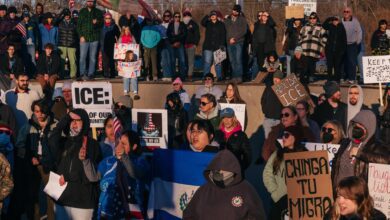
The mission of the far-right movement around Trump is to undo the gains won during two key periods of progressive advance in U.S. history – the New Deal of the 1930s and the Civil Rights Movement of the 1950s and 60s. While his administration has taken steps in this direction, the blowback has been massive. Huge protests involving millions of people (cumulatively tens of millions) have broken out repeatedly since Trump returned to office. From the struggle against mass deportations to the No Kings Day protests, to the General Strike in Minneapolis on January 23, 2026 followed by the nationwide National Shutdown on January 30, 2026 and the mobilizations for May Day and beyond, the anti-Trump movement is growing in strength as an expression of the viewpoint held by the majority of people in the United States.
While Trump hopes to turn back the clock, what his all-out offensive on basic social and economic rights might actually end up accomplishing is the opposite. More and more people, especially young people, are coming to the conclusion that the entire system of rule by the billionaire class has to go. This could usher in a period of struggle even more profound than anything that we have seen yet.