April 17 marks the 55th anniversary of the first prisoner exchange between Palestine and the Israeli occupation in 1971. Since 1974, this day has been commemorated worldwide as an international day of solidarity with the hundreds of thousands of Palestinians who have been illegally imprisoned by Israel since 1967.
On March 30th, Israel’s parliament adopted a law, called the “Death Penalty for Terrorists Law,” making capital punishment the standard for those that carry out “acts of terror” on citizens of Israel — only if the accused or convicted is Palestinian. As the law was passed, the fascist Israeli Minister of National Security Itamar Ben-Gvir was photographed celebrating with champagne and a noose-shaped lapel pin on his jacket.
As of April 2026, there are nearly 10,000 Palestinian hostages held in Israeli prisons, including 342 children. Over 3,500 Palestinians are held in so-called “administrative detention” — that is without any trial or charges. Since 1967, when Israel occupied the West Bank and Gaza, the Palestinian Commission of Detainees and Ex-Detainees Affairs estimates that over one million Palestinians have been detained and held hostage in Israeli prisons.
“Death Penalty” law legalizes lynching, escalates ethnic cleansing
To refer to this new law as enforcing the “death penalty” is entirely euphemistic. This is legalized lynching, and an escalation in Zionisms century-long genocidal campaign to ethnically cleanse Palestine.
The law now mandates that Israeli military courts in the West Bank must default to execution by hanging for Palestinians charged with killing an Israeli citizen, even if the prosecution does not seek such a sentence. There are no allowances for pardons or reductions, and Israelis accused of similar offenses are not subject to these draconian laws.
These military courts, which only try Palestinians and notoriously have a nearly 100% conviction rate are fundamental pieces of the Israeli apartheid system. Israelis accused of murder in the West Bank, on the other hand, are tried in civilian courts. Since the outset of the U.S.-Israeli war on Iran, seven Palestinians have been killed by Israeli settlers in the West Bank, and no Israeli has been charged at all.
In addition to being manifestly racist, the entire premise of Israeli legal jurisdiction over the West Bank is illegal under international law, which states that as an occupying power Israeli has no right to legal jurisdiction over the occupied. The U.N. High Commissioner for Human Rights, Volker Turk, reaffirmed this fact after the passage of the law, stating that it “is deeply discriminatory, and must be promptly repealed.”
This law comes after over a year of escalated assaults on the Palestinian prisoners movement. As Aseel Saleh reported for People’s Dispatch, since January 2023, Ben-Gvir has led a campaign to increase “several repressive measures that have made detention conditions unbearable, including solitary confinement, severe torture, and deliberate medical neglect.”
The centrality of the prisoners’ struggle
In response to the passage of the law, Palestinians in the West Bank mobilized for a general strike in early April. Across the West Bank, shops and institutions closed their doors and people took to the streets. These strikes and protests were not simple solidarity—there is no Palestinian in Palestine untouched by Israel’s barbaric prison system.
The prisoners’ struggle has been central to the Palestinian struggle for national liberation for decades. Illegal detention, solitary confinement, torture, sexual abuse, and countless other crimes have not broken the Palestinian people. Both inside and outside Israel’s dungeons, the Palestinian people have demonstrated persistent and steadfast resistance.
Within the prisons, Palestinians have built entire societies of resistance, building schools of political education and cultural production. Palestinians have smuggled novels to tell their stories and semen to reproduce their family lineages out of the prisons in a persistent rejection of Israel’s attempts to eradicate Palestinian life.
From the youngest child illegally detained to the most senior national leaders facing solitary confinement and torture, the liberation of all Palestinian political prisoners remains a central goal of all Palestinian resistance factions.
The Palestinian resistance operation on October 7th, 2023 was in essence a prison break. The strategic calculus on the part of the Palestinians was to secure the release of as many of the 10,000 Palestinian hostages in Israeli prisons as possible in a trade for Israeli military prisoners. This strategy has recent and historical precedent, for example in 2011 when Israeli soldier Gilad Shalit was exchanged for the release of 1,027 Palestinian prisoners, including Yahya Sinwar who went on to lead Hamas in Gaza.
The Israelis, on the other hand, are seeking to eliminate any leverage Palestinians have wielded in the past. The occupation’s attempts to crush the prisoners’ movement, to legalize the execution of prisoners, to re-arrest those who have been released, and to do anything to prevent their own soldiers from being taken prisoner by Palestinian and Lebanese resistance factions all reflect this reality.
International solidarity reaffirms the struggle for freedom
The last month has seen an outpouring of solidarity and mobilization with the Palestinian prisoners’ struggle across the world. Protests swept the region in the days after the Death Penalty for Terrorist Bill’s passing, especially in Lebanon and Syria.
European governments including Germany, France, Italy, and the United Kingdom expressed “deep concern” about the “discriminatory character of the bill” in a joint statement, despite their deep support for complicity in Israel’s many crimes.
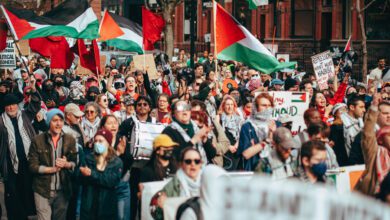
This weekend, renewed actions across the world are raising the call to free all Palestinian political prisoners to commemorate Palestinian Prisoners’ Day. It is essential that the international movement maintain and expand its efforts to put pressure on governments and international institutions around the world to hold Israel accountable.
The long and epic history of Palestinian resistance tells a story of unimaginable resilience — one of a people who refuse to accept humiliation and extermination and who, against all odds, continue to extract strategic defeats and concessions from the occupation. It is this struggle we commemorate and uplift on Palestinian Prisoners Day.
Featured image: Courtesy of Aseel Saleh / People’s Dispatch