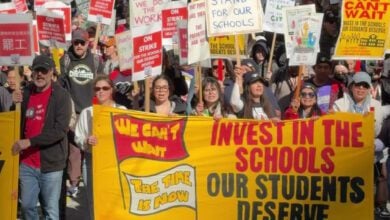
UESF Vice President Nathalie Hrizi spoke with On Strike! to draw out some of the key lessons from the union’s historic strike and contract victory.
OS: Could you summarize some of the key lessons that you think are important for people in San Francisco and all across the country to learn from this strike?
NH: We haven’t done something like this in the history of our organization. The last teachers’ strike was in 1979, but it was a teachers’ strike. It was not United Educators of San Francisco, with certificated and classified going out together. And so one of the major lessons is the importance of this type of unity and solidarity that’s built when you take collective action to win very reasonable demands. That’s a fundamental lesson that we’re seeing in so many different ways.
We felt this unity together out on the picket line. It bridged gaps and differences that bubble up in any community. That dissipates as we fight together for a common cause.
OS: What were the tactics, the strategies used to secure this victory?
NH: This victory has been years in the making. This is a contract struggle that started in February [2025], with negotiations beginning in March. We succeed through building up our site structures and the understanding of the educators that we work with about what’s necessary to win what we think is just and fair for our students and educators.
So there’s a year-long trajectory to this, but there’s also the building that has happened over the last five years, where we have intentionally connected with members in many, many different ways in order to build their capacity to do a thing that’s very hard to do. Withholding our labor, not going into the classroom, not being with our students is very hard for us. It impacts us, it impacts them, and we don’t take it lightly. So getting to that takes time.
One of the keys for us is that we built a really large, diverse, representative bargaining team. And having that many people — the final round it was 120 people, but the round before it was 65, and the round before it was 20. It wasn’t just done in one fell swoop. But having all those people in the room who come directly from the sites and then know exactly what the boss is up to and can tell their coworkers and then go back to their sites — this contributed to the building of leadership, the connection to the membership that is necessary to then do the hard thing and strike.
OS: San Francisco is one center of the billionaire class. A lot of the members who went on strike can’t live in the city where they educate anymore. How did that factor into the struggle overall?
NH: I think that it factored in in a number of different ways. Ultimately, what the strike did was to ripp away the cover of some of the contradictions that exist in San Francisco. San Francisco is known for its liberal history. And it is true that this city has a rich, rich history of struggle. It was the site of one of the general strikes of 1934. But it also has an element of sort of a socially conscious cover to what are actually extremely exploitative conditions.
We have Salesforce and Peter Thiel, and we have billionaires that are profiting off of the direction of our city towards one that is unwelcome to the working class. And I think what we did by taking this action together — for health care, for special education, for wages that would keep us here and make sure we could be in the community — is we ripped the cover off of some of those contradictions.
Our strike scared folks who are in power, who want to build a city where we’re not welcome, a city where our students aren’t welcome. We have an increasingly unhoused student population, and we won housing protections for them. We have our immigrant families who are under attack, and we won protections for them in our contract.
This was won in direct contradiction to the attempts of the ruling class of San Francisco to divide us amongst ourselves and to pit those students against us and those families against us. And instead, we’re together, and we’re united, and we pushed through that to win what are actually very, very basic demands.
But it wasn’t just about the demands, it was about what we learned in that process and about where we can go from here. And I’ve been saying this to the membership over and over and over again: We don’t go back. You don’t get this sense of power and your ability to actually control your future and your working conditions and then just roll back into the cave, right? We’re gonna keep going, and we are part of a campaign that is statewide, that has the intention of increasing funding to public education. Again, a righteous demand, but it will be on the basis of building power as workers.
On Strike! is a publication created to report on the courageous teachers across California who are going out on strike to take a stand for their rights and the future of public education. On Strike! is a project of the Party for Socialism and Liberation, a nationwide organization of activists fighting for justice on all fronts whose members are proudly participating in and supporting the strike.