A contract that delivers justice for educators, students and communities
After four days on strike, San Francisco educators have secured a historic contract victory. The UESF bargaining team announced in the early hours of the morning on February 13 that the determined fight of their members and countless community supporters had produced a major win on the key demands.
The contract secures fully funded healthcare for employees and their families starting at the beginning of next year, with relief on costs coming into effect even earlier. Pay raises stand at 8.5 percent for paras and 5 percent for certificated employees, helping to close the pay gap while delivering major improvements for all members. Special educators will see their working conditions improve dramatically with caseload reductions for RSPs, increased overage pay, compliance periods, and complexity indicators that trigger support.
And programs to support the communities that educators serve are also included in the historic contract. This includes sanctuary school language that will create an additional layer of legally binding protection for immigrant students and families. And it also includes the preservation of the emergency housing Stayover program.
The tentative agreement now goes to the membership for a vote. But educators and their supporters across the city, and supporters of public education nationwide, are already celebrating the prospect of these major gains.
Nonstop struggle delivers the win
This transformational victory came after massive and widespread action across the city that mobilized people from all walks of life.
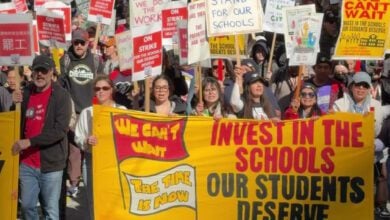
The bedrock of the struggle was the picket lines that formed early in the morning every day at over 130 work sites. Even though class was not in session, educators were working even longer hours pressing their demands for the schools our kids deserve. Because there are SFUSD schools in every neighborhood, the morning pickets created a level of visibility throughout the city that was impossible to ignore.
Parents, students and other community members were a consistent presence on the picket line, as well as other actions throughout the city. This was a powerful answer to the divide-and-conquer narratives spread by politicians and corporate media outlets. Rather than viewing the strike as a disruption to their normal routines, it was widely understood that this was a fight over the future of San Francisco. Will the city belong to the billionaires, or will San Francisco be a place where families can send their kids to good schools that are safe from ICE terror, and where people who provide essential services to the community can afford to live and access health care?
Even though they were not in class, students learned valuable lessons in the power of collective action. On Feb. 11, a delegation of high school students entered the War Memorial building where bargaining was taking place and demanded to speak with Superintendent Maria Su to explain why they supported their educators’ demands. Su outrageously sent an aide instead, but the students nevertheless took turns giving moving speeches about why the importance of the core demands being raised by the union.
Thousands of posters went up around the city in yet another unmistakable sign that the educators enjoyed overwhelming public support. Many of these were put up by small businesses, which are also feeling the squeeze of the affordability crisis. Other posters were displayed in the windows of residential homes.
Many times throughout the strike, thousands of people converged for citywide marches and rallies. At Civic Center, Dolores Park, the Embarcadero and beyond, large marches took over the streets in huge displays of strength. One march even went directly to Superintendent Su’s home, in outraged response to her absence from negotiations and manipulative media presentation. Protesters chanted: “Listen up Maria Su/You need us, we don’t need you/If there’s no money tell us why/your salary is too damn high!”
And add to all this the groundwork laid over years of organizing and preparation by the union. For instance, as far back as two years before the strike the union had been organizing practice pickets to boost educators’ readiness to fight.
The struggle ahead in California and nationwide
The San Francisco educators’ strike was an opening round in a statewide fight. Educators in Oakland, Los Angeles, and San Diego are set to take a stand in the coming weeks as well. UESF’s victory sets the stage for more historic contract wins by tens of thousands of others.
Education is under attack all throughout the country. The billionaire class wants to starve our schools of resources, underpay the people who work there, and ultimately privatize to turn public education into a source of profit. The only way to stop this is to stand up and fight — exactly what the union has done over the course of the strike.
And so many other basic rights in addition to education are under threat. The Trump administration is sending tens of thousands of federal agents into our communities to kidnap our immigrant neighbors. Food stamps, the Affordable Care Act, and practically every federal program that helps working families make ends meet is being slashed or eliminated. White supremacist ideology is being openly promoted by top government officials. Any regulation to protect the environment or combat climate change is being trashed in the pursuit of corporate profit.
The educators in San Francisco have taught all working people in this country a valuable lesson. By using the power of our labor to shut down business as usual, we can turn the tide.
On Strike! is a publication created to report on the courageous teachers across California who are going out on strike to take a stand for their rights and the future of public education. On Strike! is a project of the Party for Socialism and Liberation, a nationwide organization of activists fighting for justice on all fronts whose members are proudly participating in and supporting the strike.