There is a mad rush on the part of the GOP and Trump to get the misnamed “One Big Beautiful Bill” passed by Congress. An article by the White House claims, “Real wages for workers will increase by as much as $7,200 per year,” and “The deficits will be reduced by as much as $11.1 trillion.” Why the rush? It is because workers in the country can feel in their bones that this really is a huge windfall for billionaires. Polls show that more than half of the public is opposed to the bill, and Trump’s approval rating has continued to plummet to 40%, according to The Economist.
A New York Times article titled, “Trump’s Big Bill Would Be More Regressive Than Any Major Law in Decade,” quoted the vice president of the Center on Budget and Policy: “I’ve never seen anything that simultaneously really goes after poor people and then really helps rich people.” The chair of the White House Council of Economic Advisers responded, saying, “The best way to help workers across the income distribution, including all the folks at the bottom, is to create an environment in which firms want to hire them.” This is a rehash of trickle-down economics, a concept promoted in the 1980s during Reagan’s presidency. What happened then was that the rich grew richer and the poor grew poorer. Trump’s bill does that as well as cut funding for services that mitigate poverty, health inequities, recidivism and more.
One aspect of the bill extends the 2017 tax cuts that gave the top 1% a savings of $1.9 trillion over ten years. Trump wants to extend these tax cuts and provide $400 billion yearly to the wealthiest of the wealthy, according to the Center on Budget and Policy Priorities.
The grotesqueness of this giveaway is surpassed by the planned cuts to social services that will pay for it. The BBB will cut $800 billion from healthcare programs and $300 billion from SNAP food assistance. The healthcare cuts will deny 10 million people access to medical care over the next ten years. The SNAP cuts will affect 11 million people, including 4 million children. The $1.1 billion in cuts to these programs is equivalent to the $1.1 billion in tax savings for individuals earning more than $500,000 per year.
One other provision in the bill bans regulation on the use of artificial intelligence for 10 years. With no oversight, the large language models put marginalized people at risk by producing biased and discriminatory outputs, leading to misuse by corporations and police. As AI gets integrated into all aspects of society, the use of it by law enforcement will mean more Black, Asian, and Indigenous people will be erroneously misidentified and misclassified, leading to wrongful incarceration, according to a report by the National Institute of Standards and Technology.
While Trump promised safer cities during his campaign, cuts to Medicaid and SNAP will lead to an increase in crime, according to the Vera Institute of Justice, which works to end mass incarceration. Vera wrote that meeting people’s needs, such as healthcare and food, makes communities safer. Vera writes, “Research has shown time and again that Medicaid expansion is linked to drops in crime. States that expanded Medicaid as part of the Affordable Care Act rollout saw violent crime decrease by more than five percent.” Further they point out, “wider access to SNAP benefits reduces crime, with studies showing that lifted SNAP restrictions lead to lower rearrest rates and reduced intimate partner violence, among other safety-related benefits.”
These cuts are all part of the Trump administration’s playbook of taking from the needy and giving to the greedy. The billionaires in the White House are fully aware of the impact these cuts will have on the working class, particularly its poorest and most vulnerable sectors. They know that if they were to say, “We are going to transfer billions of dollars from the social safety net for the poor and the workers to the billionaire class that includes the likes of Musk, Trump, and Bezos,” there would be an uprising unlike anything this country has seen since the Civil War.
They attack DEI, immigrants, trans people, and persons with disabilities as being responsible for the desperate plight of many of the population, who are a paycheck or medical emergency away from homelessness. It is a sleight of hand to deflect attention from the implementation of Project 2025. Project 2025 is a doctrine from the Heritage Foundation, considered one of the most influential Republican think tanks in the country. The vision it lays out involves the destruction of vital social services and an overhaul of the federal government’s structure to lock in right-wing policies.
The proponents of this plan aim to turn back the clock to before the great social revolutions of the 1960s and 1970s, and even to before the significant labor victories of the 1930s. They want to overturn the gains of the civil rights, women’s, and LGBTQ movements. They want a return to a time of institutionalized racial and gender discrimination, when unions were illegal and LGBTQ and disabled people had no rights under the law. These ultra-right politicians want to return to the period of laissez-faire capitalism, where the government has minimal involvement, allowing free markets to operate with little to no intervention.
What will stop them? The Democratic Party has proven to truly be the “lesser of two evils.” Their campaign promises to improve the lives of the people have proven to be empty, which have then enabled the ultra right to demagogically speak to people’s needs by attacking immigrants, trans people, DEI, and environmental, food, and workplace regulation. What have the Democrats done to fight this war on the people? Bernie Sanders and Alexandria Ocasio-Cortez have traveled the country speaking to tens of thousands of people, talking about joining the fight against the oligarchs. What that really means is working to help Democrats regain the Senate and House in 2026.
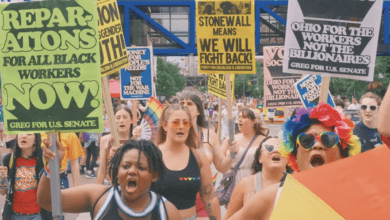
The fight for unions, unemployment insurance, and Social Security in the 1930s was won in the streets and the workplace, not at the ballot box. It was the Montgomery bus boycott that signaled the end to Jim Crow, it was the Stonewall Rebellion that broke the hinges of the closet door, and it was the chair-ins of disabled people that won some level of accessibility in society. The success of these social movements forced politicians to enact laws that mitigated exploitation and oppression.
Only the organized people can stop this war on the working class. The working class is the majority of the population. Without our participation, nothing in society happens. In 2005, Congress passed the Sensenbrenner bill, which made every undocumented person a felon and made it a felony to provide any services to the undocumented, such as healthcare, legal services, or childcare. On May 1, 2006, International Workers Day, tens of millions of immigrants conducted a strike, called “A Day without an Immigrant.” The meatpacking industry had to shut down for that day, and restaurants closed. The Sensenbrenner Bill quietly went away.
That kind of mobilization, but on a larger and broader scale, can roll back the plans of the proponents of Project 2025 and the BBB. We can fight back and win. We can roll back the cuts in social services, reinstate DEI, secure healthcare for trans people, make abortion truly accessible and strengthen labor and environmental laws and regulations. We need to look back at the struggles of the past, not to return to them, but to remind ourselves how we improved the quality of life for the working class and the oppressed. United against the multifaceted attacks of Project 2025, we can overturn Trump’s “One Big Beautiful Bill” and build a society for the many.
Feature image: Gage Skidmore, CC BY-SA 2.0.