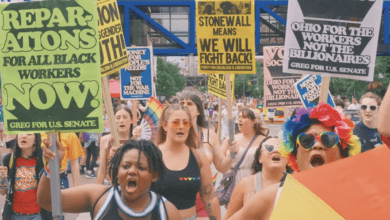
On April 29, the US Supreme Court gutted a key provision of the Voting Rights Act which protected equal representation of Black and brown voters. The Tennessee state legislature responded by redrawing the state’s congressional map on May 7. The new map breaks up Memphis–a majority Black city which previously constituted the state’s only solidly Democrat congressional district–into three separate districts.
The day of the vote, multiple protestors were arrested, including the brother of state representative Justin Pearson. Now, the state legislatures have stripped all Black members of the Tennessee House of Representatives from their committee assignments in retaliation.
Democratic rights were won through struggle, from the Reconstruction to the Civil Rights Movement
The state GOP’s latest aggression against Black lawmakers and Black Tennesseans is a bold escalation — but this didn’t come out of nowhere. In fact, attacks like this one are a continuation of anti-democratic repression across the South, revealing how fragile our rights are in a system that was designed and built for the slaveocracy.
Democracy did not just “break” overnight; these politicians are continuing a very old Southern political tradition. For Black communities, poor people, labor organizers, and anyone outside of the elite political power, there was never some golden age where democracy fully belonged to The People.
The “rights” people enjoy today were not generously handed down by enlightened politicians. They were fought for through mass struggle: sit-ins, marches, boycotts, strikes, and labor organizing. Every single win has been met with backlash from the same political and economic forces grappling to maintain control.
That backlash is deeply rooted in Tennessee history. From Jim Crow to attacks on unions to the criminalization of protest movements today, the state has repeatedly adapted its methods to suppress movements that threaten existing, racist power structures. The strategy changes depending on the era, but the goal remains the same: contain dissent and protect the interests of those already in power.
But what scares Tennessee politicians most is not mere disagreement; it’s organized resistance.
Peoples’ movements can protect – and expand – democratic rights
The state has never responded this aggressively when billionaires reshape cities for profit, corporations exploit workers, or developers displace entire communities. But the second ordinary people organize collectively–whether through labor movements, civil rights struggles, or mass protest–the response becomes immediate: increased policing and surveillance, criminalization, retaliation.
The pattern is playing out again now. Lawmakers are not just trying to redraw districts. They are trying to discipline opposition itself. Stripping Democrats from committee assignments after protests at the Capitol was about making an example out of anyone willing to disrupt business as usual. The goal is to exhaust people into silence and convince them resistance is pointless before movements can grow stronger.
But the working class in Tennessee knows better. From coal miners fighting for their safety in the Coal Creek War, to the “I AM A MAN” strike in Memphis, to the Nashville Sit-Ins, the biggest changes in this state have never come from politicians suddenly deciding to do the right thing. They came because ordinary people forced those in power to respond.
Memphis has a long history of organizing in the face of intense state repression. In 1968, Black sanitation workers in Memphis were so united and organized in their strike that Dr. Martin Luther King Jr. dared for the first time to propose a general strike as a next step. Ten days later, over 4,000 members of the National Guard were called in to attempt to crush the workers. But Memphis has never stopped resisting.
Now, thanks to a collaboration between Donald Trump and Governor Bill Lee, the National Guard is occupying Memphis yet again. But that has not stopped Memphis from fighting for the working class, including against Elon Musk’s massive AI data centers that have been devastating to the Black community. And the fight back is not limited to Memphis! In Nashville–community members, local elected officials, and even the workers at the jobsite–have fought against the “Music City Loop”, demanding real public transit in a city with a growing transportation crisis.
Don’t just fight back, fight for socialism!
The working class knows that we have never won any of our rights by sitting around and waiting for politicians or courts to save us. Our power comes from collective struggle. To fight back against these anti-democratic attacks, we cannot despair. Neither can we merely vote harder in a system that was not designed to reflect the interests of working-class, and especially Black people, in the South. Instead, we must organize.
The Civil Rights Revolution that won the Voting Rights Act was nothing short of a Second Reconstruction. As the far-right tries to roll back these gains, we know that it will take a Third Reconstruction — a Socialist Reconstruction — to win the lives we deserve, once and for all.
Featured image: Alvine, a Nashville-based street photographer