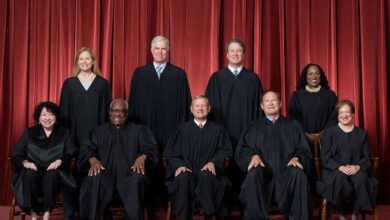
On April 1, 2026, the Supreme Court heard arguments in Trump v. Barbara—a legal challenge to Trump’s January 2025 executive order that sought to outlaw birthright citizenship in the United States. For the first time in modern history, Trump personally attended the oral arguments at the Supreme Court. Every lower court that has heard the case thus far has blocked the Executive Order and the Supreme Court—including right wing judges—seemed skeptical of the Trump Administration’s case and a decision is expected sometime this summer.
In mainstream coverage of this case, the focus has been on the wavering opinions of individual justices, the debates between different judicial philosophies, historical precedents, and personal narratives of the children of immigrants. What this obscures is the deep history of people’s struggle that actually defines this debate.
Birthright citizenship, the legal principle that grants citizenship to nearly all people born in this country, regardless of the parents’ status, is a right hard won by people’s struggles throughout history. It is a legacy of the Civil War, codified in the 14th Amendment to the Constitution passed during Reconstruction and supported by decades of case law from the 19th century, through the New Deal and the Civil Rights Revolution, to today.
What is also missing from mainstream coverage of this story is the reality that these attacks are part and parcel of the Trump administration’s mass deportation agenda and wider war on immigrants. Abolishing birthright citizenship has always been a pipe dream of the far right, no matter how clearly protected this right is in the Constitution and decades of case law. These attacks are part of the same program to manipulate the demographic makeup of the United States.
Part of the ‘mass deportation’ agenda
This attack on birthright citizenship is yet another front in the far-right’s agenda to roll back all democratic rights that have been fought for, bled for, and won by working people over centuries. These attacks must be seen as an expansion of the ‘mass deportation’ agenda of the Trump administration.
The goal of this multipronged attack is clear: to reimpose and maintain racist and undemocratic rule by a dwindling minority of wealthy, white Americans. The racist core of both this legal challenge and the broader agenda of the Trump administration is blatantly clear to all, but it is also integral to understand the class dynamics of these attacks as well.
For decades, the far right in the United States has been working at chipping away the gains of the Civil Rights revolution, the New Deal, and the Reconstruction Era. The expansion of democratic rights, even in its tortured and half-baked form in the United States, has been a bridge too far for the far right who aim above all else to impose minority rule on an increasingly diverse and progressive populace.
Stephen Miller made clear the class dynamics of these attacks in a post on X on April 1st, saying: “Birthright citizenship means the children of illegal aliens can vote to tax your children and seize their inheritance.” For those of us who can expect no inheritance—the vast majority of people in the U.S. regardless of race or citizenship status—this ‘concern’ rightfully reads as the paranoid anxieties of an out of touch racist millionaire.
While the court, including conservative justices appointed by Trump himself, signaled unwillingness to side with the administration, people’s movements must keep the pressure on to protect, reform, and expand citizenship rights across the country.
Birthright citizenship is the people’s victory
Prior to the Civil War, citizenship was legally undefined, and practically extremely limited on the basis of race, sex, and property, with citizenship requirements reserved for “free white persons” of “good character” who had established residency in the United States and renounced foreign allegiances. The infamous Dred Scott decision of 1857 decreed that no Black person, free or enslaved, was a citizen of the United States, but in less than a decade the political winds in the country had shifted dramatically.
It was the revolutionary struggle against slavery that forced the formal definition and expansion of citizenship rights in the United States. The Civil Rights Act of 1866 codified birthright citizenship in the particular context of developing a legal framework for Black freedom during Reconstruction. Despite Andrew Johnson’s veto, Congress pushed the Civil Rights Act through and inaugurated the most radical phase of Reconstruction because of mass popular pressure.
This period saw the passing of the Reconstruction Amendments to the Constitution. The 13th Amendment abolished slavery (except as punishment for a crime), the 14th Amendment established birthright citizenship and granted “equal protection of the laws” to all persons, and the 15th Amendment prohibited the denial of voting rights based on race, color, or previous condition of servitude.
The case for birthright citizenship was strengthened again over the decades. The 1898 case of Wong Kim Ark, born to Chinese immigrants in California, confirmed again the legal basis for birthright citizenship. This case arose in a period when the Chinese Exclusion Acts specifically barred Chinese people from becoming naturalized citizens, yet the Supreme Court ruled 6-2 that Wong Kim Ark was legally a citizen regardless of his parents’ lack of citizenship. This case established more defined parameters for birthright citizenship, further cementing its place in U.S. legal canon.
International contexts
There are two primary legal regimes governing citizenship in the world. Birthright citizenship is known as jus soli, “law of soil,” compared to jus sanguinis, “law of blood.” The Trump administration is attempting to argue that most countries in the world do not offer birthright citizenship, but the story is much more complex.
Looking at countries globally, birthright citizenship reveals itself as a legal regime concentrated in the Americas. This is a progressive legacy of anti-colonial republican struggles in the Americas. As countries in the Western Hemisphere liberated themselves from European colonialism and abolished slavery, beginning in the early early 19th century, the newly independent republics adopted jus soli regimes for citizenship across the board.
This reflected the reality of diverse, multinational populations of indigenous peoples, liberated Africans, peoples of mixed heritage, and European settlers and later immigrants. Jus solis became an integral part of the national, economic, and social development of the Americas, which saw waves of immigrants welcomed over the decades after independence: from Europe, Asia, Africa, and the Middle East.
Even in Europe, which the Trump administration holds up as the model to emulate for jus sanguinis regimes, reality reveals a complex patchwork of naturalization and citizenship regimes. For example France maintains a mixed system: French citizens can pass their nationality on to their children by blood, but there are also provisions for children born to non-citizens to obtain citizenship at 18 if they are born and reside in France for their childhood.
Other European countries maintain harsher, more reactionary policies. For instance, Italy has no guarantees for citizenship for children born to non-Italian parents. What this means practically is that there are thousands of people born and raised in Italy, who often only speak Italian and have never lived abroad, who are left without a legal nationality because their parents emigrated from Africa, Asia, or the Middle East. These policies are deeply unpopular and have faced constant threat from progressive movements in the country over recent years.
People’s movements are decisive
While it is certainly possible the Supreme Court will uphold birthright citizenship in this particular case, we cannot afford any illusions about the security of democratic rights. It is incumbent on popular movements across the country to continue building power—not just in defense of existing hard-won democratic rights—but to advance the struggle for a truly just society.
It is not simply enough to retain the deeply flawed citizenship regime that we currently have. It is not enough to simply oppose mass deportations. History shows that popular pressure and working class power—from the Civil War to the Great Depression to the Civil Rights Era—is what has won the rights we rely on. Continuing the struggle means fighting for a socialist society. A society that would ensure full rights for all immigrants and end once and for all the reign of terror that so many are subjected to in this country.
Featured image: “Birthright citizenship” by Victoria Pickering, CC BY-NC-ND 4.0