A bombshell 2025 study from Yale University’s School of Public Health has revealed that life expectancy in several Southern states barely changed in a hundred years, despite a full century of medical and technological advancements.
While there were some advances for men, women born in 2000 in West Virginia, Oklahoma, Kentucky, Mississippi and Arkansas can expect to live no longer than their counterparts born in 1900. In Oklahoma, the life expectancy for women born in 2000 was actually down 0.7 years from those born 1900.
The Yale study also illuminates the massive discrepancies in health outcomes that have only been growing. Especially for poor Black women in conservative states like Mississippi and West Virginia, health and life outcomes are stalled at unacceptable.
These shocking statistics reveal the U.S. at a turning point for health care and social determents of health and should be a clarion call to take action to change the situation immediately. Instead, the second Trump administration’s aggressive attacks on funding for public health infrastructure, healthcare access and the standard living of working people can only make matters worse.
Longevity gulf of 20 years
Especially since 2020, the health and longevity of the United States population has stagnated (and in some cases, decreased). The U.S. suffered a greater rise in mortality and premature deaths due to COVID than countries with comparable levels of development. But what is most alarming is that the U.S. has not recovered its longevity losses from the pandemic in the way that all other developed nations have. This is because COVID-19 only accounted for about half the decline in life expectancy. Factors such as drug overdoses, heart disease, liver problems, and suicide also contributed to the decline significantly.
Multiple studies have noted that the effect has not been felt the same across the board. Income level, access to education and healthcare, zip code, and community, known as “social determinants of health,” play a major role in someone’s life expectancy. Mirroring income inequality, the health of Americans has greatly stratified since the 1980s. The “longevity gulf” across the U.S. is now a staggering 20 years: On the low end, life expectancy is 66.8 years in the Pine Ridge Indian Reservation in Oglala Lakota County, South Dakota, and it peaks at 86.8 years in the affluent ski resort belt of Summit County, Colorado.
The existing stratification has been severely compounded in recent months. Donald Trump’s “One Big Beautiful Bill Act,” signed into law in July 2025, stripped tens of millions of the lowest-income Americans of their health insurance coverage. Other crucial programs like SNAP and Medicaid have been slashed or stalled. The full effect of these policies is still yet to be seen.
Women’s health in critical danger
Additionally, the bill’s cuts included a provision prohibiting state Medicaid payments to any healthcare nonprofit that has previously received federal funding and provided abortion services, which will immediately put at least 300 rural hospitals across the U.S. in danger of closure. (About 200 Planned Parenthood health clinics across 24 states may close as well.)
Lisa David, President of New York’s largest nonprofit health agency Public Health Solutions, argues that women’s healthcare “used to be a common sense, bipartisan cause.” (PHS) Even Republican Richard Nixon oversaw several women’s health initiatives, including the passage of Title X. David writes that politicians use the concept of women’s health “euphemistically” as a stand-in for supposedly controversial health matters like abortion. The conflation of “women’s health” with “abortion” means that now where abortion care is under attack by the right wing, so is care for breast cancer, cervical cancer, ovarian cancer, mental illnesses, STIs, bone health, menopause and more.
Crisis in maternal care
Women and babies have been especially neglected in American policy for a long time. But in the past few years, changes to policy have led to a full-blown crisis in maternal care. This has been one of the most significant factors in the nearly-stagnant life expectancies for poor women in the U.S. South. The most recent shifts in policy and health outcomes mark a decisive turning point away from progress, and a total assault on working class women and children.
Maternal mortality is the death of a woman during or within 42 days of the end of pregnancy from any cause related to or aggravated by the pregnancy or its management. The maternal mortality rate in the United States (23.8 per 100,000) is already nearly three times higher than that of France (8.7), the country with the next highest rate, and it is growing.
While the rate for white women hovers around 19 per 100,000, the rate for Black women is a staggering 55. While Hispanic women’s mortality rate is still lower than that of Black women, they have seen the greatest short-term increase, with their rate growing 44 percent in just one year. Even in New York, a state heralded for its progressive policies in support of women, Black women suffer five times as many deaths related to childbirth than white women.
Mississippi declares emergency on infant mortality
Maternal and infant mortality are highly intertwined. The state of Mississippi recently declared a public health emergency after their 2024 infant mortality rate hit 9.7 per 1,000 births, which is the highest in over a decade.
Mississippi State Health Officer Dr. Dan Edney recently said, “Improving maternal health is the best way to reduce infant mortality. That means better access to prenatal and postpartum care, stronger community support and more resources for moms and babies. Healthy women of childbearing age are more likely to have healthy pregnancies, which in turn lead to healthier babies.”
Study grants with the word ‘women’ are to be automatically denied
Policies that promote care for women in turn promote care for infants. But just a few months ago, the Trump administration decided to gut the majority of employees at the Division of Reproductive Health in the federal Centers for Disease Control and Prevention, as well as eliminate funding for state maternal mortality review committees. They also passed a provision that prohibits federal Medicaid funding to Planned Parenthood, closing off access to family planning, fertility treatments, and maternal disease detection.
At the National Institutes of Health’s Boards of Scientific Counselors, about 25 percent of all women board members and 40 percent of all Black and Latino members were fired. Staff at the U.S. Department of Health and Human Services have also been directed to automatically disapprove grants that include certain words. One of those words is “women.”
We are beginning to see the longer-term effects of these anti-woman policies following the disastrous overturning of Roe v. Wade in 2022: Mothers living in states with total abortion bans are nearly twice as likely to die during pregnancy, childbirth, or soon after birth than mothers who live in states where abortion is accessible. Texas, the first state in the country to enact a near-total abortion ban, saw a maternal death rate 155% higher than the rate in abortion-supportive states like California. In the first year of the abortion ban alone, maternal mortality rose 56 percent. More maternal deaths now occur in Texas than any other state in the nation.
Time to demand investment in our health
What will it take to reverse this trend of decline?
Many studies around the social determinants of health reveal that the way forward is intentional investment in healthcare and people’s daily living: that means livable incomes, access to education, access to health facilities, affordable health care, paid sick leave at work, adequate maternal care, access to healthy food, a clean environment and more. It also includes widespread access to abortion, which the World Health Organization considers to be a safe yet critical public health service. This would necessitate depoliticizing “women’s health” and healthcare in general.
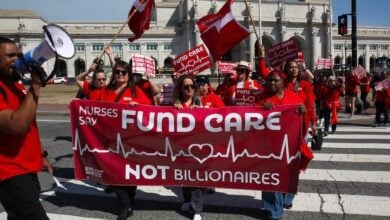
Healthcare is not supposed to be a hot-button issue. It’s an unglamorous solution, but the answer is to fully fund care. That means funding hospitals and clinics as well as funding preventative care measures. It means taking disease seriously by putting healthcare and the right of people to recover from illness over the need to make profits by forcing them back to work. It means entirely redefining healthcare policy to be determined by what people need to be mentally and physically well, not what saves money for employers or corporations.
The right to adequate, accessible healthcare for all will have to be won by a movement. The right to an abortion was undemocratically eviscerated by the Supreme Court less than 50 years after it was won. It was only the next year (1974) that women also won the right to borrow credit, start a business, or buy homes in their own names. It is important to remember that these rights, which we now take for granted, at one point seemed impossible. With enough political pressure, the right to abortion could be reinstated just as suddenly as it was lost.
The same goes for other healthcare measures that the rest of the world is increasingly adopting, such as universal healthcare, paid sick time, and sufficient parental leave. But the wealthy lawmakers in the U.S. and their corporate donors, who certainly have world-class care for themselves, will not hand these rights to working people without a fight. It is up to grassroots mobilizations and working people all across the country to demand our right to a healthy life.
Liberation photo.