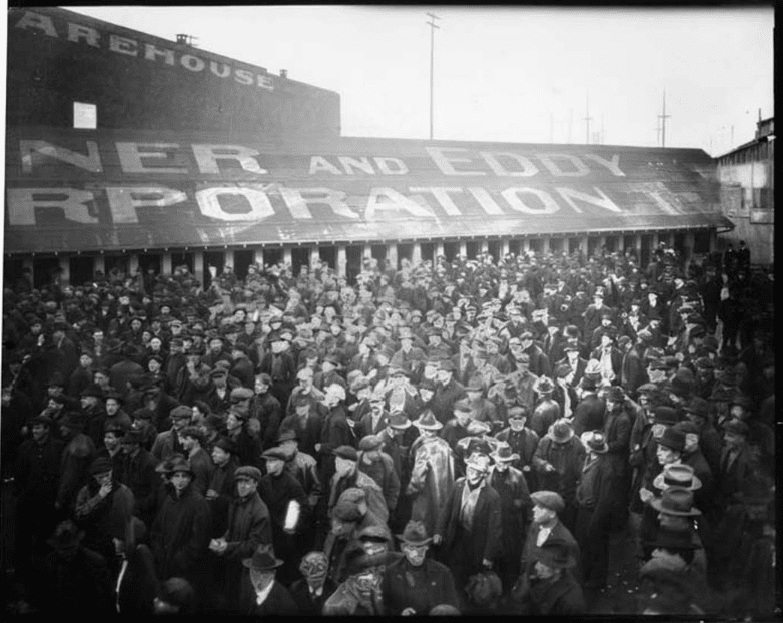
On February 6, 1919, a general strike stopped all work in Seattle, a city of 315,000 residents. Some 25,000 union members joined about 35,000 shipyard workers who were already on strike. One hundred and one unions affiliated with the American Federation of Labor had voted for a general strike in solidarity with the shipyard workers. Other workers stayed at home; transit did not run and most stores were closed.
An elected Strike Committee coordinated essential services. Culinary unions fed thousands at stations all over the city. The teamsters delivered to hospitals and made sure that milk and food made it to the community. Unarmed union members formed into “War Veteran Guards” who patrolled the streets, helping to maintain calm and encouraging workers to stay home. On day two of the strike, the Mayor threatened martial law; two battalions of U.S. Army troops took up position in the city, but labor ignored the provocation. “’Nothing moved but the tide,’ remembered a striker years later.” (University of Washington Seattle General Strike Project)
The war in the shipyards
The General Strike of 1919 in Seattle was among the first of its kind in modern U.S. history. A confluence of international, national and local factors created the conditions for this historic action and its lessons remain valuable today. Historian Roberta Gold summarizes the conditions in Seattle at the time:
“Seattle in 1919 was an auspicious stage for labor’s critical fight. The port city’s workers were among the most organized in the nation, with solid union presence in building, longshore, transport, retail and other trades by the mid-nineteen teens. Seattle’s craft locals forged industrial ties through trade councils that coordinated such fields as Metal and Building, and they maintained a citywide coalition through the Seattle Central Labor Council (CLC). They also stretched the usual AFL boundaries by organizing in such “unskilled” fields as waitressing and longshore work. Finally, many Seattle unionists stood well to the left of the AFL mainstream in political ideology. Socialists (and, to a lesser extent, Wobblies) formed substantial minorities in some unions and occupied a number of leadership positions.”
Seattle’s industrial development was greatly influenced by the demands of the First World War. With Atlantic shipping lanes and European trading fleets bottlenecked by the war, the United States found itself in urgent need of ships. Congress created the “Emergency Fleet Corporation” to coordinate the domestic development of merchant vessels. This demand from the EFC meant that tens of thousands of workers flooded Seattle for the shipyards in 1917 alone.
Initially, Gold describes how radical unionism thrived during the boom. The shipyard workers quickly won major concessions, including a closed shop. “Led by the exponentially expanding metal trades, who filled the yards that built steel-bottomed ships,” Gold continues, “Seattle’s union ranks grew from 15,000 to 60,000 in three years. Moreover, many new shipyard unionists were Wobblies and Socialists from the outlying timber camps who brought militance as well as numbers to the Seattle movement.”
While the 1918 armistice ended the violence in Europe, the class war at home intensified as short term gains built on war production were rolled back. 1918 and 1919 saw the closure of all the wooden shipyards in Seattle, with the steel shipyards facing massive cuts to labor. The shipyard workers’ strike in 1919 had its roots in a conflict between shipyard workers and the EFC dating back to 1917 “when the EFC established a Shipbuilding Labor Adjustment Board (known as the Macy board after its chair, Everit Macy) to handle wage and other labor questions through the war.”
Gold continues, “The Macy board quickly angered Seattle’s metal trades workers when it set uniform ship-building wages below those prevailing in the expensive port city. EFC general manager Charles Piez provoked the workers further when he reneged on his promise to let Seattle locals negotiate directly with yard owners rather than be bound by board rates. The locals struck, then yielded to patriotic calls and returned to work. But they did so aggrievedly and they looked forward to armistice when they could win back what they saw as just wages and rights.”
Shortly after the November 1918 Armistice agreement, the Metal Trades Council in Seattle requested direct negotiation and members authorized a strike. The owners offered a small increase to the elite crafts, refusing to even discuss raises for the underpaid so-called less-skilled workers. Adding insult to injury, the EFC’s Piez wired the owners to stand firm or lose their steel ration. “Through a messenger boy’s ‘mistake’ the telegram reached union rather than employer offices. It confirmed labor’s fears that more than shipyard wages were at stake: government and capital were out to drive back labor’s wartime gains, including the closed shop. On the morning of January 21st, 1919, Seattle’s shipyard workers walked silently off the job.” (Gold)
The threat of revolution
The Seattle General Strike of 1919 erupted as the anti-communist official religion of the United States was beginning to take hold on the podiums, pulpits and public media of the country. This period is now known as The First Red Scare. The Palmer Raids, which targeted socialists, labor unionists, and immigrants in particular, was launched later that same year.
During the war only socialists took a strong stance in opposition, leading to the imprisonment of Eugene Debs. Less well-known is the Green Corn Rebellion in Oklahoma, in which thousands of socialist or socialist-influenced Black, white and Indigenous farmers and workers marched to the state capitol. This insurrection was crushed. “Of the 450 men arrested for allegedly participating in the rebellion, 184 were indicted, 150 convicted, and in the fall about half that number sentenced to prison terms.” (Marcy, Bolsheviks and War)
When in 1917 a socialist project in the former Russian Empire began emerging from the ashes of the most extensive and brutal war the world had yet seen, the ruling classes of the U.S. began to tremble in fear and like any scared beast, they began to lash out.
Thus, when the shipyard workers asked for the support of Seattle’s Central Labor Council, and the CLC voted for a general strike, the strident tones of the threatened U.S. capitalists and imperialists were heard accusing the labor movement of “Bolshevism.”
But a strong voice was raised in response in Seattle by labor’s own media featuring socialist and radical voices.
The Seattle Union Record and Anna Louise Strong
In addition to its hybrid craft/industrial organizational structures, labor in Seattle had its own media in the form of the Seattle Union Record newspaper. An important writer for the Union Record was Anna Louise Strong.
Strong, an open socialist, had been elected to the Seattle school board in 1916 but was recalled for her opposition to WWI in 1918. She then moved to journalism with the Union Record, just in time to become a key voice of the General Strike, articulating a clear vision of what this general strike meant, not only in terms of the immediate issues underlying the shipyard workers beef with the EFC and shipyard bosses, but more broadly vis a vis the struggle of workers against capital.
She also served as the “historian” of a pamphlet written by the History Committee of the CLC about the General Strike in which her famous editorial in the Union Record, “No one knows where,” is reprinted.
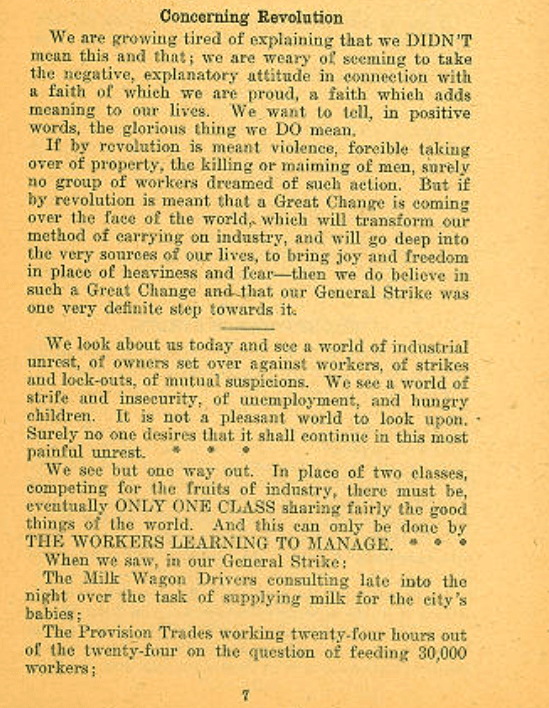
That the Central Labor Council of Seattle took proactive measures to record the history of the strike, on the workers terms, is a testament to the breadth and seriousness of the workers movement. It is a record that bourgeois historians and archivists cannot hide.
Lessons for today
In 1917 before the war ended, the shipyard workers were mad about the EFC’s wage rules but they ceded to patriotic appeals to keep working. A rigid interpretation of this would have had socialists saying after the war, “Well they fell for the patriotic propaganda, serves them right.” Instead, the radicals in the labor movement seized the moment and organized a historic general strike which continues to inspire to this day. That the strike did not achieve its objectives is of far less importance than the fact that it happened and that workers ran the city, taking care of the people’s needs peacefully, showing that we really don’t need the bosses. This is why people still celebrate and study the lessons of the Seattle General Strike of 1919.
With all the discussion and debate today about the general strike, it’s important to understand that the struggle in 1919 was sparked not simply over the bread and butter wage issue. It was understood by Seattle workers as an attack by the government and bosses on the union movement as a whole, in the context of a global class war. The role of socialists and radicals in the labor movement in Seattle enabled these deeper issues to be expressed with clarity, written into the historical record.
The so-called Great War was not coincidental to the strike but was intertwined with it. In the same way, working people today have been for all intents and purposes engaging in a general strike tactic against ICE as an expression of solidarity and in defense of democratic rights. This tactic is emerging in the context of increasing immiseration and radicalization spurred by the Palestine solidarity struggle during which millions came to see the truth about U.S. imperialism and capitalism.
What happened in Seattle in 1919 is not a recipe to be followed exactly today. What it shows is that ordinary workers can do extraordinary things. We can understand the interplay of social and historical developments and see our place as agents of history. We can run society without the parasite bosses when we organize and realize our power.
Feature image: A group of men and boys carrying groceries during the Seattle General Strike. Public Domain.