As disability advocates mark the 26th anniversary of Olmstead v. L.C. a memo from the U.S. Department of Justice Office of Legal Counsel has reignited debate over one of the nation’s most important disability rights decisions. Although the Supreme Court’s ruling remains the law, changed interpretation and enforcement of the integration mandate of the Americans with Disabilities Act could weaken protections that help disabled people receive services in their communities rather than institutions.
In the memo, the DOJ argues that “neither Section 504 of the Rehabilitation Act nor Title II of the Americans with Disabilities Act (ADA) imposed an integration mandate on states.” The opinion takes a narrower view of Olmstead v. L.C. than previous federal administrations have adopted. Disability rights organizations argue that this interpretation threaten federal enforcement of community living protections.
What was the Olmstead decision?
The Olmstead decision changed disability rights in the United States by recognizing that disabled people should not be forced into institutions when they can safely receive the support they need in their communities. Lois Curtis and Elaine Wilson challenged a system that kept them in a Georgia state psychiatric hospital even after medical professionals determined they were ready for community-based care. Their case led to a landmark Supreme Court ruling that unnecessary institutionalization is discrimination under the ADA, affirming that disabled people have the right to receive services in the most integrated setting appropriate to their needs.
Lois Curtis later reflected on what the case meant to her saying “I wanted to be free.” Elaine Wilson spoke about the impact institutionalization had on her life. “When I was in an institution, I didn’t like myself. I was trapped. I had no hope.” Their experiences showed the human cost of unnecessary institutionalization and helped the nation understand why disabled people were demanding the right to live in their communities instead of being separated from society. Their courage not only changed their own lives but also helped strengthen disability rights for millions of people across the country.
The significance of Olmstead reaches far beyond one Supreme Court case. It became a major civil rights victory that strengthened the fight for community living, independence and equal opportunity for disabled people across the country. The decision also affected decades of organizing by disabled activists who challenged segregation and demanded the right to live with dignity in their own communities. More than 26 years later, Olmstead remains a powerful reminder that progress is won through collective struggle and that every civil rights victory must continue to be defended through organization, solidarity and action.
Significance of the DOJ memo on Olmstead
The June 2026 memo from the DOJ Office of Legal Counsel has raised new concerns across the disability rights movement. While the opinion does not overturn Olmstead v. L.C., disability rights organizations argue that it challenges the long-standing interpretation of the ADA’s integration mandate and could weaken the federal government’s enforcement of community living protections. For many advocates, the memo represents more than a legal debate-it raises questions about how strongly the federal government will continue defending one of the disability rights movement’s most important civil rights victories.
For many disabled people the debate over Olmstead is not just about a legal opinion. It has real consequences for everyday life. Millions of Americans with disabilities rely on home and community based services to remain in their homes, maintain employment, attend school and stay connected to their families and communities. Disability advocates argue that changes in how Olmstead is enforced could affect the people who depend on these services every day.
The DOJ’s attack on Olmstead comes at a time when many disabled people are already facing significant barriers. Across the country, advocates continue pushing for stronger home and community-based services, accessible housing, reliable transportation, affordable healthcare and adequate personal care services. Disability rights advocates have also spoken out against attacks on Medicaid and Social Security Disability Insurance, arguing that these programs are essential for independent living. Many see these efforts as part of a broader agenda that prioritizes cuts to public services over the needs of working-class and disabled people. For them, defending Olmstead also means defending the programs and public investments that make community living possible.
It took a struggle and will take more struggle to achieve justice
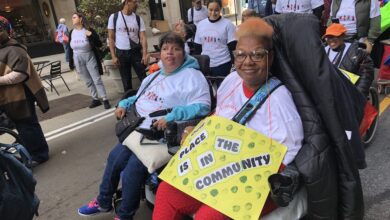
The history of Olmstead reminds us that disability rights have never advanced through court decisions or legislation alone. Every major victory- from the 504 sit-in to Americans with Disabilities Act and Olmstead was achieved because disabled people organized and challenged discrimination, demanding equal treatment. More than 25 years later advocates say that the same commitment remains essential as they work to defend community living and ensure that the promises of the ADA are fully realized for future generations.
The fight for disability rights did not end with Olmstead v. L.C and it will not be won solely by court decisions. Every right we have today was fought for by disabled people who organized protests and refused to accept being treated as second-class citizens. That same spirit is needed now. We cannot afford to stand by while disability rights are weakened. We must continue building a movement that defends community living, protects the ADA and demands the resources disabled people need to live with dignity and independence.
Now is the time to organize. Join your local disability rights organizations, stand with disabled activists, speak out in your communities and hold elected officials accountable for protecting and expanding disability rights. The future of disability rights depends on all of us. When we organize together, we have the power to defend the victories won by those who came before us and continue the fight for society where no disabled person is left behind.