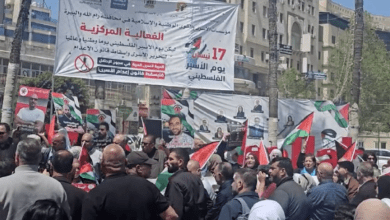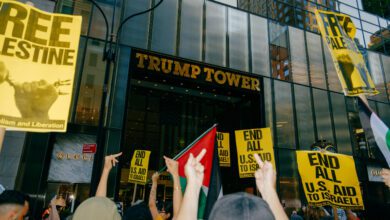
Today is Nakba Day, marking the anniversary of the genocide and ethnic cleansing that established the Israeli state. From 1948 to today, generation after generation of Palestinians have taken a stand for freedom in an unbroken legacy of resistance.
Just like in 1948, Israel is right now engaged in a terror campaign designed to drive Palestinians from their land. Since the “ceasefire” in Gaza, Israel has killed close to 1,000 Palestinians and moved to expand illegal settlements. But support for Palestine around the world is growing, including here in the United States. On Nakba Day, we commit ourselves to intensifying the struggle to end the U.S. aid to Israel that makes the oppression of Palestinians possible.
The real history of Palestine’s Nakba
When Israelis commemorate their “Independence Day”, Palestinians and their supporters around the world remember the Nakba — Arabic for “catastrophe.” The Zionist settlers from Europe claimed that Palestine was “a land without a people.” This was a racist, colonial lie — it was and is the rightful homeland of the Palestinian people.
May 15, 2026 marks the 78th year of al-Nakba inflicted upon the Palestinian people in 1948. Every year, the Nakba — of “the catastrophe” — is commemorated with struggle against Israeli apartheid. Israel and the U.S., meanwhile, celebrate this occasion as Israeli “independence” — independence that emerged out of terror, massacres, and mass expulsions.
While the corporate media intentionally complicates the origin story of Israel, the destruction of Palestinian lives and homes is an indisputable and straightforward fact.
With the defeat of the Ottoman Empire in WWI, imperialist leaders of Britain, France, and Tsarist Russia signed the Sykes-Picot agreement in secret, laying out plans for the divvying up of the Middle East to take as colonies. With its Balfour declaration in 1917, British imperialism officially became supportive of the establishment of a Zionist state. In true colonialist fashion, any and all settlement talks entirely excluded Palestinians. The process of carving up Palestine for the new Israeli state was a repulsive expression of Western colonialism and imperialism.
In November 1947, the UN voted to partition the British colony of Palestine: 55% for a Jewish state, 44% for an Arab state, and 1% for an international zone. The Palestinians were not consulted before the UN vote — taken at a time when most nations of the world had not yet won independence and could not vote. It was clear from the start that the goal of the Zionist leaders was not just to seize territory, but uproot and expel as much of the Arab population as possible out of Palestine.
Zionist leaders unleashed a Plan Dalet on March 10, 1948 — a brutal campaign of mass murder to drive Palestinians from their land. Before this plan, the ruling Jewish Agency government could not clear Palestinian villages fast enough. To complete the expulsion of Palestinians, Zionist paramilitary forces launched a systematic terror campaign and staged heinous acts of violence against “quiet” Palestinian villages.
Plan Dalet was expressed in the infamous Deir Yassin massacre in April 1948. Zionist forces wiped out Deir Yassin village on the outskirts of Jerusalem. The brutality of this massacre has become a symbol of the genocidal character of the Israeli government from its very beginning.
Palestinians haven’t stopped fighting to return to the land stolen in the Nakba. Seventy-seven years later, the right of return remains a central issue in the struggle for Palestinian liberation.
Today, the Palestinian people face a brutal genocidal assault that has destroyed the majority of infrastructure in Gaza. The last 78 years has made it clear that this fight for freedom will continue until the collapse of the Israeli apartheid system.