AI has the potential to be a useful tool for environmental monitoring – for example, drawing from extensive pools of data to model climate and environmental outcomes – but environmental harms stemming from the massive hyperscale data centers that Silicon Valley is pushing through across the country are far outweigh any benefits.
The United Nations Environment Programme issued a report in September 2024, outlining the environmental concerns related to the rise of AI: “We need to make sure the net effect of AI on the planet is positive before we deploy the technology at scale,” said Golestan (Sally) Radwan, the Chief Digital Officer of UNEP.
Those warnings were ignored by Big Tech, which has led to an explosion of new data centers across the United States and the globe. The most well known environmental impacts are the immense drain on freshwater resources and energy consumption. Hyperscale data centers can consume up to five million gallons of freshwater per day, equaling the water usage of a 10,000 to 50,000 person town. Despite this immense drain, forty percent of existing and proposed data centers in the United States are in areas already facing freshwater scarcity.
The U.S. is home to the largest concentration of data centers globally. As energy-hungry data centers expand, the already slow transition to renewable energy is screeching to a halt as the lives of fossil fuel power plants and aging nuclear reactors are being extended. This increased energy demand is requiring electricity infrastructure upgrades, rerouting of transmission lines, and rising carbon emissions, since the majority of the U.S. grid still relies on fossil fuels.
According to the IMF, current energy consumption by data centers globally equals that of the country of France, which has a population of around 69 million people. Projections show that by 2030 that consumption rate will increase to the equivalent energy use of 1.4 billion people. To meet this demand, Big Tech is pushing for the tripling of nuclear power by 2050, which would be environmentally catastrophic due to the impacts from extraction to plant construction to waste disposal, along with the risk of radiation exposure for “downwinders” and indigenous communities.
And who is footing the bill for the increased energy needs stemming from Big Tech’s data centers? It’s average rate payers who have seen a 5 to 10 percent increase in their energy bills over the last year, far surpassing overall inflation.
The drain on resources and increase in carbon emissions doesn’t begin when these data centers become operational, but long before in the resource extraction and production of the components. One 2 kg computer requires 800 kg of raw materials, plus the rare earth elements used in the microchips, which have major environmental impacts from the extraction process. Data centers also produce electronic waste that contains heavy metals and toxic chemicals that contaminate the environment. This rapid expansion of data centers will only add to the growing “e-waste tsunami” flowing from the U.S. to Global South countries with shipping containers often purposely mislabeled and illegally transported without agreement from the countries on the receiving end of this toxic waste.
Data centers are often placed in areas with low human populations without concern for the impacts on other species. Biodiversity is a key climate stabilizer, which is already in drastic decline as development and land use change increases. Light and noise pollution from data centers have negative impacts on the overall health of wildlife, disrupting migratory patterns, reproductive cycles and prey/predator dynamics.
Large data centers span millions of square feet across multiple buildings and include the installation of energy transmission lines, highly-polluting backup diesel generators and sometimes onsite power production. The immense footprint of these data centers results in added biodiversity loss from habitat fragmentation and air pollution in surrounding communities.
As Big Tech buys up land in rural areas for data centers, the cost to purchase or lease land in these areas is rising. The increasing costs to lease land is hurting small farmers who are already struggling financially, while also having to compete for freshwater resources to irrigate crops.
Is AI the problem or is it capitalism?
Compared to other AI models, China’s DeepSeek technology requires fewer computing resources, which is estimated to lower energy consumption by 90 percent, as well as greatly reducing the need for cooling mechanisms and freshwater resources, reducing its overall carbon footprint by 95 percent.
Plus, China’s main industries, such as utility providers, are state owned, which eliminates the profitmaking motive in these key industries. In China, electricity bills are one-third the cost of what we pay in the U.S. and has allowed the country to far outpace the rest of the world in the shift to renewable energy sources.
The rise of AI under capitalism will inevitably lead to job losses across many sectors. Under capitalism, the owners of business constantly look for ways to cut costs at the expense of workers’ livelihoods and the environment. We have seen mass layoffs in the past as automation was introduced into production. And we can expect the same in the near future as AI replaces taxi and truck drivers, medical staff, writers, designers, administrative and customer service staff, and the tech workers who helped train the AI models.
But the rise of AI doesn’t need to bring destitution for the working class and environmental destruction. China is using AI to reduce the length of people’s workday without imposing layoffs or pay cuts. This is what can happen under a socialist system where the wellbeing of the population is the priority, rather than the maximization of profits for the owners of industry as is the case under capitalism. The introduction of AI could mean we all work less and have more time to spend with family and friends and for recreation and educational or creative pursuits. And it could be implemented responsibly with energy efficiency and environmental sustainability as a prerequisite.
A David vs. Goliath struggle
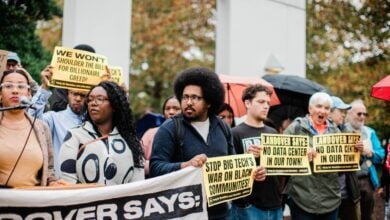
While Big Tech, with the support of the Trump administration, is ramping up data center plans across the country, communities are organizing and fighting back.
According to Data Center Watch, between April and June 2025, 20 proposals for data centers in 11 states – worth $98 billion – were blocked or delayed due to community opposition, accounting for two-thirds of the overall projects the group was tracking. Sleepy rural and suburban areas that have seen little organizing in the past, now have residents connecting over social media and coming together for door-knocking, distributing lawn signs, and flooding town hall meetings to speak out against these data centers.
Big Tech is worried despite Trump’s recent executive order, which aims to override any state level regulations or restrictions on data center construction. The top tech companies – Microsoft, Google, Meta and Amazon – are collectively spending hundreds of billions of dollars on data centers globally and investing heavily in lobbying local governments with false promises of job creation and downplaying residents’ concerns, but they are failing. With overwhelming community opposition, local elected officials clearly see they will lose their seats in the next election if they support data centers and are forced to reject rezoning proposals.
From Arizona to Wisconsin to Virginia and Oklahoma, communities across the country are hearing about and learning from each other’s struggles against Big Tech’s plans – and are winning. This is a clear example of the collective power we have when we organize. Even the seemingly most powerful corporations on the planet can be defeated when we stand together.
Feature image: OpenAI on a phone. Credit: Flickr (CC BY-NC 2.0)