Recent studies investigating the landscape of women’s healthcare across the United States are revealing a disturbing pattern: It is becoming increasingly difficult for women to secure adequate maternal care.
A confluence of factors, from the 2022 overturn of Roe v. Wade to private insurance company policies– has led to a systemic disappearance of even the most basic healthcare services for women and all pregnant patients , especially those in rural areas. This phenomenon is known as the creation of maternity deserts.
Thirty-five percent of counties in the United States are considered maternity deserts, according to a 2024 report published by March of Dimes. That means that 2.3 million women of reproductive age across 1,104 counties live where there is not a single birthing facility or obstetric clinician (March of Dimes). Over half of counties in the U.S. do not have a hospital that provides obstetric care at all.
Maternity deserts contribute to a cycle of poor health outcomes for women: fewer health choices, longer travel times, poorer health before pregnancy, increased stress, less prenatal care and even higher rates of preterm birth (March of Dimes). Researchers have noted an increase in preterm births — which increase a baby’s risk of death and disability — in areas where labor and delivery units have closed (Stateline).
This effect is compounded significantly for women of color. For example, approximately 1 in every 25 babies in the U.S. is born to women living in areas without access to care, but that number is 1 in 10 for women of American Indian/Alaskan Native descent (March of Dimes). By far the state with the highest percentage of maternity deserts is North Dakota at a staggering 73.6 percent, followed by South Dakota at 57.6 percent and Oklahoma at 51.9 percent. Nationally, 70 percent of birth centers in the United States are within just 10 states.
What is driving this increasingly unequal access to healthcare?
One of the most prominent factors is the for-profit healthcare model. Generally, hospitals lose money on obstetrics and must make up those losses with other more expensive procedures in order to stay afloat (Stateline). Insurance companies reimburse hospitals less than it actually costs to deliver a baby, making it unprofitable to operate a labor and delivery unit, despite this being one of the most vital services.
This especially intensifies the problem in rural areas. Medicaid pays for nearly half of all births in rural areas nationwide, so when Medicaid payments are slashed, hospitals and patients suffer alike (Stateline). On average, two rural labor and delivery units shut down each month in the U.S. More than 100 rural hospitals have completely stopped delivering babies since the end of 2020. Indiana has lost 12, or one-third of all its rural units (Stateline).
Rural areas also see more staffing shortages than urban areas, making it extraordinarily difficult for hospitals to maintain 24/7 on-call birthing staff, much less postpartum care, lactation support, midwifery services or maternal mental health support that exist elsewhere. Drive time also poses risks of its own. Neonatal specialists may have to travel from other hospitals after patients arrive, and some women will accept scheduled inductions or C-sections rather than risk entering natural labor and then driving an hour to the nearest clinic (Stateline). Unnecessary C-sections increase risk of potentially fatal complications.
But the problem is not just economic. The far right’s attacks on abortion rights over the past several decades have contributed greatly to the problem of maternity deserts. The landmark Dobbs v. Jackson decision of 2022, that overturned Roe v. Wade and women’s right to an abortion, initiated yet another spiral of crisis in women’s healthcare.
New data analysis finds that there have been steady reductions in applications to residency programs in states with abortion bans, reflecting a growing unease around the legal risks associated with practicing established pregnancy care guidelines since the overturning of Roe (AAMC). According to the Association of American Medical Colleges: “the continued decreased interest of U.S. MD seniors in training in states with abortion bans or restrictions may negatively affect access to care in those states; any impact will likely first affect communities who already have limited access to care (such as rural, lower socioeconomic, and marginalized racial and ethnic groups).”
Idaho, a rural state with restrictive abortion laws, lost 35 percent of its OB-GYNs between 2022 and the end of 2024. The state acquired just 20 obstetric physicians, while 114 of the 268 existing physicians stopped practicing obstetrics, left the state, closed their practices in Idaho, or retired (OPB). Across the entire US, 1 in every 25 obstetric units in the U.S. closed down in the past 2 years (March of Dimes).
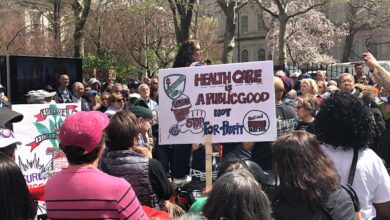
The so-called “pro-life” movement that restricts the right to abortion is actively aiding the shuttering of birthing centers and decline in health outcomes nationwide. But it is not only these far-right politicians who are to blame: those who have voted to slash Medicaid payments, eradicate hospital subsidies or generally favor a private, for-profit healthcare model shoulder some of the responsibility for the expansion of maternity deserts.
Women’s healthcare must be immediately recognized as a universal right that is in a state of crisis. Maternity deserts are a political and economic problem that, with the right investments, can be reversed just as quickly as they came to exist. There is also more than enough wealth in the United States to equip every family with the proper, modern services that people deserve, like midwifery, family planning, maternal disease detection, maternal mental health clinics along with paid parental leave and more. Healthcare is a universal right regardless of gender, race, income, or location. With enough political pressure, a well-funded women’s healthcare system can become a reality in this country.
Feature image by Griffith E. Harris Insurance. CC BY-NC 4.0.