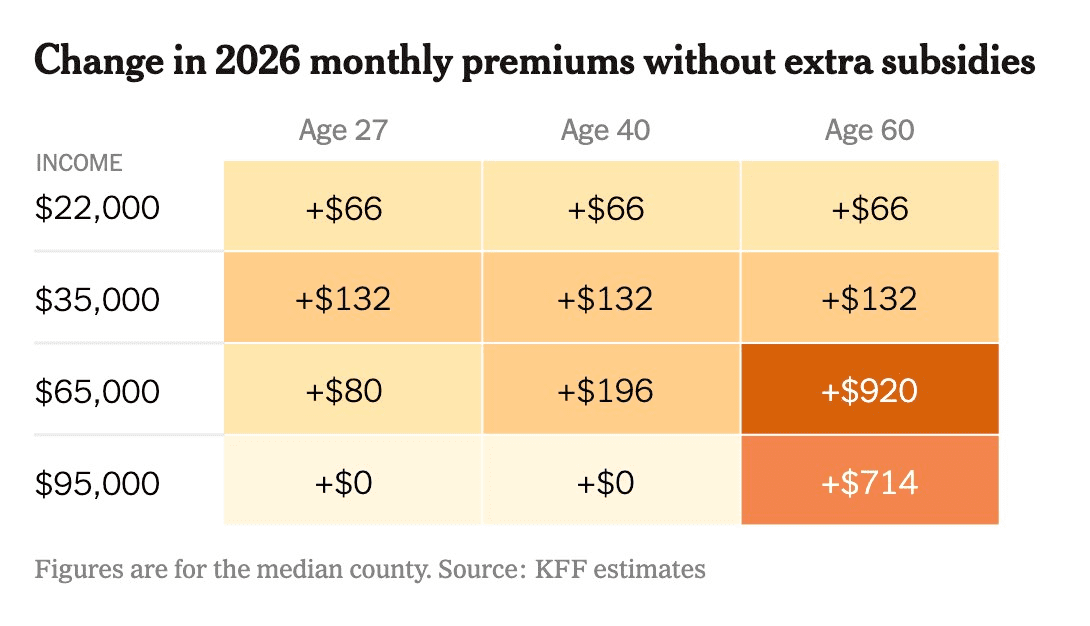
At the end of December, monthly healthcare costs for 24 million people will drastically increase if the federal government allows Affordable Care Act subsidies to expire — and it is expected to do so. If the enhanced subsidies are not extended, approximately 20 million ACA enrollees face potential premium increases averaging over 100%, with nearly 4 million potentially losing coverage altogether. This is happening while healthcare is already the biggest cause of household debt in the U.S.!
The question of healthcare was at the center of the government shutdown, which began on Oct. 1 and lasted 43 days. The Democrats’ vote to stop the implementation of Trump’s budget and shut down the government may have appeared at first to be a bold stand against healthcare cuts, but it was only a performative act.
When the government shuts down, it’s the people who suffer. The shutdown created immense hardship for the 1.2 million federal workers who went without a paycheck for six weeks. It also led to delays in SNAP (food stamp) benefits for more than 42 million people. Meanwhile, the politicians who created the crisis continued to receive their paychecks and healthcare benefits throughout the entire ordeal.
The Democrats did little to explain to the population what was at stake in this battle. Rather than rallying people across the country to take action in defense of healthcare, they chose a passive tactic that led to massive suffering — only to give in without winning their demands.
Entering 2026, attention will shift towards the midterm Congressional elections. As the New York Times wrote, the Democrats are hoping their “big shutdown loss turns out to be a win.” In other words, they are banking on the Republicans’ attacks on healthcare and their cuts to many other programs that meet basic needs causing so much devastation that there is a “blue wave” (Democratic Party sweep) in the midterms.
But would that blue wave actually result in meaningful quality of life improvements for the majority of people in this country? History tells us no. A major reason healthcare is currently on the chopping block for millions of people is because in 2009 the Democrats opted not to adopt a universal healthcare plan despite controlling both Congress and the White House.
Hoping for a blue wave is not a win strategy for those of us who desire a society where people’s basic needs and democratic rights are prioritized, as the Democrats are have shown that they don’t fight for people’s rights. But it is not enough to just condemn the two-party capitalist system. We need to build support for a different political horizon: a socialist horizon.
The November victory of social democrat Zohran Mamdani in the New York City mayoral election is one of many recent indications that people are hungry for change, and that socialism can no longer be cast aside as a fringe current. The time is ripe for us to talk with people in our lives about why socialism is the solution to our society’s deepest crises, and to invite them to join the growing socialist movement.
Here’s how socialism would make universal healthcare a reality
The cruel reality of capitalism is that it has turned the basic human right to healthcare access into a very profitable business. While U.S. life expectancy falls, health insurance and pharmaceutical corporations continue to generate massive profits at the expense of the many.
The fundamental issue with U.S. healthcare is that it’s generally organized as a market. In some cases, the U.S. recognizes health care as a social good and governmental responsibility. But overall, it’s treated as something to be purchased from corporations that stand to profit.
Under a socialist government, the for-profit healthcare model would immediately be disbanded. A socialist healthcare system will be more efficient and less costly than even single-payer systems under capitalism.
Instead of wasting tax dollars on subsidizing corporations a socialist government would replace the unfair and inefficient combination of expensive private insurance and uneven government programs with a single People’s Health Administration. Healthcare would be preventative and confront the root causes of illness and disease, and not simply be reactive.
Private insurance companies would be dissolved — along with their billing and copays. The pharmaceutical industry would be turned into public property, and its vast resources would be wielded to meet people’s needs, not to fund billionaires. Healthcare and medicines would be free!
Pharmacists, scientists, clinicians and public-health workers would work with communities to assess the use of and need for various medications based on local data and develop a plan for producing them.
A society has the responsibility to make the health of all people a priority. In the U.S., we have the resources, knowledge and skills to fulfill this responsibility right now. Socialism will enable us to redirect our resources towards people’s health and well-being, not profits!