The following interview was conducted by the news outlet Madaar with PSL founding member and Central Committee member Brian Becker following Zohran Mamdani’s victory in the New York City mayoral election. Read the PSL’s official statement on Mamdani’s win here.
1. Zohran Mamdani’s success has been met with significant celebration in the Arab region. This is largely attributed to his past pro-Palestinian positions, including his pledge to arrest Benjamin Netanyahu should he set foot in New York. From your position as key actors in the local political scene, and as a fundamental part of the mass mobilization against the genocide Israel is committing against Palestinians, what does Mamdani’s victory actually signify for American politics? And from your perspective, what does it mean for the Palestinian cause?
The electoral victory of Zohran Mamdani is an indicator of several important new features in US politics. One of the most noteworthy is the sea change in consciousness– meaning a complete reversal of public opinion– regarding Palestine and the cause of the Palestinian people. This change in consciousness exists on the mass level. Mamdani was viciously attacked during the campaign by the capitalist media, the Zionist media, and both the Republican and Democratic party establishments for his support for the Palestinian people and his opposition to the genocide in Gaza. In an earlier era, this would have definitely destroyed his campaign. Support for Israel ran strong in the United States but especially inside New York City, which has a very large Jewish community and has been the focus of political lobbying and influence by major Zionist organizations. In 2025 however, the hysteria that the pro-Israeli lobby tried to generate against Mamdani completely backfired. If anything, his support for the Palestinian people gained him additional support. Again, this is an indication of a change of consciousness within the mass of the population. This change came about for two reasons; One, is that people could watch a genocide unfold in real time because of the internet and access to smart phone technology. In short, because of social media. And the second reason is that the US anti-war movement partnering with Palestinian-American organizations succeeded in launching a massive movement that changed the political discourse in all areas of political, social, civil, and academic life.
During the campaign, the media hyper-focused on Mamdani’s use of certain slogans in the past, such as “Globalize the Intifada.” The media was basically trying to trap him in words. Instead of interpreting “Globalize the Intifada” as a righteous call for self-determination and an end to apartheid, the US media tried to frame the slogan as something profoundly antisemitic or anti-Jewish. They insisted that Mamdani renounce the slogan. Instead, he said in media appearances “it’s not the language I would use.” But he didn’t come out and outright denounce the slogan. He danced around it instead. Again, the most important point here is that Mamdani’s victory, coming as it did in the middle of a two-year long genocide, is interpreted by us as something that demonstrates the vast growth of solidarity with the people of Palestine.
2. Your statement noted that “a socialist atop a capitalist municipal government can’t change the capitalist character of the state — especially the racist, abusive NYPD.” However, it has been reported that Mamdani has offered to keep Jessica Tisch—a billionaire heiress—as Police Commissioner. How do you explain this move, which appears to be a massive strategic concession to the capitalist state’s repressive apparatus before the fight has even begun? Does this not represent the very danger of “co-optation” and “absorption” into the logic of the state that you warned about, transforming the objective from confronting the police apparatus to merely “managing” it more effectively?
Mamdani’s announced plan to retain Police Commissioner Jessica Tisch is clearly a concession. In reality it doesn’t matter who the police commissioner is. The New York City Police Department is larger than most countries’ armies. There are 43,000 uniformed police officers in the city. The NYPD is one of the most brutal police departments in the country. Regardless of who the police commissioner is, the NYPD acts as an occupation army inside Black and Latino communities and treats political protesters as enemy combatants rather than ‘citizens exercising their right to free speech.’ Mamdani’s announcement that he will keep Jessica Tisch was a signal to the police and to the capitalist class that he has no serious intention to interfere with the everyday business of the NYPD. What Mamdani is trying to communicate is that he intends to have a liberal administration, expanding economic and social programs for poor people and low-income, working-class New Yorkers, but without interfering in the class structures and hierarchies that make New York the center of US capitalism. His economic program and proposals are similar to those that were enacted by the presidency of Franklin D. Roosevelt in the 1930s during the Great Depression. Mamdani’s political transition team between now and when he takes office in January appears to be made up of long-standing Democratic Party operatives. They may be somewhat younger in age and may be somewhat liberal, but they are Democratic Party insiders, or that’s what it seems to us. The Democratic Socialists of America are supporting Mamdani, but they do not appear to be the entity that will be directing the new administration.
3. You warn that Mamdani is orienting towards being a “team player” within the capital-dominated Democratic Party. We have seen a retreat on his principled positions on Palestine, and he has previously described the leaders of Cuba and Venezuela as “dictators.” To what extent can this electoral tactic be considered successful if its cost is the abandonment of internationalist stances and fundamental anti-imperialist principles? And how can an independent movement be built to defend his social program when its most prominent symbol is making ideological compromises to align with the prevailing consensus inside what is often called the “graveyard of social movements”?
Mamdani succeeded and won the mayoral race because he ran as a Democrat. He did not run on the ticket of the Democratic Socialists of America. DSA is not a political party. They are an organization whose members normally run for office within the Democratic Party. The reason for this is quite clear. The way US electoral law is written and enforced makes it virtually impossible to win any election unless one runs as a Democrat or as a Republican. The US does not have a parliamentary system. As a consequence, there is no socialist party that has members in the US Congress. The Democratic Party is an imperialist party. The Republican Party is also an imperialist party. They are both ruling class parties. Both parties have made the overthrow of the Cuban Revolution and the Bolivarian socialist project in Venezuela as a core principle in their foreign policy. Mamdani could not have won and could not really hold office if he was an outspoken opponent of core Democratic Party policies. He did not embrace the Democratic Party’s commitment to regime change in Cuba and Venezuela and probably he does not support it as an individual. But in his appearance before the mass media in the US, the media demanded that he separate himself from Cuba and Venezuela. Sadly, but not unpredictably, he decided to use language that Cuba and Venezuela represented dictatorial forms of government.
We do not expect Mamdani to take an anti-imperialist position on either Cuba or Venezuela, or on other issues. With that said, we also believe that the Cuban government and the Venezuelan government would prefer to have US politicians in office who are closer to the political outlook of Zohran Mamdani than to Andrew Cuomo. In the US Congress, historically, even the members of congress who were friends of Cuba, and who introduced legislation to end the US blockade of Cuba, would include language in the resolutions that would condemn Cuba as a dictatorship. It is a measure of how much freedom there is, or rather the lack of freedom inside the US political system, that even friends of Cuban self-determination, had to include gratuitous US language that described it as a dictatorship.
4. Your statement rightly emphasizes the need for a “permanently mobilized mass movement” outside of City Hall. But in practice, when the Mamdani administration inevitably collides with fierce opposition from capital, won’t the temptation be for the new mayor to mobilize this mass movement simply to defend his administration and push through his reforms, rather than building an independent, working-class power that challenges the very structures of the state? From your position, how will you work to prevent this immense grassroots energy from being transformed into a mere pressure tool for a reformist mayor, ensuring instead that it continues to develop as an independent force with the ultimate goal of overcoming the state, not just mending it?
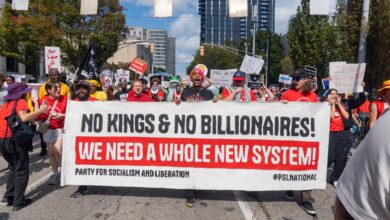
It is premature to assume that Big Capital will collide with the Mamdani administration. That may happen, but the titans of capital may feel that they can ‘do business’ with a Mamdani administration. They may also conclude that having some economic reforms, which right now they oppose, might be better to embrace rather than to experience a major social collision that takes place in the streets. In the 1960s, big sections of the ruling class decided that it was better to offer concessions to the masses of people rather than to risk popular insurrections, which were taking place in cities throughout the United States between 1964 and 1970. Trump and Project 2025 have declared war against those social and economic reforms that were granted during that time period. In the history of the United States, the ruling class has always pushed against any significant social or economic reform, but when confronted by mass movements, they have learned to accommodate themselves to these reforms. That was how the 8-hour workday was won, job safety provisions, social security for the elderly, unemployment insurance for the unemployed. The point of our statement was to emphasize that the key to social change in the United States, including inside New York city, would be the mobilization of masses of people who desperately need economic and social relief. The demands of this movement should be on all governmental structures. Demands on the federal government, state government, and the local New York City government with Mamdani as the mayor. We believe that Mamdani would even welcome such pressure because he knows very well that any initiative to carry out meaningful reforms from City Hall would be impossible without masses of people there making demands on him. We also want to emphasize that it’s premature to be overly predictive on how exactly this will play out.
6. Mamdani won his victory with a “democratic socialist” platform focused on the cost of living and evoking liberal “New Deal” policies, which your statement identified as a step forward from neoliberalism. However, the greatest challenge is the transition from immediate economic demands (bread, housing) to a higher political consciousness. What specific role will your party play in elevating the movement’s demands from merely “making capitalism tolerable” to understanding the necessity of overcoming it? What concrete mechanisms will you use to connect the struggles of sanitation workers, nurses, and bus drivers in New York to the broader struggle against imperialism and the rule of capital, ensuring the movement does not remain confined to the reformist horizon set by Mamdani’s campaign?
The ruling class, as we said, may seek to turn the Mamdani experiment into a managed failure to prove that socialism doesn’t work. There is another possibility that the ruling class will turn the Mamdani experiment into a managed success to show that the capitalist ruling class has some capacity for change, some flexibility, and some ability to adapt. So without being overly predictive, we think it’s important for the Marxist left in the United States and internationally to properly frame the question. Neither the ruling class nor Mamdani expected that Mamdani would become the mayor of New York even six months ago, or certainly even a year ago. It was an unexpected development. The main causes of the surprise victory of Mamdani was extreme disenchantment among young people in the US with the current status quo, the assault by the Trump administration on democratic rights in the US, the failure of the Democratic Party establishment to effectively combat Trump’s assault on democratic rights, the Democratic Party establishment’s attachment to the Israeli genocidal project in Gaza, and to the effectiveness of Mamdani as a politician and the effectiveness of his electoral campaign’s outreach efforts. Very famously, Frederik Engels wrote in 1884: “Universal suffrage is thus the gauge of the maturity of the working class. It cannot and never will be anything more in the modern state.” Engels’ point is very important to remember in the framing of this question. Earlier, Marx and Engels had believed that the working class, at least in some countries, could take society on the path towards socialism through the medium of universal suffrage. By gaining control of the Parliament, after having won the right to vote, the working class could legislate socialism in. But both Marx and Engels, following the Paris Commune of 1871, came to the conclusion that in order for socialism to succeed, it was necessary to “smash” the existing state rather than to mold it for socialist purposes. Thus, Engels’ comments that the elections under the conditions of universal suffrage are at best a gauge or a barometer of political maturity. Mamdani’s election is such a gauge. It is an expression of a changed political consciousness that has come into maturity during the very tempestuous events of the past two years. It is still a consciousness that is at a relatively low level. Marxism and socialism are just starting to make a comeback in the US, but we are still taking baby steps. We do not necessarily see Mamdani’s election, or a Mamdani city hall as the vehicle for change, but rather as a gauge of a new consciousness that is in formation in the United States.
Finally, and as a matter of tactics, we in the PSL do not want to jump ahead of the process. We do not want to be overly predictive. Nor do we want to stand on the sidelines, with arms folded, criticizing Mamdani’s obvious weaknesses while hundreds of thousands of young people are enthusiastically joining the movement for his election. Rather, we want to be participants. We want to have a shared experience with the masses of young people. We want to show that we hope for Mamdani’s success while recognizing the tight vice that he operates in now that he has become the chief executive of a municipal government that is the center of world capitalism and home to the most powerful ruling class in the world.