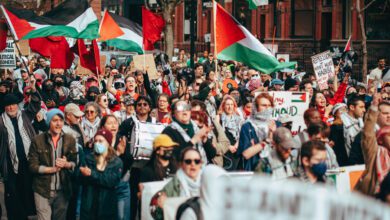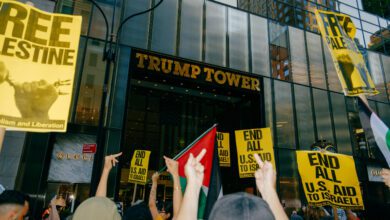
Photo: Sept. 26 Palestine solidarity protest outside the United Nations headquarters in New York
On September 26, Israeli Prime Minister Benjamin Netanyahu took the podium at the United Nations. The hall quickly emptied as delegates from dozens of countries headed to the exit, refusing to legitimize an address given by an internationally-wanted war criminal. Outside thousands protested in opposition to the ongoing genocide against the people of Gaza.
In the lead up to the 80th session of the UN General Assembly and during its proceedings, the question of Palestinian statehood and efforts to end the U.S.-Israeli genocide in Gaza emerged as a primary focus of world leaders. In the weeks leading up to this annual convening, 10 countries recognized a sovereign state of Palestine – many of them longtime U.S. allies. These foreign policy shifts are the culmination of a major sea change in the attitudes of those living in Western countries and the emergence of mass people’s movements to stop the genocide in Gaza, which is now reaching its two-year mark.
International recognition of Palestinian statehood
On September 21, Britain, Australia, Canada and Portugal confirmed recognition of Palestinian statehood. The next day, France, Belgium, Luxembourg, Andorra, San Marino, Monaco, and Malta all announced recognition of the State of Palestine. President of France Emmanuel Macron, in his speech before the UNGA on Monday, stated “nothing justifies continuing the war in Gaza any longer.” UK Prime Minister Keir Starmer stated that “the Israeli government’s relentless and increasing bombardment of Gaza, the [ground] offensive [into Gaza City] of recent weeks, the starvation, and devastation, are utterly intolerable.”
France and Britain continue to provide substantial economic, military and political support to Israel, and have been among the main international backers of Israel’s colonial project historically. Why then, would their leaders feel compelled to make these moves on the world stage?
It is a testament to the strength of the international movement for a free Palestine. Millions and millions of people have demonstrated worldwide since Israel’s genocide in Gaza began. Israel has been taken to court for the crime of genocide, and an international arrest warrant has been issued for the war criminal Benjamin Netanyahu. Even in countries where the political establishment is solidly pro-Israel, including the United States, public opinion has decisively shifted in favor of Palestine. A policy of unconditional support for the Israeli regime had simply become untenable.
In an apparent attempt to appease the United States and Israel, many of these states conditioned their recognition on the demand that all remaining Israelis held in Gaza be immediately released, that Palestine be “demilitarized” and that resistance forces not play a role in the governing of a future Palestinian state. Despite the outpouring of support for Palestine at the General Assembly, no Palestinians are in attendance because the Trump administration refused to grant visas.
This wave of official international recognition comes as the suffering imposed on Palestinians by Israel – with financial and military backing by the U.S. government – reaches new heights. The Ministry of Health in Gaza has reported that approximately 65,000 Palestinians have been killed in Gaza and nearly 1,000 have been killed in the West Bank. On August 22, the world’s leading authority on food insecurity confirmed that the conditions in Gaza constitute famine, the most severe classification of food insecurity. There are restrictions on the entry of medication, medical supplies and critical fuel. Ongoing attacks have damaged or destroyed 94 percent of hospitals in the territory. “The scale of death and destruction are beyond any other conflict in my years,” said UN Secretary-General António Guterres in his opening address of the General Assembly on Tuesday, who went on to say “nothing can justify the collective punishment of the Palestinian people and the systematic destruction of Gaza.”
It is important to note147 of the 193 UN member states have already recognized Palestinian statehood. In 1988, Palestinian poet Mahmoud Darwish drafted the Palestinian Declaration of Independence, which formally established the State of Palestine. In the few years after, 88 countries recognized the State of Palestine, out of only 155 members of the U.N. at the time, representing over half of the international community. After extending recognition in 2009, Venezuelan President Hugo Chávez circulated a letter to the General Assembly, stating that, recognition of Palestinian sovereignty “is an act of historic justice towards a people that has always carried within it all the pain and suffering of the world,” making clear that “it is one thing to reject anti-Semitism and an entirely different thing to passively accept that Zionist barbarity enforces an apartheid regime against the Palestinian people.”
The UN and Palestine
Supporters of Palestine have long pointed out the ineffectiveness of the United Nations in the face of constant violations of international law by the Israeli regime. At the same time, recognition of sovereign statehood and membership in the UN provides a diplomatic platform to advance the struggles, the facilitation of bilateral negotiations with other states and greater access to shared resources.
The United Nations has long been a contested site of struggle. In the wake of World War II, the overextension of many colonial European powers provided opportunities for formerly colonized countries to gain independence through long and heroic struggles for national liberation. To grow and develop their countries recovering from war and resource extraction, these newly liberated states demanded membership into the United Nations and wasted no time in championing their demands on the world stage. Formerly colonized countries, many from the Non-Aligned Movement, fought to mold the United Nations into a more democratic forum through declarations like Resolution 1514, the Declaration on the Granting of Independence to Colonial Countries and Peoples, which was adopted in 1960 and guarantees the right to self-determination for all peoples.
Palestinians, in line with the tradition of these movements, continue to raise their struggle for liberation in the arena of international diplomacy. After the State of Palestine was declared in 1988, the United States consistently thwarted their efforts at any access to multilateral organizations or agreements, including at one point threatening to withdraw funding from the World Health Organization if the body admitted Palestine as a member. Palestine’s application for full membership to the UN was stalled for 13 years due to fear of veto by the United States. Despite this, 138 countries voted in favor of Palestine gaining non-member permanent observer status, compared to 9 countries who voted against. This non-voting status allows the Palestinian delegation to participate in UN proceedings and maintain a mission to the UN in New York City.
Recognition of Palestinian statehood does not in and of itself indicate a shift towards a pro-Palestine foreign policy in any of these countries. Many of these countries calling for an end to the war continue to repress and punish their own people who have been protesting and campaigning for the very same calls for peace. However, after two years of genocidal war, these moves by Western countries do speak to the endurance and resilience of the people’s movements within them.
The world stands with the Palestinian people in their just struggle to return to the land stolen by the Israeli colonizers. As the thousands who marched to the UN on the day of Netanyahu’s speech showed, this includes the people of the United States, who overwhelmingly oppose their government’s policy of complicity with and participation in the genocide.