Last month, Trump’s executive order intensifying English language requirements for truck drivers went into effect. The process for how truckers will now have to prove their proficiency in English is unclear and nonstandardized, leaving the interpretation of these new requirements up to the individuals who assess the drivers. Some truckers who have hauled freight for decades will be subjected to these tests, and may be put out of service because they have a more pronounced accent, or are not “fluent enough” in the subjective opinion of the individual inspecting their language skills.
Trump’s language requirements have nothing to do with safety
English language requirements for truckers are not new. The Interstate Commerce Commission introduced core regulations in 1936 and 1937; and in 1970 English language proficiency requirements were refocused towards reading and writing. Towards the end of Obama’s second term, the Federal Motor Carrier Safety Administration once again refined the language requirements, with safety-critical communication taking precedence over conversational fluency.
In order for a truck driver to obtain a commercial driver’s license they must pass a written test in English, be able to name the parts of a truck and show they know how to check tire pressure, coolant and so on. The U.S. Department of Transportation requires truckers to pass background checks, get fingerprinted and provide driver and motor vehicle records, among other things.
In July 2007, the FMCSA released a study outlining the major causes of large truck crashes. The top 10 factors contributing to crashes include driver fatigue, traffic flow interruptions, brake problems and traveling too fast. Conspicuously absent from the list is anything at all to do with a driver’s proficiency in the English language.
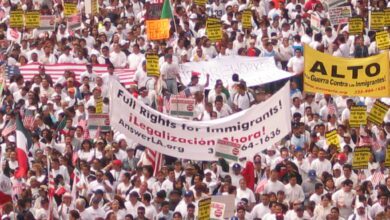
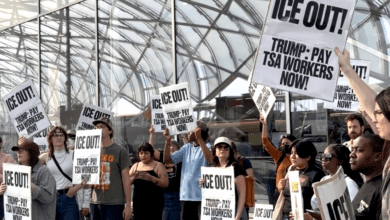
Despite such regulations already in place, the Trump administration is pushing a step further in what is clearly yet another attack by the administration on immigrant workers. With no discernible evidence linking truckers’ levels of English language verbal proficiency to risk of calamity, the new requirements are but another means of harassing immigrant workers and assaulting their livelihoods.
Trump’s billionaire con game: Divide and conquer
Billy Randel, co-founder of Truckers Movement for Justice, says Trump’s executive order is all about dividing and conquering workers.
“I’ll tell you for a fact that my membership – especially in west Texas – most of them have been driving for decades,” Randel said of Spanish-speaking truckers with whom he has worked over the years. “They know where they’re going. They’ve managed to communicate quite nicely with DOT and so forth.”
Randel, a Bronx native who organized factory workers as a teenager and now has over 30 years of experience as a truck driver under his belt, isn’t afraid to call it like he sees it.
“Why are they being punished because a bunch of racist white people and right-wing shills are trying to provoke something?” Randel asks. “It’s really dangerous. That’s where this is coming from, it ain’t coming from nowhere else.”
Workers in the trucking industry are largely unorganized and compete for jobs, sometimes undercutting one another in order to obtain work and provide for themselves and their families. Contrary to what Randel calls “industry propaganda” about the supposed shortage of truck drivers, there is in fact an overabundance of truckers and not enough work to go around.
“Capitalism requires an oversupply of workers, underemployed or unemployed, in order to drive down the working conditions,” Randel says. In the trucking industry as in others, workers compete for jobs and thus for sustenance. Without organization and solidarity, xenophobic rhetoric from Trump and elsewhere often finds a home in the anxiety workers feel in their material lives.
“To be perfectly honest and blunt with you, Randel says, “the right-wing is manipulating the fears of the white working class.”
The real dangers on the road
If the Trump administration is so concerned about safety in the trucking industry, it is odd that, for all the bellowing about English language proficiency, one hears nary a peep about the dangers posed by automated trucks, most recently seen in Texas. According to Randel, driverless trucks have been in operation in the Port of L.A. Long Beach for years, and have even been used on I-95 out of Norfolk, Virginia.
Randel spoke to these dangers, as so-called self-driving vehicles require what is known as “remote supervision.”
“Some kid is going to be sitting at a computer running 20 trucks. You don’t think they’re going to get tired?” Randel asks. “I’ve watched people focus on a computer for 4, 5, 6 hours straight, and they’re about as punchy as if they drank a gallon of moonshine from the West Virginia hills, staring at that computer. You don’t think they’re going to fall asleep?”
There is at least one group of people who Randel says are extremely happy about truck automation: lawyers. “They’re probably salivating at the thought of all the robo-truck accidents that there are going to be.”
“We’re not organized; that’s the big problem.”
Trucking isn’t what it used to be. Back when the Teamsters under Jimmy Hoffa negotiated the National Master Freight Agreement covering 400,000-500,000 workers, even non-union shops had to pay truckers close to union wages with benefits. Since deregulation, it has been a free-for-all. “It’s the wild west,” Randel says. “You go to certain segments of the industry, you’re talking about cowboy capitalism here. And drivers ain’t making any money.”
Trump’s attacks on immigrants, such as the new English language requirements, are part of a larger strategy to cast workers deeper into the battling pit where they compete for fewer and fewer scraps. For Randel and Truckers Movement for Justice, the only way to fight back is through organizing and building worker solidarity.
“Whether it’s robo-trucks, or the non-English speaking people, it’s bulls—,” Randel says. “It’s a divide and conquer issue. We’re not organized; that’s the big problem.”