In Chicago, the electrical utility company ComEd announced that households would be paying more than $10 more on average for electricity per month this summer, a rise of 10%. In downstate Illinois, serviced by utility company Ameren, prices are rising even more. Households there can expect their electric bills to rise by roughly 20%, which for the average residential customer is around $40 a month.
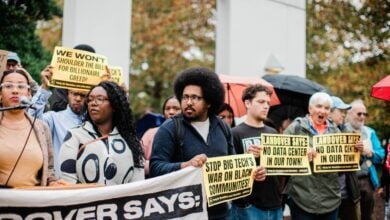
This dramatic rise in the price of electricity is primarily caused by the rapid growth of AI data centers in the region. Chicagoland is one of the top markets for data centers in the country. Data centers consume huge amounts of electricity, and are creating unprecedented demand in electricity markets. These data centers are generating massive profits for some, but leave workers with more bills and devastate the environment.
‘Deregulated’ energy
Electricity rates in Illinois, like much of the United States, are not rationally set according to the needs of people or industry. Instead, the country is broken up into multiple electrical power markets. In some markets, prices are determined by auctions where utility companies, like ComEd and Ameren, bid to buy power from electricity generators — corporations like Constellation and Vistra. The cost set at these auctions determines what households eventually pay. This system has its origins in neoliberal reforms introduced in the 1990s, and was sold as a way to harness the free market to decrease prices. In reality, it has enabled energy companies to make massive profits.
Last year, an auction on these markets saw a massive increase in the price of electricity, with prices jumping 830%. On the day of the auction, the stock of Constellation rose 11% and the Vistra stock price jumped 14.5%.
The regional transmission organization that oversees the energy market that includes Chicago and much of the eastern United States is PJM Interconnection. The independent monitor of PJM attributed the spike in electricity prices to new data centers, stating that “data center load growth is the primary reason for recent and expected capacity market conditions, including total forecast load growth, the tight supply and demand balance, and high prices.” The report says that data center energy use by itself added $9.3 billion in costs to the record breaking energy auction of 2024. These costs are causing the increased bills for regular households.
Governor JB Pritzker, a champion of data center construction, pushed back on PJM for allowing these massive price increases to occur at auctions. Last month, the New York Times highlighted discontent with PJM from several state governors. The decentralized, profit-driven U.S. energy system never delivered on its promise of lower prices for consumers, and now it seems unable to cope with the rapid growth of AI data centers.
AI fuels more energy use
The growth in data centers is a nationwide phenomenon. Liberation News has previously reported on how the rapid development and deployment of AI, in the form of large language models, is currently a key priority of the U.S. capitalist class. For U.S. capitalists, AI is seen as a way to reassert their global power and cut back on labor costs, but for working people, it means potential job losses and environmental destruction.
The AI industry requires large amounts of physical infrastructure to run its models. While services like OpenAI’s ChatGPT, Google’s Gemini and Meta’s Llama may be accessible on an individual’s phone or computer, they are actually being run on specialized hardware in dedicated data centers. The massive rollout of AI, alongside crypto and cloud data, has fueled a doubling in the number of data centers from 2021 to 2024. In Illinois, data centers already take up more than 5% of the state’s total electricity consumption. This number will keep rising as new data centers are constructed.
The increased need for electricity is leading to the delay of closures for electrical plants which rely on fossil fuels, which will make hitting emission targets to mitigate climate change even harder. Former Google CEO Eric Schmidt has even advocated for abandoning climate emission goals in order to power more AI data centers, because he claims AI will solve the climate crisis.
Giant tech companies who run data centers seem to be cutting out the middleman of the energy markets entirely and signing deals directly with generators, with the deals often involving nuclear power plants. Three Mile Island in Pennsylvania, site of an infamous nuclear disaster in 1979, is being brought back online after Constellation Energy signed a deal with Microsoft to power their data centers. In Illinois, Meta has signed a similar agreement with Constellation Energy to keep the nuclear power plant in Clinton in operation.
Chicagoland
Chicagoland is one of the biggest data center markets in the United States for multiple reasons. Lake Michigan can provide water to data centers close to Chicago, and the area is at the center of U.S. transportation and communication infrastructure. As noted above, technology firms are increasingly looking towards nuclear power to power their data centers. Illinois has the highest percentage of nuclear generated energy of any state in the United States, with more than half the state’s power coming from nuclear plants. Finally, Illinois political leaders have courted data center construction, passing tax breaks for their construction in 2019. Chicagoland will likely be on the frontline of struggles around AI data centers in the years to come.
The rising cost of electricity in Illinois and around the country is because capitalists and government officials are prioritizing the implementation of AI and the rapid building of data centers over the needs of working people. The rise in electricity prices is not the result of some natural phenomenon, but because of decades of policies meant to tct profits and reaffirm free-market beliefs.
The potential benefits of AI do not have to come at the cost of the average person’s standard of living and the environment. A socialist system could distribute electricity in a centralized and planned manner without the need for profit. Instead of a competition to quickly construct data centers, facilities could be constructed in a sustainable manner that protects surrounding communities and the environment.
Feature photo: Meta has signed a 20-year deal with Constellation Energy to secure nuclear power from the Clinton, Illinois, power plant (pictured) for its growing AI data center needs. Photo credit: Exelon Nuclear (CC BY-NC-ND 2.0)