The UK is witnessing a major crackdown on the Palestine solidarity movement. As one recent report has put it, the UK has been deploying “an alarming package of state-supported measures designed to impose social control on protests on a scale reminiscent of the ‘War on Terror’ two decades ago.” As in the United States and many EU countries, these efforts to criminalize solidarity with Palestine in as many ways as possible are clearly meant to demoralize one of the most massive social movements in recent memory.
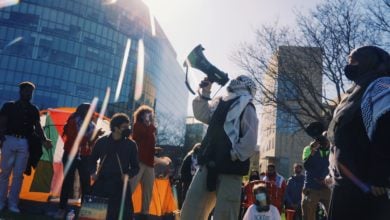
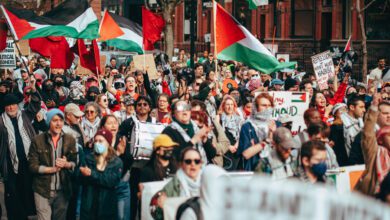
Indeed, since Israel’s genocidal assault on Gaza began in October 2023, millions have taken to the streets across the UK in defiance of a political establishment that remains committed to unconditional support of Israel. Protesters have organized massive marches, protested at weapons factories, staged campus occupations, and disrupted business as usual for the institutions complicit in the ongoing devastation of Palestine.
Far from responding with openness to this popular movement, the UK has escalated its attacks on the movement. Protesters are being arrested, charged, surveilled, and harassed with increasing frequency. While the mainstream media works overtime to paint solidarity with Palestine as divisive or extreme, the reality is that support for Palestinian liberation is widespread and growing—especially among young people, workers, and those disillusioned with the failures of the mainstream political parties.
Activists accused of “terrorism” for protesting a genocide
Among the most high-profile cases is the case of the Filton 18, a group of Palestine Action activists arrested for alleged involvement in direct action against Elbit Systems, Israel’s largest arms manufacturer. In August of 2024, six of these activists were arrested after driving a van into an Elbit research facility in Filton, Bristol, where they proceeded to dismantle and damage weapons and equipment intended for shipment to Israel for use against the people of Gaza. The remaining twelve defendants were later rounded up by counter-terrorism police in a series of raids that involved damage to activists’ homes and at least one instance of arrest at gunpoint.
The British state has responded to the action with charges so severe that even United Nations human rights experts have intervened, warning that activists’ rights to freedom of expression and peaceful assembly may be under threat. Remarking on the initial terrorism charges that were used to arrest the activists and detain them beyond the standard legal timeframe, the UN officials’ report notes that the Filton 18 “have been arrested under counter-terrorism legislation for conduct that appears to be in the nature of ordinary criminal offences and does not appear to be genuinely ‘terrorist’ according to international standards.”
Meanwhile, the SOAS 2, university students arrested for speaking out in support of Palestinian resistance, now face serious legal consequences for what amounts to a peaceful expression of political opposition. Both students are currently being tried under Section 12 of the UK’s Terrorism Act, which carries a possible 14-year prison sentence.
In another key case, nearly a dozen activists affiliated with the Palestine Solidarity Committee and the Stop the War Coalition have faced police harassment in connection to a January 18th march in London. At this march, a group of protestors walked across Trafalgar Square in London towards the offices of the BBC, with the intention of placing down memorial flowers in commemoration of the tens of thousands of Palestinians killed since October 2023. The Metropolitan Police later responded by issuing summons to a number of movement leaders, including MPs Jeremy Corbyn and John McDonnell, as well as 87-year-old Holocaust survivor Stephen Kapos.
The movement grows despite repression
But the repression tells its own story. If the state is panicking, it’s because the movement is making historic gains by transforming public opinion.
Since October 2023, the UK has witnessed some of the largest and most sustained protest activity in a generation. Cities across the UK have seen mass mobilizations week after week, and non-violent civil disobedience continues to disrupt business as usual for the arms industry and other institutions of the war machine. Far from being isolated or fringe, the movement reflects deep and growing public outrage toward the UK’s complicity in Israeli war crimes.
Importantly, some activists have already won legal victories. In April, five Palestine Action members were acquitted after shutting down Elbit Systems’ site in Kent. In December of last year, two other Palestine Action members were unanimously acquitted by a jury after arguing that their rooftop occupation of an Elbit drone facility was motivated by an urgent moral necessity.
Each acquittal exposes the contradictions of the state’s narrative. If these actions are “extremist,” why are juries refusing to convict? If Palestine solidarity is a fringe, extremist position, why does it continue to grow despite mass arrests? The answer is that this repression is not a response to violence or disruption—it is a response to power. The state is lashing out, not because the movement is weak, but because it is strong.
A global pattern of imperialist fear
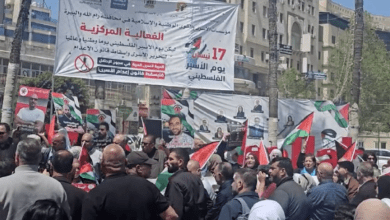
What is happening in Britain is not an isolated phenomenon. Across the so-called democratic West—from France to Germany to the United States—governments are clamping down on pro-Palestinian voices, banning demonstrations, censoring slogans, and criminalizing dissent. The entire Euro-Atlantic alliance is revealing the depths of its commitment to imperialism and war. As in the United States, this desperate repression has revealed once again: the fight for a free Palestine is a fight for freedom everywhere.
But more than that, this far-reaching wave of political repression is revealing the ruling class’s fear—the fear that the Palestine solidarity movement could become the spark for a broader, more unified, and more militant anti-imperialist struggle right at the heart of their empire. This is a movement that connects the bombs falling on Gaza to the austerity and censorship imposed at home, that sees through the lies of the corporate media and calls the system what it is: racist, colonial, and capitalist to its core.
As the repression deepens, our answer must be clear and collective: we will not be silenced, we will not be divided, and we will never waver in our solidarity with the Palestinian people.