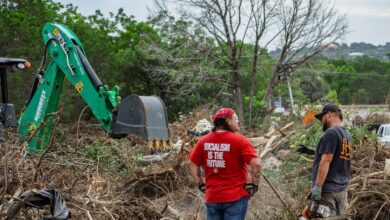
Photo via Martin Austermuhle on X
Hundreds of millions of gallons of raw sewage have poured into the Potomac River for weeks, deeply threatening the already strained water supply for large parts of D.C., Maryland, and Virginia. Federal, state, and local governments across the region have repeatedly tried shift the blame onto each other, all while continuously prioritizing budget-trimming and corporate profits over public health.
Don’t touch the river
On January 19, 2026, a massive 6-foot-wide pipe on the Potomac Interceptor sewer line, which transports 60 million gallons of raw sewage per day, ruptured, pouring raw sewage into the Potomac River just upstream from Washington, D.C., a city of more than 700,000 people.
Aside from notifying the public about the spill, DC Water, which manages the sewer system, was not forthcoming about the true size or impact of the spill, or about its cause. The agency only issued a public letter explaining the crisis on February 11 – three weeks after the spill began! For weeks after the spill started, the Potomac Riverkeepers, a water quality monitoring NGO, and researchers from the University of Maryland’s School of Public Health were the primary source of public information about the contamination of the Potomac River and the presence of dangerous bacteria like e. Coli, reporting levels were 10,000 times higher than the recreational water quality limit guidelines established by the EPA.
In total, some 243 million gallons of raw sewage entered the river before the leak was contained – that’s more than 368 Olympic-sized swimming pools. The immediate and ongoing impacts to the environment and public health have yet to be quantified. Public water monitoring, cleanup and mitigation efforts remain sparse despite the overwhelming scale of the disaster. The D.C. Department of Energy and Environment issued a directive last week, as ice on the frozen-over Potomac began to break up, for residents to “not touch the Potomac River, or engage in any Potomac recreational activities including fishing.”
“I’ve seen it characterized as one of the major ecological disasters in the eastern part of the United States,” Maryland Delegate Linda Foley said at an environmental subcommittee hearing in the Maryland General Assembly. “It is not only polluting the Potomac, but it is also threatening the Chesapeake Bay and environs.”
In a strange twist, President Donald Trump has criticized Maryland Governor Wes Moore for the sewer rupture as he announced the Federal Emergency Management Agency (FEMA) would be dispatched to help with the containment and cleanup – almost a month after the rupture. While the Maryland government’s response has hardly been adequate, the section of the Potomac Interceptor pipeline that burst is operated by D.C. Water and has to meet U.S. Environmental Protection Agency (EPA) safety inspections, meaning responsibility for the failure is spread across local, state, and federal governments alike. Instead, Trump’s comments should be seen as an opportunistic attack on the only Black state governor in the country who he has been criticizing for weeks.
Maintenance of infrastructure in Washington, D.C. remains severely underfunded, showing a gross lack of care for health and the environment. The EPA reported that the 50+ year-old-pipe systems in the District require over a billion dollars in upgrades that are currently only being addressed as emergencies arise. Despite the scale of the need, in 2022, the EPA awarded a mere $10 million to D.C. for infrastructure improvements, one-tenth of the amount required, and since then the budgets have only been slashed further.
The Potomac Interceptor pipeline was built in the 1960s and was known to be rapidly deteriorating and in need of essential repairs. As state and local governments continue to prioritize funding for police and billionaires, infrastructure continues to fail as aging systems collapse and the trained workforce required to repair and maintain them remain understaffed. In addition to the resources required to deal with emergent issues like collapsed pipes, there is a lack of clear data and a clear plan to protect water sources from ongoing contamination.
Potomac water supply already under threat
At the same time our fresh water is being depleted and poisoned, governments in Maryland and Virginia continue to push to build more massive, hyperscale AI data centers before even moving to address the dilapidated and dangerous sewage spill and allocate funding to ensure this type of emergency never happens again by updating the water infrastructure. This type of inaction and neglect is absolutely criminal.
In Maryland, widespread public opposition to data center development is met with complacency by elected officials, despite the public’s very real concern for the strain more data centers will place on drinking water resources, electrical grid capacity, and rapidly inflating utility costs.
For example, in Landover, a town in Prince George’s County Maryland, local and state government hand in hand with business attempted to hoodwink an entire community with a parasitic hyperscale data center that would take advantage of the community’s existing water infrastructure at the Landover Mall site. The site is situated in a largely working-class Black community next to neighborhoods, senior centers, and schools. For elected officials in Prince George’s County and Maryland, building this data center has been given precedence over addressing the failing half-a-century-old water infrastructure throughout the state.
Among the issues not even given consideration is the high demand on fresh water. Much of D.C. and Maryland rely on the Potomac and Patuxent Rivers as their primary sources of drinking water. Neither the corporations or the politicians behind the data center’s construction have even attempted to answer the question if Landover or central Maryland can handle the doubling of water demand in order to cool a hyperscale data center – or what happens to the people if it can’t.
Nonetheless, these corporations are exempt from taxes and not required to first update the water infrastructure in the region before taking advantage of the existing infrastructure to siphon drinking water for data center cooling. Data centers, but especially hyperscale data centers being proposed throughout Maryland are incredibly water intensive. The massive hyperscale data center Amazon has built in Morrow County, Oregon, uses twice as much water every day as an entire city, leading to higher concentrations of contaminants in drinking water, magnifying an existing pollution problem, and leading to rare cancers and miscarriages.
In 2024, a single data center in Iowa consumed 1 billion gallons of water – equivalent to the entire state’s demand for five days. This water is literally consumed, it is evaporated in the process of cooling the immense hot computer servers and vented into the atmosphere. It cannot be reused or recycled by the community, and there is currently no requirement for these corporations to recover or reuse the water they consume.
While in Maryland there are 39 data centers, across the Potomac in Virginia, there are an incredible 570 data centers already built, according to the Data Center Map. Much of this infrastructure has been built to accommodate the cloud computing demands of the Pentagon, the Central Intelligence Agency, and the host of intelligence and weapons manufacturers they rely upon to wage imperialist wars around the globe. Pressured by powerful lobbying firms, county governments have bulldozed noise ordinances, emissions standards, and community groups to pave the way for their construction.
A 2024 audit by the state of Virginia found data centers “largely incompatible” with the residential areas where they were commonly being built and warned of the impacts on water resources and the electrical grid if construction continued apace – a warning to Marylanders as-yet unconvinced of the dangers these facilities would bring to our state.
Prioritizing People Over Profits
The greed of capitalism and corporations is endless and it is at our expense. Instead of the corporations being tasked with optimizing their existing data center infrastructure to be more efficient, use less water, pollute less, pay their own taxes, and improve the communities they operate in, they force us to suffer, get sick, and go without one of the essentials of life: water.
A world that prioritizes profit over human health and environmental wellbeing will never see the urgency in addressing the crisis currently facing the entire DMV region that relies on the Potomac to sustain life. A government of the working class would put public health at the forefront of its concerns, ensuring quality drinking water for all.