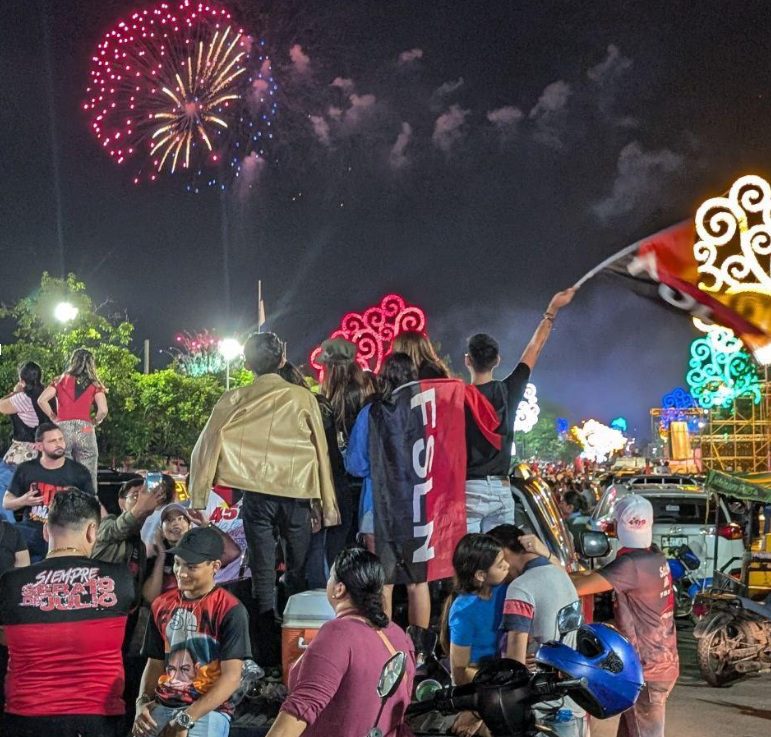
Tens of thousands of Nicaraguans filled the streets of Managua and many other cities around the country to celebrate the 46th anniversary of the Sandinista Revolution. The crowd gathered to reaffirm their support for this living revolution – not a moment confined to history but an ongoing process of national liberation, anti-imperialist resistance and social transformation that began with the triumph in 1979 over the U.S.-backed Somoza dictatorship.
Starting the celebrations the night before, the internationally acclaimed resistance music group Los Guaraguao from Venezuela took the stage at San Judas’ popular vigil. The crowd, energized after many hours, sang every song of resistance and responded to chants of “¡Sandino Vive!” (Sandino lives) with “¡La Lucha Sigue!” (the fight goes on!); “¡No Pudieron!” (They could not) with “¡Ni Podrán!” (and will not!); “¡Ni nos vendemos!” (We’re not for sale) with “¡Ni nos rendimos!” (and we don’t surrender!); among many others.
Vice President Rosario Murillo opened the official ceremonies on July 19 with an affirmation rooted in peace and resolve: “This is the strength of peace. Here, no one surrenders… This is the peace we zealously guard and defend.” From the Plaza de la Fe, she proclaimed Nicaragua’s commitment to remain free and sovereign, in battle not for domination but for dignity, justice, and solidarity with the peoples of the world, “We declare ourselves in permanent battle… in frontal combat against poverty in all its forms… to realize our dreams… and to serve, united, for the common good.”
A tradition forged in struggle
The Nicaraguan people have faced over a century of U.S. military occupation, economic manipulation, and regime-change warfare. This stretches as far back as the 1856 invasion by U.S. mercenary William Walker, who re-imposed slavery and declared himself president. The country also faced a U.S. Marine occupation from 1912 to 1933. At every turn, the Nicaraguan people resisted imperial subjugation. The resistance of Augusto C. Sandino in the 1920s and 30s, and the founding of the Sandinista National Liberation Front (FSLN) in 1961 mark the genealogy of struggle that culminated in the 1979 overthrow of the U.S. backed Somoza dictatorship.
President Daniel Ortega, addressing the nation from the square, reminded the crowd, “It is the principle that our General Sandino left us in our hearts… when he told the Yankees, ‘I am not for sale and I do not surrender!”
Sandino’s legacy, Ortega emphasized, lives on in the youth, in the workers, and in the peasants who continue to build socialism in Nicaragua.
2025: A revolution that builds
Despite relentless U.S. sanctions, propaganda, and coup attempts, Nicaragua has continued to build a sovereign, dignified society focused on the needs of its people.
Economic Resilience
- The IMF reports Nicaragua achieved 4.5% real GDP growth in 2023 and early 2024, driven by strong internal demand and declining inflation.
- The Monthly Economic Activity Index reports 3.3% growth in 2025.
- Nicaragua reduced its total external debt in Q1 of 2025.
Public Investment and Infrastructure
- In partnership with China, Nicaragua inaugurated a new social housing complex of 920 homes in July 2025, part of an ongoing plan to build thousands more.
- China has supported Nicaragua with state-of-the-art public buses, port expansions, a large-scale solar plant, and plans for a new international airport.
- Electricity coverage has expanded to 99.3%, with 62.7% from renewable sources.
- Over 4,600 km of roads and bridges have been constructed since 2006.
Health and Education
- Nicaragua dedicates 22% of its national budget to free public healthcare, including building the largest hospital in Central America
- Infant mortality declined by 20% in the first half of 2025.
- Cervical cancer deaths dropped 17.5% in the same period.
- Comisarías de la Mujer (Women’s Police Stations) made over 12,000 house visits this year to prevent gender-based violence.
- The country dedicates 21% of its budget to education, including multilingual and intercultural programming.
Women’s equality
Women have always been central to the Sandinista project—as fighters, farmers, educators, organizers, and political leaders. In the second stage of the revolution, major laws have institutionalized gender equality:
- In 2022, the World Economic Forum ranked Nicaragua with the first lowest gender gap in the Americas, 7th in the world.
- Law 648 and Law 779 protect women’s economic and social rights.
- A 50/50 gender mandate for all elected positions has placed Nicaragua 1st in the world for women in ministerial positions.
- Programs like Zero Usury and Hunger Zero have empowered rural women with access to credit, land, livestock, and training.
- Agroecological schools like IALA Ixim Ulew train women in sustainable farming, leadership, and political education.
The internationalist spirit lives on
The 46th anniversary celebrations were marked by a renewed display of international solidarity. Delegations from across the global south and beyond attended the commemorations, with representatives from China, Russia, Palestine, Vietnam, Venezuela, Cuba, Honduras, Burkina Faso, Algeria, Turkey, the DPRK, Belarus, Côte d’Ivoire, and Myanmar.
This year, the Central Committee of the Communist Party of China sent a formal message of solidarity, saluting the enduring revolutionary spirit of the Sandinista process and affirming its commitment to deepening ties between the CPC and the FSLN.
President Ortega also reaffirmed Nicaragua’s solidarity with other nations under siege by U.S. imperialism. Speaking of Haiti, Iran, and Palestine, he questioned the legitimacy of the United Nations, “And what does the United Nations do? The United Nations is nothing more than an instrument, an instrument of the imperialist countries, of the countries that want to dominate the world. The United Nations is no longer good for anything. It must be refounded—and to refound it means that this United Nations must disappear. It is the powerful that are united there.”
While Palestinian resistance icon Leila Khaled did not attend this year, her words from the 45th anniversary still resonated, “Nicaragua is my other homeland… a sovereign country that does not submit to any foreign influence… together we face a common enemy: the United States.”
She had honored her comrade Patricio Argüello, a Sandinista martyred in the Palestinian struggle, and praised Nicaragua’s actions denouncing genocide at the ICJ. The chants of “¡Viva Palestina!” and “Free, free Palestine!” continued this year, echoing through the festivities as a testament to the long and enduring alliance between the Nicaraguan and Palestinian peoples.
The homeland, the revolution, the future
The Sandinista Revolution lives—in the lives saved, in the homes built, in the food grown, in the women leading, and in the dignity defended. Nicaragua does not stand alone. It stands with the oppressed of the world, building an alternative rooted in justice, peace, and sovereignty.
Like so many of Latin America’s great revolutionary processes, the reality and history of Nicaragua has been deeply distorted — flattened by U.S. foreign policy and media narratives that seek to destroy it outright.
Framed alongside Cuba and Venezuela as part of a so-called “troika of tyranny” by imperialist politicians in the United States, the Sandinista project is vilified precisely because it endures. But no amount of propaganda or hybrid warfare can erase the tangible gains of the Nicaraguan people—gains even acknowledged by international bodies that are often hostile to it.
In a world longing for peace and justice, Nicaragua’s path of sovereignty, anti-imperialism, and popular power offers not just a resistance to be admired, but a future to be learned from. As Nicaragua approaches its next general elections in 2026, the country continues to walk its own path despite being constantly vilified. But these attacks are just further proof that an alternative is being constructed in Nicaragua.