On December 11, the Indiana Senate voted to reject redrawn congressional maps ahead of the 2026 midterm elections by a vote of 31–19. A majority of Republicans joined Indiana’s 10 Democratic state senators to defeat the proposal, which had passed in the Indiana House. The map would have redrawn Congressional boundaries to eliminate two districts held by Democrats, designed to ensure Indiana would elect 9 Republican Congresspeople in 2026.
Governor Mike Braun called a special session specifically for redistricting in October, but the General Assembly did not convene until December after the Senate said they would not support the map, initially saying they would not meet to vote on redistricting at all.
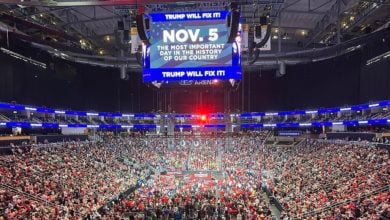
Trump and right-wing political organizations including Turning Point USA and the Heritage Foundation put immense pressure on Indiana Republicans to pass the redrawn map, including threatening to support primary challenges for opponents of redistricting and promises to withhold federal funding to Indiana if the map didn’t pass.
Divided capitalist class chose to avoid confrontation with workers
Polls repeatedly indicated that redistricting was broadly unpopular with Hoosiers regardless of their political affiliation. Senator Greg Goode, whose district covers Terre Haute and parts of the Wabash Valley, was the only senator to hold a community listening session where testimony was overwhelmingly opposed to redistricting. After the bill was voted down, more senators have told the media they voted against redistricting because their constituents were mainly opposed.
But when has the General Assembly ever let what Hoosiers think guide their decisionmaking? When they stripped away abortion rights in 2022, polls showed that a majority of Hoosiers supported the right to a legal abortion, with over 80% saying that there should be exceptions to any ban. In 2023, nearly 90% of Hoosiers said they were satisfied with their child’s school, but the General Assembly has nonetheless waged a relentless war on public schools, especially Indianapolis Public Schools and Union School Corporation.
Another factor that senators claimed impacted their vote were threats, with swatting and fake bomb threats on top of the previously-mentioned political threats. While senators no doubt have a sense of personal and state pride, this is not an overriding factor in how they choose to vote.
The General Assembly didn’t reject redistricting because they listened to voters. They rejected the map because the ruling class itself in Indiana is split on the issue. When the ruling class is divided and the masses are united in strong opposition despite political divides, it makes sense that the capitalists would choose not to light a spark that could destabilize the system by inviting protests and strengthened challenges to the supermajority control Republicans enjoy in Indiana.
Early reactions have proven them right: senators who don’t listen to the people on any other issue and who are open bigots are being thanked by liberals for “listening to their constituents” and for their “courage.”
Republicans and Democrats lie to justify redrawing Congressional maps
Several Indiana Senators who supported redistricting pointed to states like Oregon and Massachusetts which have Congressional delegations entirely made up of Democrats. Lieutenant Governor Micah Beckwith amplified this claim, saying, “Indiana’s voice has been stolen from [sic] states who have been playing by a different set of rules.” But the real fight is not Democrats versus Republicans, or so-called “blue states” versus “red states.”
The billionaires who control the Democratic Party won’t give workers anything. California, which approved redistricting in a statewide referendum after Texas changed its map, has been ruled by Democrats for 50 years, yet they have no free healthcare or affordable homes. Electing Democrats is not the answer—it is up to workers to organize and fight for our needs.
Others criticized the maps for combining portions of Indianapolis with rural areas. Republican Senator Greg Goode, who voted against the maps, said, “Clay County residents are unhappy that their county would be drawn into a district with Indianapolis and Central Indiana suburbs, which would dilute the voices of this important rural county.” But the real fight is not between people living in cities and people living in rural areas, either.
The real struggle we face is one of the capitalist class against working people. Capitalists in the cities exploit workers in the cities, just like capitalists in rural areas exploit rural workers. Rural workers in states controlled by Democrats have more in common with urban workers in states controlled by Republicans than either share with the capitalists where they live.
How would a socialist government address redistricting?
A socialist government would dramatically increase the number of elected representatives, ensuring that the needs of workers in small towns and rural areas are met on their own terms, not in competition with the interests of workers in highly populated cities. Today, there is only one U.S. Representative for every 750,000 people, which is an absurdly low rate of representation. By comparison, Cuban representatives serve around 20,000 people each, and Chinese deputies to the National People’s Congress each represent around 100,000 people.
Administrative units would be redesigned from the antiquated states, counties, and municipalities we have now to reflect modern reality: why should workers in Louisville, present-day Kentucky, have a different government from workers who live directly across the Ohio River in Jeffersonville, now Indiana? What material difference is there between workers in East Chicago, Indiana, and Chicago, Illinois, that necessitates their separation?
The solution is not, as Indiana Republicans have proposed, to annex parts of Illinois that vote for Republicans into Indiana. A socialist government would institute more rational administrative units not governed by the partisan interests of this or that faction of the capitalist ruling class. These administrative units would not be in conflict with one another. There would be no reason for one region to change its boundaries to gain an advantage over another.
Changes in population would lead to adjustments in the number of representatives for a particular area, but this would be done to ensure proper representation of working and oppressed people—not to guarantee control of government by this or that political faction.
Feature image: Indiana State Capitol. By Diego Delso, CC BY-SA 3.0 https://creativecommons.org/licenses/by-sa/3.0, via Wikimedia Commons