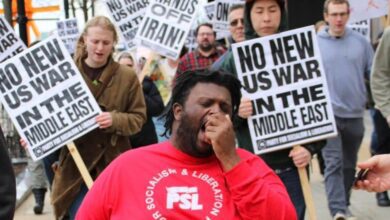
We are at an inflection point moment. Millions of people are wondering: “how do we stop this terror being sowed by ICE, Border Patrol, and all these other federal agents and their adjuncts, against immigrants?” This moment has created a crisis in this country—everyday people are outraged at seeing people being executed on the street and kidnapped off our blocks in broad daylight.
The students at the University of Minnesota have launched a call for people all around the country to do a national shutdown on Friday, January 30th. No business as usual: no work, no school, no shopping. An economic shutdown is the way to make our power as working class and oppressed people felt in a way that can’t be denied, to turn the tide against ICE and CBP and the attacks on immigrant communities and all working class and oppressed people.
Now we know that this kind of call raises some questions. People are fired up, people are ready to go, you can see it taking off all across the country in many different ways. The call is being taken up from all sectors of society—from grassroots organizations to celebrities, labor unions, tenants unions, and regular everyday people. It’s important that we understand that this call is very much in the history of how general strikes have emerged in this country since the mid 19th century.
It’s clear from history that general strikes and other mass rebellions usually take root after a relatively smaller groups of targeted workers are brutally repressed, and often killed, by the forces of the state—whether we are talking about the police, National Guard, or even private militias—and the combined outrage creates a wave of indignation that sweeps the country and creates the opening to shut it down in cities and states across the country.
From the 19th century…
The Great Strike of 1877 essentially shut down the economy of the entire country and scared the hell out of all the ruling elites. The strike emerged city to city, oftentimes unorganized in the sense that it was led by whoever could get it together spontaneously. Organic groups came together with the few political parties and unions who were willing to participate, but it was fundamentally a mass movement in response to the fact that almost all working and oppressed people were living with starvation wages at that time.
Workers, starting with the railways but expanding beyond that, said: “we are going to push back, we’re going to strike to demand that we have the most basic ability to survive. We need decent pay and livable working conditions.” Because of the brutal violence, especially in the city of Pittsburgh, there was mass indignation around the country. People were being shot down in the streets. People felt, “now is our time, we have rise up and show that we can expand this strike and make it something nationwide to shut down the country in defense of basic human dignity for working class people!”
And they did—from Pittsburgh to Baltimore to Martinsburg, WV, to Buffalo to Albany to Chicago to St. Louis (where workers actually took over the city and ran it for a few days) to Galveston, TX, (where Black workers on the docks and in the laundries were able to organize successfully to raise their wages).
They were able to shut it down, but it was something that wasn’t prepared ahead of time at all. Workers were able to organize themselves on the basis of existing, relatively modest, organizations by merging that embryonic organization with the spontaneous anger of the masses. By combining those two things, they were able to meet the challenges that they faced as they came.
…to the Great Depression…
We can see similar things in Minneapolis and in San Francisco in 1934, where there were groups of workers in one industry that were targeted by state violence. This turned latent sympathy for their struggles into general strikes shutting down both cities in defiance of capitalist sponsored terror and for the rights of working people.
In both these instances, the unions that launched these strikes in some of the initial industries were connected to socialist political parties and growing union drives, but they were not massive institutions of working class power. What they had was enough organization that when the spontaneous anger of working class people in both cities said “we have had enough, these workers were right to stand up for their rights,” they were able to channel that power to shut those cities down and win the workers’ demands.
They were able to organize and meet the challenges as they came. They were able to organize food distribution so that nobody went hungry. They were able to organize public order. They were able to do various different miraculous things that people wouldn’t have thought could be done on the fly, but because they had some organization and they had the determination of hundreds of thousands of workers to find a way to defeat the bosses for the dignity of working and oppressed people, they were able to emerge victorious in both cases.
…to the Civil Rights Revolution…
We can turn to examples of this historical phenomena outside the labor movement. Within the development of the Montgomery Bus Boycott you can see similar historical precedent for actions merging existing organization with mass anger to become more than the sum of its parts.
In Montgomery, organizations like the Women’s Political Committee and the NAACP had been organizing for some time. Nonetheless it was still a relatively embattled core in this segregationist bastion of Montgomery. When Rosa Parks decided to take a stand, it created the conditions to lead these organizers to call for a one-day boycott of the buses.
The response of the masses was so great that they decided to extend that boycott and to form new political organizations, to raise up new leaders, including a person named Dr. Martin Luther King Jr. who had recently come to town. They faced tremendous challenges, but they met them one by one because they had the existing core of organizers that had some experience and knowledge, and they had the determination of the masses of people to succeed, and they were able to merge those and meet the challenges dynamically and in the moment.
Similarly in Birmingham, a laboriously conceived plan to take down segregation by Civil Rights organizations fell flat. But the young people of Birmingham, from elementary school to high school, started coming to organizing meetings demanding to march and take down segregation in their city, and we know that they succeeded, but it was unplanned. It was not necessarily something anybody expected, but the images have lived through the ages.
Many people denounced the Civil Rights leaders and said: “how could you send children out to do this?” But they weren’t sending them out—the children were demanding to go out—and existing organizers were helping them and assisting them to grow their movement and to turn the tide against segregation.
… we shut it down together!
So when we think about the current moment that we’re in now, that’s what we have to think about. There are challenges, there are risks, for a lot of people there might be a lot of risk, but the more of us who act together in concert, the more we can lessen the risk. The more we can act together in concert, the more we can meet the challenges we face, and just like 1934 in San Francisco and Minneapolis, just like in the Civil Rights Movement, we can overcome great challenges and find a way to support our people because we have an initial level of organization just like they did.
Look at what the call from the students of the University of Minnesota has brought forth already —you have the Palestine solidarity movement, forces in the labor movement, political organizations, celebrities, people doing mutual aid, people from every type of background you can imagine who have seized hold of this because they have recognized the justice of the call for January 30th who are ready to take action.
If we can merge our existing organization that we’ve built through many different struggles, there is nothing we can’t overcome and history proves that. The call from these students for a national shutdown, no business as usual, no work, no school, no shopping—yes, a national general strike—is in the direct tradition of how general strikes have historically emerged in this country, which is to merge whatever level of organization we have with the anger, indignation, and determination of the masses of people to act, and just like in those past cases where we were victorious, we can be victorious now.
We can turn the tide. It is already starting to turn. Now is the time. Even though it is an uphill climb we know that it has happened in the past and it can happen again today.