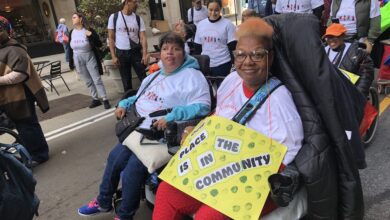
On Jan. 23, nine states launched a legal attack on the hard-fought right of disabled people to live independently in their communities, rather than be forced into institutions. The lawsuit, Texas v. Kennedy, seeks to undo the federal regulations underpinning Section 504 of the Rehabilitation Act, a key piece of civil rights legislation that prevents discrimination by entities receiving federal funding.
The nine states, Texas — along with Alaska, Florida, Indiana, Kansas, Louisiana, Missouri and South Dakota — say the regulations are unconstitutional, especially the rule known as the integration mandate, and should be blocked.
The integration mandate says that state and local governments that receive Department of Health & Human Services funding “must serve people with disabilities in the most integrated setting appropriate.” It also says that entities may be in violation of Section 504 if they place disabled people at serious risk of unnecessary institutionalization. Violations of Section 504 could result in a loss of federal funds.
If this lawsuit is successful, it may become harder for disabled people to live and participate in their communities, and disabled people may be forced, against their will, into institutions. In 1999, the Supreme Court recognized the right of disabled people to live, work and participate in their communities in the landmark case Olmstead v. L.C.
In Olmstead, two women in Georgia diagnosed with mental disabilities filed suit claiming the state was violating their civil rights by only offering them services in an institution and refusing to provide them services in the community. Lois Curtis and Elaine Wilson had both been placed in a state-run psychiatric institution, Curtis at age 11, and Wilson at age 15. Wilson said she had been confined in 36 different institutions. As adults, they wanted to move back into their own communities. But the state wouldn’t let them. They took their case all the way to the Supreme Court, which agreed that unnecessary institutionalization harms people with disabilities, saying, “confinement in an institution severely diminishes the everyday life activities of individuals.”
The services in question — known as Long-Term Services and Supports — include help getting out of bed, bathing, grooming, dressing, cooking, eating, etc. Millions of people who require these services have been affected by the Olmstead decision, which has led to more disabled people being able to live in the community with their friends and families. In 1999, only 27% of Medicaid LTSS spending took place in the community, with the rest being in institutions. By 2000, 63% of Medicaid LTSS was community-based.
In effect, Olmstead recognized that disability rights are civil rights. The decision came about because of the intense struggle of disabled people and it has freed millions from institutional segregation and allowed them to live with their families and participate in community life.
The Disability Rights Education and Defense Fund is leading a fight back against Texas v. Kennedy. Hundreds of comments on their Facebook page, show how important community care is to disabled people: “I cannot live independently but thrive with daily care in the community. I was miserable in a group home,” writes Ezekie. “I am disabled with a fairly normal life, a part-time job and a social life … Putting me away would be putting away a tax payer too,” says Sarah. “Institutionalizing me is NOT the answer. That is the MOST restrictive environment for me. If you take me away from my family, take away my little bit of independence. Take away the little things I enjoy. I will deteriorate rapidly,” writes Jinnifer.
Texas v. Kennedy is the continuation of a broader anti-civil rights challenge, Texas v. Becerra, which was filed by 17 states during the Biden administration. Texas v. Becerra, which faced strong opposition from the disability community, argued that Section 504 itself was unconstitutional. However, after HHS agreed to change the rule so that gender dysphoria would not qualify as a disability, eight states dropped out of the suit.
Given current legal trends and the composition of the judiciary, it is likely that the courts may rule in favor of Texas in Texas v. Kennedy. The Supreme Court has a six to three conservative majority and, as The New York Times notes, Trump-appointed appellate judges have voted 133 to 12 in favor of conservative positions in recent major cases.
This means that it is all the more important that we fight back now, before the lawsuit becomes embroiled in the courts. DREDF has prepared resources to help all people in the nine affected states contact their attorney general and governor to ask them to drop out of the case. If you live in Texas, Alaska, Florida, Indiana, Kansas, Louisiana, Missouri and South Dakota, please contact your governor and attorney general now.
The right to live, work and participate in one’s community is a basic human right. For far too long, disabled people have been forced to live in institutions away from their families and communities. Disabled people have fought long and hard for their rights. We cannot go back now. Disabled rights are civil rights.
Photo: Recent New York City demonstration for disability rights. Credit: Joyce Chediac, Liberation News.