As we witness mass protests erupting throughout the world, from Africa to Latin America, to the United States, working-class people are rising up to defend themselves against capitalist, colonialist, and imperialist efforts. Protesters are taking to the streets to demand a future where people can live without constant exploitation and corruption from ruling class tyrants. In Guinea-Bissau, we see a long history of resilient stamina from working-class citizens who have experienced countless vicissitudes in their ongoing struggle for sovereignty. From fighting for independence, to witnessing multiple coups, to being directly under the boot of Western imperialist manipulation. The people of Guinea-Bissau continue to grapple with these ongoing battles towards liberation.
On Nov. 26, outgoing president of Guinea-Bissau, Umaro Sissoco Embaló, was reportedly ousted in a coup d’état led by military leaders loyal to Embaló. This occurred on the eve of the National Electoral Commission’s announcement results – clearly indicating opposition candidate Fernando Dias de Costa’s win over incumbent Embaló. This result was reported by the Regional Electoral Commissions revealing Dias won with a confirmed vote tally of 54% while Embaló garnered 44% of the vote. The military coup comes on the heels of Embaló’s presidential term that officially expired back in February. Despite his term ending, he sidelined the national elections process utilizing the Supreme Court to rule in his favor pushing elections to November. This move was deeply unpopular among masses of people in the country who demanded, “Sissoco out!”
The military leadership in this alleged coup suspended the electoral process indefinitely. Under “interim president” Major General Horta Inta-a, the junta insisted on overseeing a period of transition to allegedly address drug trafficking and corruption among senior politicians. The western-backed ECOWAS rejected the transition plan announced by General Horta. The West African economic bloc has threatened targeted sanctions while domestic and international observers condemn the coup. In the flurry of attacks made by the military junta against opposition parties, civil society organizations and parties such as the PAIGC have asserted that the coup d’etat is one staged by outgoing president Embaló himself.
Guinea-Bissau’s political volatility in the face of neoliberal interests
Guinea-Bissau gained independence from Portugal in September 1973 following a decades-long struggle for national liberation. This struggle was led by the PAIGC under the leadership of Amilcar Cabral. Unfortunately, like many African countries at the turn of the century, Guinea-Bissau became economically subjugated to the IMF and World Bank particularly through Structural Adjustment Programs. These international institutions – dominated by the U.S. and the West – paved the way for neo-colonial opposition to actively prevent a genuine democratic structure from taking place inside the country.
Since the introduction of these economic reforms, the country has experienced more than a dozen coup attempts, both successful and unsuccessful. Since 1994, no democratically elected president has ever completed a second successive term. Many of these coups are the result of struggles between transfers of power causing immense political instability.
This can be witnessed in Sissoco Embaló’s presidency, mired in controversy around his legality to govern the nation. In 2019, Sissoco Embaló won the presidency in a second round of voting against PAIGC candidate, Domingos Simões Pereira. It is worth noting that Pereira had 40.13% of the vote in the first round while Sissoco Embaló carried just 27.65%. After Sissoco Embaló won in the second round, neither the supreme court nor the parliament of Guinea-Bissau granted approval for an official swearing-in ceremony. Instead, he swore himself in through an alternative ceremony at a hotel heavily guarded by soldiers in February 2020.
Under Sissoco Embaló’s presidency, he issued a decree that unconstitutionally dissolved Guinea-Bissau’s parliament, dominated by the PAIGC at the time. This dissolution was justified by claiming a coup attempt allegedly staged by himself. Ultimately, it consolidated Sissoco Embaló’s presidential powers as he replaced the opposition with a “Government of Presidential Initiative.”
It would not come as a surprise to citizens within the country or political parties considered in opposition to Embaló if the coup was staged. Guinea-Bissau under Embaló was considered one of the “five Atlantic-facing African countries” due to its geostrategic position. This designation comes after Embaló signed a defense cooperation agreement in 2023 with Washington after the president himself claimed a coup attempt that same year. Ultimately giving up the nation’s sovereignty for Washington to impose military operations in one area of the continent to secure critical minerals and combat anti-colonial and anti-imperialist upswing in the broader region.
Masses demand ownership over the country’s future
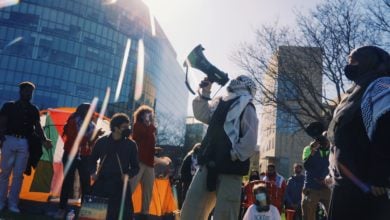
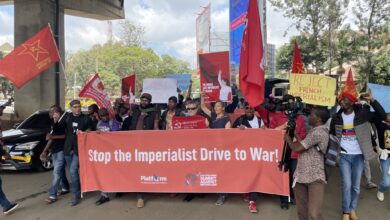
Hundreds of people took to the streets in a public demonstration of opposition to the military coup. It is important to note that the mass demonstration was not focused on the defense of Sissoco Embaló. Rather, it reflected the deep anger over the politically motivated detention of senior opposition figures such as Domingos Simões Pereira – leader of the PAIGC. The protest itself was organized by opposition parties including PAIGC and civil society organizations. Pereira was arrested during the coup and still remains detained. Friday’s demonstration was met by violent confrontation from security forces with tear gas and batons being deployed onto civilians.
Despite large-scale protests being high risk, that has not deterred the masses from staking their rejection of the ‘transitional government’. During a press conference in Guinea-Bissau, civil society activist Vigario Luis Balanta heeded the call for the masses to hold a general strike and observe a week of civil disobedience. Youth were among the mass demonstrators speaking to the heart of the demonstration:
“We are the youth and we are the future of this country, we will never, ever accept that our sovereignty be called into question.” – protestor Antonio Sami
Feature image: Members of the African Party for the Independence of Guinea-Bissau and Cape Verde (PAIGC) rally after parliamentary victory in March 2019. Credit: DW/B. Darame