At the start of November, Trump threatened military action against Nigeria, Africa’s most populous country. Trump’s desire to go “guns-a-blazing” into the African nation comes in the backdrop of a two-month U.S. right-wing campaign that has peddled a conspiracy of a “genocide” against Christians in Nigeria. Senator Ted Cruz has been championing this false claim on behalf of Nigerian Christians and American Evangelical leaders. Cruz introduced the “Nigeria Religious Freedom Accountability Act of 2025” (S.2747), designating Nigeria as a “Country of Particular Concern” – a status that is also placed on China, India, and Russia. Such a designation would allow for the imposition of sanctions on Nigeria.
Trump’s seemingly arbitrary allegations against Nigeria reduce its internal development and crises to a one-dimensional religious conflict. The threat of invasion comes at a moment when the U.S. is gearing up to invade Venezuela under the pretext of “destroying drug cartels.” Just like Venezuela, Nigeria is home to vast fossil fuel wealth. Crude oil and natural gas form the backbone of its economy, while the nation also contains over 40 types of minerals including: iron ore, gold, limestone, lithium, and tin. Nigeria serves as an anchor in the region for the U.S. and Western European allies to carry out geostrategic interests. It borders the Alliance of Sahel States (AES) and is a source for AFRICOM to contain influence from China and Russia in its new Cold War.
Nigerian people on the ground view Trump’s threats as a classic form of imperialist intervention under the guise of “protecting Christians from persecution.” This pretext masks the underlying interests of the U.S. to secure energy resources and use Africa as a battleground for its new Cold War. It is necessary to understand the multifaceted challenges the Nigerian people face and their demands for sovereign resolutions void of U.S. imperialist expansion.
A ‘Christian genocide’?
Nigeria is home to one of the world’s largest Muslim and Christian populations, roughly divided in half. A majority of Muslims live in the north and Christians mostly in the south. Trump’s threats to cut off aid and use military action to “wipe out the Islamic Terrorists who are committing these horrible atrocities” raise the question of what is actually happening in Nigeria. For decades, Islamic State splinters such as Boko Haram and Islamic State West Africa Province have ravaged the northeast region of the country. The northern region of Nigeria is predominantly Muslim, with northern states being over 90% Muslim. The Hausa and Fulani are the main ethnic groups in this region. Most of the people killed by Boko Haram and ISWAP are Muslims due to this majority demographic makeup. Muslims are also the primary victims of violence from Islamist extremist groups who engage in looting, kidnappings, and cattle rustling by bandit groups in the northeast.
A 2022 data report from Armed Conflict Location and Event Data reveals anti-Christian attacks as part of a wider spike in political violence across the country. Worsening insecurity spanning the North and South stem from the expansion of militia groups from the far north and a growing climate crisis of pasturelands pushing forced migration of herders south.
The claims of a Christian genocide have been pushed by groups like U.S.-based firm Moran Global Strategies to lobby on behalf of separatists with their own political interests in the governance of Nigeria. The firm represents the Biafra Republic Government in Exile. Nigerian courts recognize this “government” as the external arm of the Indigenous People of Biafra – a group designated as a terrorist organization in 2017, reaffirmed by the Court of Appeal in 2025.
Environmental degradation as a primary source of conflict
The central region of Nigeria, referred to as the Middle Belt, hosts a nearly 50/50 split of Christians and Muslims. The Middle Belt is an area naturally rich in biodiversity and is home to several key river systems including the Niger River – a vital source for agriculture and broader livelihood. The global climate crisis has not made Nigeria immune to its devastating effects – with desertification and land degradation as key features of the growing climate crisis in Nigeria’s northern region.
The conflict within the Middle Belt at its root is a land-use struggle between the farmers in the region and herders migrating from the north over dwindling access to land, water, and grazing resources. Ninety percent of Nigeria’s pastoralists are primarily from the Muslim Fulani people and are traditionally nomadic. Most farmers are Christians of various ethnicities. Disputes over land use between farmers and herders are dangerously manifesting into violence that takes on ethnic and religious dimensions. Yet, it is important to note that organizations such as Crisis Group highlight how Nigerians “are weaving destructive conspiracy theories to explain the conflict … ethnic cleansing and even genocide.”
Relatedly, Nigeria’s resource wealth spans all the way south with critical oil-rich wetlands. The Niger Delta, a vast low-lying region covers nine Nigerian states with a population of over 31 million people from more than 40 ethnic groups. The Niger Delta is highly biodiverse with mangrove forests, freshwater swamps, and riverine floodplains. It was historically important for fishing and agriculture. Now it is the center of Nigeria’s petroleum industry, accounting for the nation’s oil and gas reserves. The region hosts expansive environmental features and economic significance. Despite that, it is a source of widespread poverty, underdevelopment and lack of basic infrastructure due to the consistent handover of Nigeria’s resources to multinationals such as Shell. The oil giant Shell, alongside other international oil companies have ravaged the Niger Delta with upwards of 40 million litres of oil spilling every year. The pollution, killing off of food and water resources, is pushing Nigerians to resort to methods of illegal refining, crude oil theft, and other criminalized activities to survive.
Whether it be the catastrophic effects of climate change or the resource exploitation of multinational corporations, the people of Nigeria pointedly look towards the Nigerian government as the driving force behind the various crises facing millions in the country.
Nigerian President Tinubu: A servant of the West
Current President Bola Tinubu took office in 2023 after winning a contested election. Within the first few months of his presidency, he rushed to deepen International Monetary Fund policies by ending fuel subsidies to Africa’s largest crude oil producer. The removal led to a rapid increase in fuel prices, with prices at gas stations tripling overnight. Tinubu imposed an IMF-prescribed measure of free-floating currency, undermining Nigerians’ purchasing power and reducing its value to a fraction of the dollar. His economic reforms additionally quadrupled the costs of staple foods like maize and beans.
In June of this year, the End Bad Governance Movement, Coalition of Socialists, Students Against Hardship and Hunger, and labor activists mobilized against the acute food insecurity and cost-of-living crisis. Nearly 32 million Nigerians this year alone are suffering from food insecurity under Tinubu. The World Bank’s Africa Pulse April 2025 report states that Nigeria has the highest number of people living in extreme poverty (defined as living on less than $2.15 a day) globally.
Not only is Tinubu reshaping Nigeria with IMF-World Bank liberalization, in September 2023, he led the charge of threatening to invade Niger after the formation of AES. Through the Western-backed regional bloc ECOWAS, Tinubu pushed states to invade Niger while instituting sanctions on the country for daring to chart a sovereign path independent of U.S. and French influence. His governance is mired by his concessions to the IMF, compliance with the West’s desire to combat the AES, and dire economic hardship for millions of Nigerians.
Nigerians demand sovereign solutions
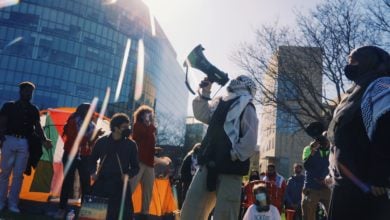
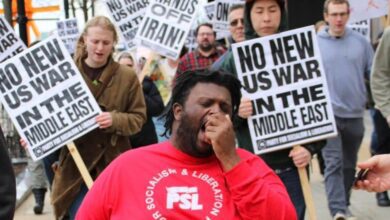
On Nov. 8, protests erupted across Nigeria in opposition to Trump’s threats to attack the country. In northern Nigeria, the city of Kano witnessed demonstrators with placards and other signs stating, “We condemn Trump’s threat to attack Nigeria,” “There is no Christian genocide in Nigeria,” and “America wants to control our resources.”
Movements on the ground wholeheartedly reject any form of U.S. military intervention while simultaneously criticizing Tinubu’s government for failing to respond to the growing security and economic crises they face. To effectively deal with security threats, Nigerians want their government to rectify the problems of mass unemployment, lack of basic infrastructure, and poverty first.
Feature image: President Trump speaks at Joint Base Andrews, Md. in 2019. Credit: Defense Visual Information Distribution Service/public domain