The Trump administration has just requested $25 billion from Congress for the National Nuclear Security Administration to spend on nuclear weapons for fiscal year 2026, $5.5 billion more than last year. Nearly all of this money would be used to “modernize” — or make more lethal — the U.S.’s massive nuclear arsenal, which is already the most destructive in the world. This is the latest in the Trump administration’s $1.7 trillion effort to upgrade U.S. nuclear capabilities.
The budget would give the NNSA billions more than the Environmental Protection Agency, the Food and Drug Administration, the Center for Disease Control, and the National Science Foundation combined.
This budget request comes a week after the House of Representatives passed the “One Big Beautiful Bill,” which would cut $880 billion from Medicaid and SNAP and give $4 trillion to the billionaire class over the next decade. Last year the Congressional Budget Office projected total spending on nuclear weapons between the NNSA and the Department of Defense to be nearly $1 trillion over the next decade — money which could be used to address the massive cost of living crisis, create millions of high-paying jobs, end homelessness, guarantee universal healthcare, and mitigate the climate crisis, rather than increasing the threat of nuclear armageddon.
‘Nuclear modernization’ part of larger anti-China war drive
The vast majority of the budget would be used for “Weapons Activities,” including:
- Increasing the production of plutonium cores for new nuclear warheads
- Achieving full-scale production of B61-13 hydrogen bombs, one of the most destructive weapons in the U.S. nuclear stockpile, and developing new sea-launched nuclear cruise missiles (SLCM-N), the first new U.S. nuclear weapon since the end of the Cold War
- Developing Columbia-class submarines designed to launch nuclear missiles from anywhere around the globe
The B61-13 is designed specifically to threaten Chinese and Russian underground military facilities, while SLCM-N cruise missiles are intended to target the Chinese and Russian navies. The SLCM-N is designed to enable so-called “theater deterrence” in the Indo-Pacific region, threatening the use of targeted nuclear weapons to limit China’s ability to protect its coastline and trade with other countries.
At a May 30 security summit, Secretary of Defense Pete Hegseth declared that if the U.S. government cannot “deter” China from acting independently of U.S. imperialism, it is “prepared to do what the Department of Defense does best: to fight and win, decisively.” He highlighted “improving DOD’s forward force posture” — or escalating the U.S. military encirclement of China in the South China Sea — as a key effort.
This campaign of encirclement is part of a longstanding bipartisan policy of “great power competition” — an imperialist doctrine that prioritizes conflict with China and Russia as key to U.S. domination of the globe. The Bush, Obama, Biden, and both Trump administrations have forefronted military aggression against China as a strategic priority.
U.S. nukes have always been tools of imperialist domination
U.S. imperialism has always sought “nuclear supremacy” to impose its will on independent, and especially socialist, countries.
The U.S. dropped nuclear bombs on Hiroshima and Nagasaki in 1945. This show of force was aimed not just at Japan, but also the Soviet Union. It was the opening salvo in the Cold War, designed to contain the international communist movement which had grown dramatically in size and prestige across Europe and Asia.
The U.S. ruling class used the threat of nuclear warfare to prevent workers from taking power through revolution in Italy and France. It forced the Soviet Union into a defensive posture and drove a wedge between the Soviet Union and China, which sought its own nuclear weapons to defend against U.S. aggression.
In the 1950s, the U.S. made repeated plans to drop nuclear bombs on mainland China and on North Korea. In the 1960s, the U.S. kept nuclear-armed warplanes in South Korea on 15-minute standby to bomb the north.
U.S. “atomic diplomacy” reached dangerous extremes in 1961-62, when NATO placed Jupiter missiles in Italy and Turkey aimed at the Soviet Union and socialist Eastern Europe. This led to the Cuban Missile Crisis, which brought the U.S. to the brink of apocalyptic nuclear war against the Soviet Union.
The massive U.S. nuclear arsenal forced the Soviet Union to divert enormous resources to military spending, straining its socialist economy. Ronald Reagan’s 1983 Strategic Defense Initiative, a fantastical space-based missile defense system which would have allowed the U.S. to carry out nuclear strikes against the Soviet Union without fear of retaliation, amplified this military and economic pressure.
The SDI was cancelled due to cost and technical infeasibility, but it is being revived by the Trump administration’s “Golden Dome” proposal to build an $831 billion missile defense system to neutralize the ability of China and other countries to deter U.S. aggression.
The people can end the threat of nuclear armageddon
For decades, millions of people in the U.S. have organized and mobilized to end the exorbitant cost, environmental damage, and existential threat of the U.S. nuclear arsenal.
In 1961, Women Strike for Peace mobilized 50,000 women to march in 60 U.S. cities against nuclear weapons testing under the slogan “End the Arms Race not the Human Race”. This protest pushed the U.S. to sign a nuclear test ban treaty with the Soviet Union two years later.
In 1982, the Nuclear Freeze Campaign mobilized one million people in New York City to protest the nuclear arms race — the largest demonstration in U.S. history to that point — and delivered 2.3 million signatures on an antinuclear petition to the United Nations, slowing the Reagan administration’s aggressive nuclear policy.
As the movement for Palestine has demonstrated with crystal clarity, antiwar movements within the United States have always played an important role in restraining U.S. imperialism. Nuclear escalation, which only serves the interest of the U.S. billionaire class, is not inevitable.
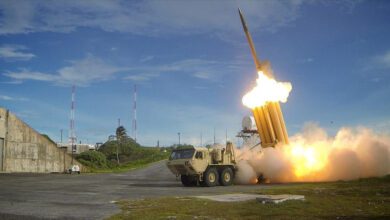
Feature image: The Dept. of Defense conducts a ground-launched missile test on San Nicolas Island, California in August 2018. Credit: DOD